Portrét Kawanabe Kyōsai

72 nejslavnějších obrazů autora Kawanabe Kyōsai, každý naprosto unikátní

Aktualizováno listopad 2026 · seřazeno podle našeho skóre popularity (vyhledávání, návštěvy a objednávky u každého díla) · 72 děl umělce Kawanabe Kyōsai v našem katalogu

Stručně řečeno

Three Kyōgen Dancers (801) je obraz autora Kawanabe Kyōsai, který přitahuje nejvíce pohledů; originál se nachází v Metropolitan Museum of Art, New York. Poté se zrak přesouvá k Sketches of East Asian Legendary Figures (801) a Yang Guifei Adjusting her Hair (1850). Z 72 děl umělce Kawanabe Kyōsai v našem katalogu je těchto 72 těch nejznámějších; každé z nich je unikátním originálem s uvedením roku vzniku, muzea a důvodu jeho nesmrtelnosti.

1831 – 1889, Koga Ukiyo-e Nejvíce děl: Metropolitan Museum of Art

Top 10 obrazů autora Kawanabe Kyōsai podle výběru galerie

1
Three Kyōgen Dancers (801) od Kawanabe Kyōsai

Three Kyōgen Dancers

801 · Ink · Metropolitan Museum of Art, New York

A preliminary ink drawing captures three performers in the midst of a kyōgen dance. These figures, rendered with a fluid and spontaneous energy, embody the comedic essence of traditional Japanese theater. Each dancer is frozen in a distinct, expressive pose that suggests movement and rhythmic timing. One figure holds a drum, another a fan, and the third a bag, marking the specific roles and props essential to the performance. The…

2
Sketches of East Asian Legendary Figures (801) od Kawanabe Kyōsai

Sketches of East Asian Legendary Figures

801 · Ink · Metropolitan Museum of Art, New York

The ink flows across the paper, capturing a moment of quietude and myth. In this black and white drawing, figures from the realm of legend emerge from the shadows of the everyday. We see Japanese figures like Daikoku and Urashima Tarō sharing space with Chinese immortals and the Twenty-Four Paragons of Filial Piety. There is a strange, casual intimacy to the scene, as if these divine and legendary beings have…

3
Yang Guifei Adjusting her Hair (1850) od Kawanabe Kyōsai

Yang Guifei Adjusting her Hair

1850 · Ink On Paper · Los Angeles County Museum of Art, Los Angeles

In "Yang Guifei Adjusting her Hair" by Kawanabe Kyōsai, the brush captures a moment of quiet preparation. The subject is Yang Guifei, a woman known to history as Lady Yang. She was the beloved consort of Emperor Xuanzong of Tang and remains celebrated as one of the Four Beauties of ancient China. Here, she is a figure of grace, focused on the delicate task of arranging her hair.

4
Yamauba and Kintarō (1850) od Kawanabe Kyōsai

Yamauba and Kintarō

1850 · Ink On Paper · Los Angeles County Museum of Art, Los Angeles

In this vertical composition, Kawanabe Kyōsai presents a dynamic encounter between two figures from Japanese folklore. The work, created about 1850, centers on the mountain hag Yamauba and the superhuman child Kintarō. A large, standing female figure dominates the space, her presence defined by the voluminous folds of her robes. Beside her, a smaller, crouching male figure provides a sense of scale and tension. The arrangement of these two bodies…

5
Hell Courtesan (1870) od Kawanabe Kyōsai

Hell Courtesan

1870 · Clevelandské muzeum umění, Cleveland

The scene unfolds within the delicate confines of a hanging scroll, where the figure of the Hell Courtesan, known in Japanese as Jigoku Tayū, emerges from the silk. This work, titled Hell Courtesan, captures a moment of profound stillness and spiritual weight. The artist, Kawanabe Kyōsai, brings this legendary character to life through a composition that balances the elegance of a high-ranking courtesan with the unsettling imagery of the afterlife.…

6
Frolicking Figures and Animals (1870) od Kawanabe Kyōsai

Frolicking Figures and Animals

1870 · Ink On Paper · Metropolitan Museum of Art, New York

In this horizontal handscroll from 1870, we find a quiet, almost whispered dialogue between human presence and the natural world. The composition relies heavily on the use of negative space, a deliberate emptiness that allows the viewer to focus entirely on the gestural energy of the brushstrokes. It is a work of profound restraint, where the absence of color speaks more loudly than a full palette could. The monochromatic shades…

7
Calligraphy and Painting Party (1877) od Kawanabe Kyōsai

Calligraphy and Painting Party

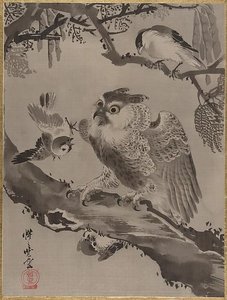
1877 · Ink On Paper

Calligraphy and Painting Party is a hanging scroll created by the Japanese painter and caricaturist Kawanabe Kyōsai. Born in 1831 in Koga, Japan, the artist navigated the shifting tides of the Edo and Meiji periods. This work dates to 1880, a moment when his brush captured the restless energy of a changing nation. His hand moved with the precision of a trained scholar and the wit of a satirist.

8
Wisteria Maiden and Demon Priest (1872) od Kawanabe Kyōsai

Wisteria Maiden and Demon Priest

1872 · Ink · Minneapolis Institute of Art, Minneapolis

In this work, Wisteria Maiden and Demon Priest, Kawanabe Kyōsai presents a dramatic encounter between a maiden and a demon priest. The composition is centered on a woman dressed in an ornate, multi-colored kimono featuring red, blue, and white patterns. She appears to dance or float gracefully above a crouching, monstrous figure. This figure, the demon priest, is depicted with a weathered, muscular, and grotesque face, wearing dark, heavy robes…

9
Painting Party (1880) od Kawanabe Kyōsai

Painting Party

1880 · Woodblock Print · Clevelandské muzeum umění, Cleveland

Painting Party is a traditional Japanese ukiyo-e woodblock print by Kawanabe Kyōsai. The artist, born in 1831 in Koga, Japan, lived until 1889. This work emerged from a life defined by the shifting currents of the Meiji era. It captures a specific moment of social gathering through the precision of the woodblock medium.

10
Night Procession of One Hundred Demons (1880) od Kawanabe Kyōsai

Night Procession of One Hundred Demons

1880 · Ink

Kawanabe Kyōsai painted Night Procession of One Hundred Demons about 1880. The work captures a Hyakki Yagyō, a traditional Japanese Night Parade of One Hundred Demons. This supernatural event brings a chaotic procession of various yokai into the light of the viewer's gaze. It is a rhythmic movement of spirits passing through the dark.

Slavná díla umělce Kawanabe Kyōsai, čísla 11 až 72

11Hell Courtesan (1880) od Kawanabe KyōsaiHell Courtesan1880 12Jurōjin [center of a triptych] (1884) od Kawanabe KyōsaiJurōjin [center of a triptych]1884 · Minneapolis Institute of Art 13Theatre Curtain of Shintomi-za, with an Impromputu Sketch Monster (1880) od Kawanabe KyōsaiTheatre Curtain of Shintomi-za, with an Impromputu Sketch Monster1880 14Squirrels Eating Chestnuts (1886) od Kawanabe KyōsaiSquirrels Eating Chestnuts1886 · Los Angeles County Museum of Art 15A Beauty in Front of King Enma's Mirror (1887) od Kawanabe KyōsaiA Beauty in Front of King Enma's Mirror1887 16Urashima Tarō Riding on a Tortoise (1888) od Kawanabe KyōsaiUrashima Tarō Riding on a Tortoise1888 · Metropolitan Museum of Art 17Two Children Playing with Goldfish (1887) od Kawanabe KyōsaiTwo Children Playing with Goldfish1887 · Metropolitan Museum of Art 18Two Birds on a Branch (1887) od Kawanabe KyōsaiTwo Birds on a Branch1887 · Metropolitan Museum of Art 19Singing Bird on a Branch (1887) od Kawanabe KyōsaiSinging Bird on a Branch1887 · Metropolitan Museum of Art 20滝に燕図 Swallows by a Waterfall (1887) od Kawanabe Kyōsai滝に燕図 Swallows by a Waterfall1887 · Metropolitan Museum of Art 21Tale of the Tongue-cut Sparrow (1800) od Kawanabe KyōsaiTale of the Tongue-cut Sparrow1800 · Los Angeles County Museum of Art 22Sketches of Birds and Animals (1870) od Kawanabe KyōsaiSketches of Birds and Animals1870 · Metropolitan Museum of Art 23Three Crossbills on a Leafless Tree (1878) od Kawanabe KyōsaiThree Crossbills on a Leafless Tree1878 · Minneapolis Institute of Art 24Chinese-style Landscape with Man Fishing from a Boat by Moonlight [right of a triptych] (1884) od Kawanabe KyōsaiChinese-style Landscape with Man Fishing from a Boat by Moonlight [right of a triptych]1884 · Minneapolis Institute of Art 25Landscape with River in Mountainous Country [left of a triptych] (1884) od Kawanabe KyōsaiLandscape with River in Mountainous Country [left of a triptych]1884 · Minneapolis Institute of Art 26猿を襲う鷲図 Eagle Attacking a Monkey (1885) od Kawanabe Kyōsai猿を襲う鷲図 Eagle Attacking a Monkey1885 · Metropolitan Museum of Art 27兎を追う鷲図 Eagle Pursuing Rabbit (1885) od Kawanabe Kyōsai兎を追う鷲図 Eagle Pursuing Rabbit1885 · Metropolitan Museum of Art 28Eagle Attacking a Mountain Lion (1885) od Kawanabe KyōsaiEagle Attacking a Mountain Lion1885 · Metropolitan Museum of Art 29White Eagle Eyeing a Mountain Lion (1885) od Kawanabe KyōsaiWhite Eagle Eyeing a Mountain Lion1885 · Metropolitan Museum of Art 30Rocky Landscape (1887) od Kawanabe KyōsaiRocky Landscape1887 · Metropolitan Museum of Art 31Crow on a Branch (1887) od Kawanabe KyōsaiCrow on a Branch1887 · Metropolitan Museum of Art 32Untitled (D2X7KF) (1887) od Kawanabe KyōsaiUntitled (D2X7KF)1887 · Metropolitan Museum of Art 33Fox Catching Bird (1887) od Kawanabe KyōsaiFox Catching Bird1887 · Metropolitan Museum of Art 34Bird and Frog (1887) od Kawanabe KyōsaiBird and Frog1887 · Metropolitan Museum of Art 35松に鴉図 Two Crows on a Pine Branch (1887) od Kawanabe Kyōsai松に鴉図 Two Crows on a Pine Branch1887 · Metropolitan Museum of Art 36Cranes in Marsh (1887) od Kawanabe KyōsaiCranes in Marsh1887 · Metropolitan Museum of Art 37Buffalo and Herdsman (1887) od Kawanabe KyōsaiBuffalo and Herdsman1887 · Metropolitan Museum of Art 38柳に鴉図 Crow and Willow Tree (1887) od Kawanabe Kyōsai柳に鴉図 Crow and Willow Tree1887 · Metropolitan Museum of Art 39岩に鴉図 Crow on a Rock (1887) od Kawanabe Kyōsai岩に鴉図 Crow on a Rock1887 · Metropolitan Museum of Art 40Owl Mocked by Small Birds (1887) od Kawanabe KyōsaiOwl Mocked by Small Birds1887 · Metropolitan Museum of Art 41木に鴉図 Crow on a Branch (1887) od Kawanabe Kyōsai木に鴉図 Crow on a Branch1887 · Metropolitan Museum of Art 42竹に鴉図 Crow on a Bamboo Branch (1887) od Kawanabe Kyōsai竹に鴉図 Crow on a Bamboo Branch1887 · Metropolitan Museum of Art 43旭に群鴉図 Flock of Crows at Dawn (1887) od Kawanabe Kyōsai旭に群鴉図 Flock of Crows at Dawn1887 · Metropolitan Museum of Art 44ムクドリ図 Starlings on a Branch (1887) od Kawanabe Kyōsaiムクドリ図 Starlings on a Branch1887 · Metropolitan Museum of Art 45Fish in a Whirlpool (1887) od Kawanabe KyōsaiFish in a Whirlpool1887 · Metropolitan Museum of Art 46富士図 Mount Fuji (1887) od Kawanabe Kyōsai富士図 Mount Fuji1887 · Metropolitan Museum of Art 47Rocky Landscape (1887) od Kawanabe KyōsaiRocky Landscape1887 · Metropolitan Museum of Art 48瓜に鼠図 Mice in a Melon (1887) od Kawanabe Kyōsai瓜に鼠図 Mice in a Melon1887 49Eagle Attacking Fish (1887) od Kawanabe KyōsaiEagle Attacking Fish1887 · Metropolitan Museum of Art 50Squirrels Gathering Chestnuts (1887) od Kawanabe KyōsaiSquirrels Gathering Chestnuts1887 · Metropolitan Museum of Art 51Monkey Hanging from Grapevines (1887) od Kawanabe KyōsaiMonkey Hanging from Grapevines1887 · Metropolitan Museum of Art 52雪中鴉図 Crow Flying in the Snow (1887) od Kawanabe Kyōsai雪中鴉図 Crow Flying in the Snow1887 · Metropolitan Museum of Art 53Waterfall, Eagle and Monkey (1887) od Kawanabe KyōsaiWaterfall, Eagle and Monkey1887 · Metropolitan Museum of Art 54月に鴉図 Crow and the Moon (1887) od Kawanabe Kyōsai月に鴉図 Crow and the Moon1887 · Metropolitan Museum of Art 55Pheasant Caught by a Snake (1887) od Kawanabe KyōsaiPheasant Caught by a Snake1887 · Metropolitan Museum of Art 56Shakyamuni Conquering the Demons (Shaka Gōma zu) (1888) od Kawanabe KyōsaiShakyamuni Conquering the Demons (Shaka Gōma zu)1888 · Metropolitan Museum of Art 57Eagle Holding Small Bird (1887) od Kawanabe KyōsaiEagle Holding Small Bird1887 · Metropolitan Museum of Art 58Monkeys (1888) od Kawanabe KyōsaiMonkeys1888 · Metropolitan Museum of Art 59Deer and Monkeys (1887) od Kawanabe KyōsaiDeer and Monkeys1887 · Metropolitan Museum of Art 60Rabbits (1887) od Kawanabe KyōsaiRabbits1887 · Metropolitan Museum of Art 61Cat Catching a Frog (1887) od Kawanabe KyōsaiCat Catching a Frog1887 · Metropolitan Museum of Art 62水辺に鴉図 Crow and Reeds by a Stream (1887) od Kawanabe Kyōsai水辺に鴉図 Crow and Reeds by a Stream1887 · Metropolitan Museum of Art 63白衣観音図 White Robed Kannon (1887) od Kawanabe Kyōsai白衣観音図 White Robed Kannon1887 · Metropolitan Museum of Art 64Playful Demon od Kawanabe KyōsaiPlayful DemonYale University Art Gallery 65Frolicking Animals, Nekomata and Tanuki Badger od Kawanabe KyōsaiFrolicking Animals, Nekomata and Tanuki Badger 66Long Arms [right of a pair of Long Legs and Long Arms] od Kawanabe KyōsaiLong Arms [right of a pair of Long Legs and Long Arms]Minneapolis Institute of Art 67Long Legs [left of a pair of Long Legs and Long Arms] od Kawanabe KyōsaiLong Legs [left of a pair of Long Legs and Long Arms]Minneapolis Institute of Art 68Seven Otafukus od Kawanabe KyōsaiSeven OtafukusMinneapolis Institute of Art 69Tanuki (Racoon Dog) Viewing Its Reflection in Water (801) od Kawanabe KyōsaiTanuki (Racoon Dog) Viewing Its Reflection in Water801 · Metropolitan Museum of Art 70Boy’s Day Carp Streamer and Shōki Banner (1870) od Kawanabe KyōsaiBoy’s Day Carp Streamer and Shōki Banner1870 · Metropolitan Museum of Art 71Figure Sketches od Kawanabe KyōsaiFigure Sketches 72Frolicking Figures and Animals od Kawanabe KyōsaiFrolicking Figures and Animals

Slavná díla Kawanabe Kyōsai podle jednotlivých období

Motivy, které zaujaly Kawanabe Kyōsai

Čtyři témata, která se v těchto originálech nejčastěji objevují, z nichž každé má svůj nejlepší příklad.

Muzea, v nichž jsou vystavena originálna umělce Kawanabe Kyōsai

5 muzea, v nichž je umístěno nejvíce obrazů z této stránky.

Muzeum Město Díla autora Kawanabe Kyōsai Obrazy z tohoto seznamu
Metropolitan Museum of Art, New YorkMetropolitan Museum of Art New York 48 Three Kyōgen Dancers, Sketches of East Asian Legendary Figures, Frolicking Figures and Animals
Minneapolis Institute of Art, MinneapolisMinneapolis Institute of Art Minneapolis 8 Wisteria Maiden and Demon Priest, Jurōjin [center of a triptych], Three Crossbills on a Leafless Tree
Los Angeles County Museum of Art, Los AngelesLos Angeles County Museum of Art Los Angeles 4 Yang Guifei Adjusting her Hair, Yamauba and Kintarō, Squirrels Eating Chestnuts
Clevelandské muzeum umění, ClevelandClevelandské muzeum umění Cleveland 2 Hell Courtesan, Painting Party
Yale University Art Gallery, New HavenYale University Art Gallery New Haven 1 Playful Demon

Kawanabe Kyōsai napříč desetiletími: jeden unikátní originál pro každou dekádu

Díla podle dekád

Vyberte si dekádu a prohlédněte si originál, který ji definuje.

Obrazy umělce Kawanabe Kyōsai: dotazy pro galerii

Kterým nejznámějším dílem je Kawanabe Kyōsai?Odhalit odpověď

Three Kyōgen Dancers (801), Metropolitan Museum of Art, New York. Následují Sketches of East Asian Legendary Figures (801) a Yang Guifei Adjusting her Hair (1850).

Kterých deset obrazů autora Kawanabe Kyōsai je nejznámějších?Odhalit odpověď

Three Kyōgen Dancers, Sketches of East Asian Legendary Figures, Yang Guifei Adjusting her Hair, Yamauba and Kintarō, Hell Courtesan, Frolicking Figures and Animals, Calligraphy and Painting Party, Wisteria Maiden and Demon Priest, Painting Party a Night Procession of One Hundred Demons. Hodnocení výše uvádí rok a muzeum pro každé z nich.

Kolik známých děl má autor Kawanabe Kyōsai?Odhalit odpověď

Náš katalog obsahuje 72 děl umělce Kawanabe Kyōsai z let 1850 až 1888.

Kde lze vidět nejznámější originály umělce Kawanabe Kyōsai?Odhalit odpověď

Většinou v Metropolitan Museum of Art (New York), Minneapolis Institute of Art (Minneapolis) a Los Angeles County Museum of Art (Los Angeles). V tabulce muzeí výše jsou vypsány všechny.

V jakém období vytvořil(a) Kawanabe Kyōsai svá nejznámější obrazy?Odhalit odpověď

V období 1880s: 52 z celkem 72 děl na této stránce vzniklo právě tehdy, z toho Painting Party z nich.

Který slavný obraz od Kawanabe Kyōsai je nejstarší a který nejnovější?Odhalit odpověď

Na této stránce je nejstarší dílo z Yang Guifei Adjusting her Hair (1850) a nejnovější z Urashima Tarō Riding on a Tortoise (1888).

Jakým tématům se Kawanabe Kyōsai věnoval/a nejčastěji?Odhalit odpověď

Animals (8), Woman (6) a Black ink (6) napříč 72 díly na této stránce.

Jaké materiály používal(a) Kawanabe Kyōsai nejčastěji?Odhalit odpověď

Ink, u 8 z 72 děl na této stránce.

K kterému směru patří dílo umělce Kawanabe Kyōsai?Odhalit odpověď

Ukiyo-e, podle originálů na této stránce.

Jaká originální díla Kawanabe Kyōsai mohu vidět v Metropolitan Museum of Art?Odhalit odpověď

Three Kyōgen Dancers, Sketches of East Asian Legendary Figures a Frolicking Figures and Animals: muzeum Metropolitan Museum of Art, New York má v obsluze 48 děl z této stránky.

Kawanabe Kyōsai: portrét umělce

Život v inkoustu a rebelii

Kawanabe Kyōsai přišel na svět v roce 1831 v Koga, v rodině samurajů. Jeho raná léta byla poznamenána náhlým, hluboce působivým setkáním se smrtí, když si v devíti letech v řece Kanda všiml lidské hlavy oddělené od těla. Tento raný šok předcházel formálnímu vzdělání pod vedením mistrů školy Kanō a Utagawa Kuniyoshi. Ačkoliv ovládl precizní tahy štětcem vyžadované tradicí, jeho duch se neustále gravitoval k svobodnějším stylům populárních škol. Stěhoval se do Edo, kde se jeho otec stal součástí oficiálních hasičů šógunátu, a právě tam Kyōsai začal vypracovávat osobnost, která mu měla definovat celou kariéru.

Jeho cesta nebyla nikdy cestou tiché konformity. Během politických převálcování z období Edo do éry Meiji se stal postavou vyvolávající fascinaci i tření. Šógunátní úřady ho třikrát zatkly, a to často kvůli satyrickému náklonu jeho děl, která posměsně vykreslovala vládní úředníky a kritizovala tehdejší politiku. Tyto střety s právem jeho tvorbu neodrazily; naopak posílily jeho pověst nezávislého myslitele. Jeho umění odráželo chaos národa, který se měnil z feudálního státu v moderní mocnost.

Malířský démon

Technické mistrovství Kyōsaiho bylo vyrovnáno divokou, neovlivnitelnou energií. Získal přezdívku Shuchu gaki, neboli „malířský démon“, což je titul, který přijal skrze používání různých pečetí ve svých dílech. Jeho náměty byly rozsáhlé a často bizarní, sahající od těch náboženských až po ty groteskní. Na své plátna obsazoval démony, kostlivce, žáby a zvířata, kterým často vdechl lidský humor nebo politický význam. Jeden významný dlouhý obraz na svinku, Bitva prdů, zachytil politické bouře jeho éry skrze čistou karikaturu.

Jeho tvůrčí proces byl stejně legendární jako jeho náměty. Říká se, že dokázal malovat i po celé noci pití, kdy vstupoval do stavu, v němž štětec pohyboval instinktivní rychlostí. Tento spontánní styl, někdy označovaný jako kyōga neboli „šílené obrázky“, umožňoval fluidní kresbu, která působila živě. Přestože disponoval technickými základy školy Kanō, jeho dílo se sklánělo spíše k chaosu a komedii než k tiché úctě. Byl to zručný umělec vytvářející dřevořezné snímačky, který produkoval díla jako Kyōsai hyakuzu a různé tisky namazu-e, které rezonovaly u široké veřejnosti.

Dědictví v liniích

Kromě svých jednotlivých obrazů Kyōsai přispěl k evoluci vizuálního vyprávění. V roce 1874 pomohl vytvořit to, co je považováno za první mangovou časopis, Eshinbun Nipponchi, spolu s Kanagaki Robunem. Ačkoliv vydavatelství vydalo pouze tři čísla, představovalo první pokus o novou formu grafických médií. Jeho vliv sahal daleko za hranice Japonska, neboť jeho díla našla cestu do sbírek, jako je Britské muzeum nebo Muzeum Guimet v Paříži. Dokonce i západní návštěvníci, včetně architektů jako Josiah Conder, dokumentovali jeho mimořádné schopnosti.

Umělec zemřel v roce 1889 na žaludeční rakovinu. Zanechal po sobě obrovský objem práce, odhadovaný na více než 10 000 kusů, zahrnující tisky, skici a alba. Jeho život byl zrcadlem éry, kterou obýval – bouřlivou, přechodnou a hluboce komplexní. Skrze jeho inkoust našel přechod ze středověku do moderní industrializované společnosti svůj nejvýraznější hlas.