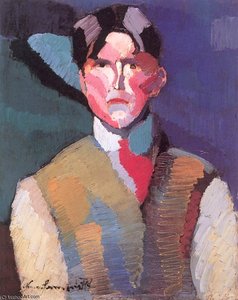
József Nemes Lamperth: A Hungarian Visionary Bridging Expressionism and Secessionism
Born in Budapest, Hungary, in 1891, József Nemes Lamperth’s life was tragically cut short at the young age of thirty-three. Despite his brief career, he left an indelible mark on early 20th-century Hungarian art, becoming a pivotal figure bridging the expressive fervor of Expressionism with the decorative elegance of Secessionist aesthetics. His work, often characterized by bold colors, dynamic brushwork, and a deeply personal vision of the Hungarian landscape and its people, continues to resonate today.
Lamperth’s artistic journey began during a period of intense social and political change in Hungary. The late 19th and early 20th centuries witnessed the rise of nationalist sentiment, coupled with burgeoning avant-garde movements seeking to break from traditional academic styles. Influenced by artists like Vincent van Gogh, Paul Gauguin, and the German Expressionists, Lamperth embraced a subjective approach to artmaking, prioritizing emotional intensity over strict representation. His early works demonstrate a clear fascination with color and form, often employing vibrant hues and distorted perspectives to convey mood and feeling.
Early Works and the Embrace of Expressionism
His self-portrait, a striking example of his burgeoning style, reveals an immediate engagement with the expressive possibilities of oil paint. The bold brushstrokes, intense colors, and somewhat unsettling gaze immediately communicate a sense of inner turmoil – a characteristic that would become increasingly prominent in his later works. Similarly, “On the Slopes of Gellért Hill” exemplifies this early period, capturing the dramatic light and shadow of the Hungarian landscape with an almost feverish energy. The painting isn’t simply a depiction of a hillside; it's an emotional response to the scene, imbued with a sense of movement and vitality.
Lamperth’s artistic development was further shaped by his exposure to the Secessionist movement, which flourished in Vienna during this time. The Secessionists sought to create art that was both beautiful and socially relevant, often incorporating decorative elements into their works. While Lamperth never fully embraced the rigid formalism of the Secession, he clearly absorbed its emphasis on design and visual impact, evident in his later landscapes and portraits.
A Unique Style: Landscape and Portraiture
Lamperth’s oeuvre is notably divided between landscape paintings and portraiture. His landscapes, particularly those depicting the Hungarian countryside, are characterized by a raw emotionality and an almost obsessive attention to detail. He wasn't interested in creating idyllic scenes; instead, he sought to capture the essence of the land – its ruggedness, its beauty, and its inherent drama. “Detail Of Kolozsvár” showcases this approach, utilizing a dry brush technique to create a textured surface that evokes the atmosphere of rural Hungary.
His portraits, equally compelling, reveal a keen understanding of human psychology. He captured not just physical likenesses but also the inner lives and emotions of his subjects. The faces he painted are often marked by a sense of melancholy or introspection, reflecting the turbulent times in which he lived.
Legacy and Historical Significance
Despite his tragically short life, József Nemes Lamperth’s influence on Hungarian art is significant. His work helped to pave the way for later generations of Hungarian Expressionists and Secessionist artists. The Memorial Exhibition held at the Hungarian National Gallery in 2014, titled “The Painter and the Museum,” served as a crucial step in recognizing his contribution to the country’s artistic heritage. His paintings are now housed primarily at the Rippl-Rónai Museum in Budapest, offering visitors a glimpse into the mind of a truly original artist – a Hungarian visionary who dared to express himself with passion and intensity.
Lamperth's work continues to be studied and appreciated for its innovative use of color, its emotional depth, and its unique perspective on the Hungarian landscape. He remains a vital figure in understanding the development of modern art in Hungary and beyond.