Portrét Filippo De Pisis

Obrazy autora Filippo De Pisis: 60 nejznámějších díel podle pohledu galerie

Aktualizováno listopad 2026 · seřazeno podle našeho skóre popularity (vyhledávání, návštěvy a objednávky u každého díla) · 61 děl umělce Filippo De Pisis v našem katalogu

Stručně řečeno

Z pohledu galerie je nejslavnějším dílem Filippo De Pisis obraz Untitled (839). Untitled (529) a Untitled (788) doplňují trio, které každé oko okamžitě pozná. Z 61 děl umělce Filippo De Pisis v našem katalogu představuje galerie níže 60 nejznámějších děl, z nichž každé je originálem s uvedením roku vzniku, muzea a toho, co jej činí jedinečným.

1896 – 1956, Ferrara Impressionism Nejvíce děl: Galleria d'Arte Moderna Achille Forti

Top 10 obrazů umělce Filippo De Pisis v naší galerii

1
Untitled (839) od Filippo De Pisis

Untitled (839)

Oil On Canvas

In this work, we find ourselves drifting through a quiet, atmospheric moment in Venice, Italy. The Basilica di Santa Maria della Salute dominates the composition, yet it does not demand attention through rigid lines or heavy outlines. Instead, the structure emerges from a haze of cool blues and purples, its domes catching a diffused light that feels as though it might shift at any second. The scene is one of…

2
Untitled (529) od Filippo De Pisis

Untitled (529)

Oil On Canvas

A man in a white shirt and trousers moves through a dream, caught in a dance pose that defies the stillness of the objects around him. He is partially obscured by a rectangular frame, a boundary that separates the viewer from this fleeting gesture. At the center, a vase overflows with flowers, their petals rendered in thick, impasto strokes that catch the light. Below this arrangement, a single red fruit…

3
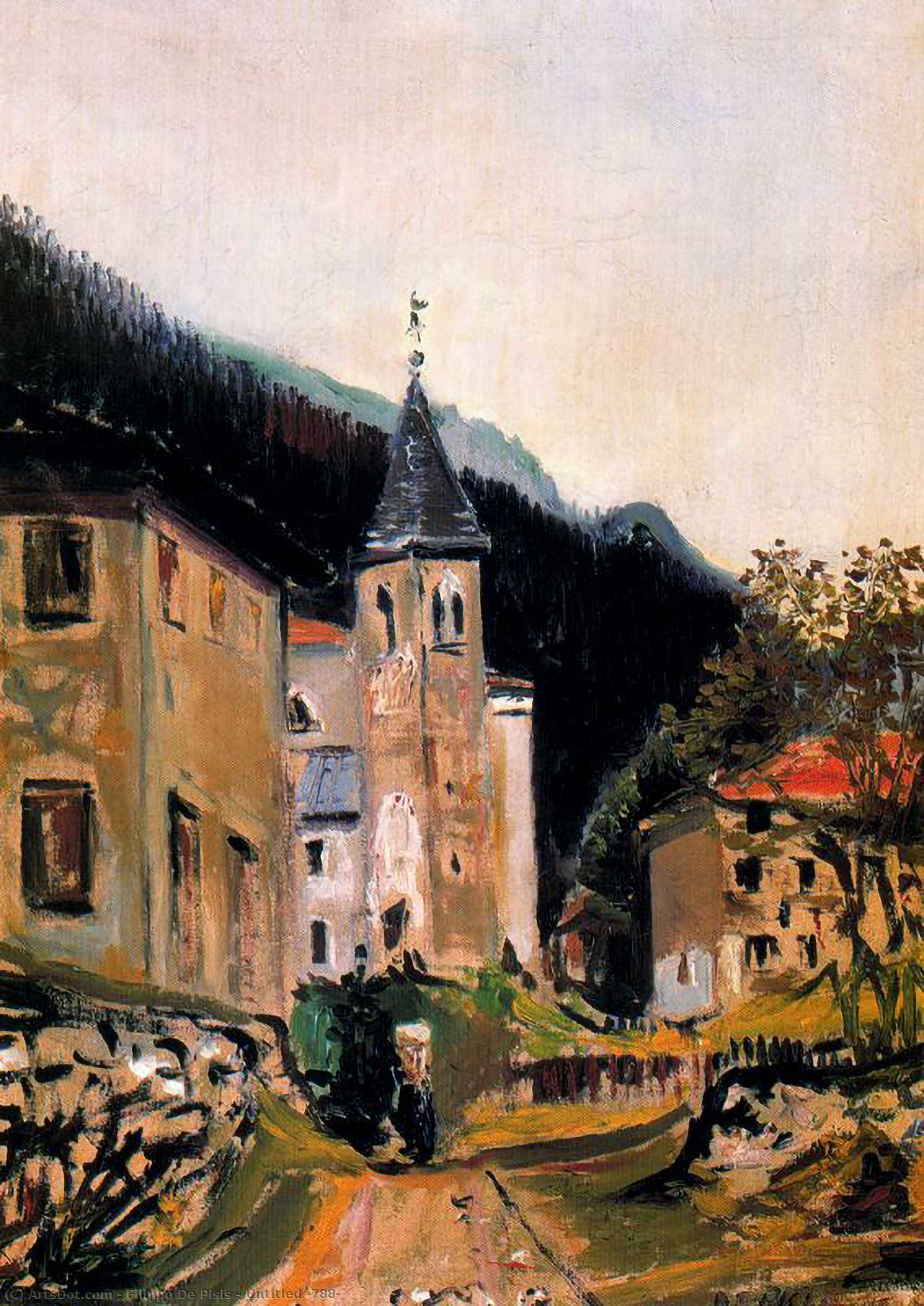
Untitled (788) od Filippo De Pisis

Untitled (788)

Oil On Canvas

A small village rests under a quiet sky, anchored by the silhouette of a church in the distance. A dirt road cuts through the scene, where a woman walks with a steady, solitary pace. Around her, the world is populated by scattered figures and the slow movement of horses. One horse lingers near the center, while another drifts toward the edge of the frame. The air feels heavy with the…

4
Flowers (1931) od Filippo De Pisis

Flowers

In Flowers, Filippo De Pisis explores the quietude of the still life. Created about 1931, the work reflects the artist's preoccupation with the ephemeral nature of organic matter. De Pisis, born in Ferrara, Italy, in 1896, often turned his attention to the mundane, finding weight in the simplest arrangements. This specific piece focuses on the botanical subject, treating the flora not as a static arrangement, but as a meditation on…

7
Still life with Mushrooms (1934) od Filippo De Pisis

Still life with Mushrooms

In the quiet intimacy of Filippo de Pisis’s Still Life with Mushrooms, we are invited into a world where the mundane is elevated to the level of poetry. Created in 1934, this exquisite composition serves as a masterclass in the art of the fleeting moment. The painting captures a scattered collection of mushrooms, their organic forms resting with a delicate randomness across the canvas. Some lie solitary on the ground,…

Obrazy autora Filippo De Pisis, seřazeny od 11 do 60

Motivy, které zaujaly Filippo De Pisis

Čtyři témata, která se v těchto originálech nejčastěji objevují, z nichž každé má svůj nejlepší příklad.

Muzea, v nichž jsou vystavena originálna umělce Filippo De Pisis

2 muzea, v nichž je umístěno nejvíce obrazů z této stránky.

Muzeum Město Díla autora Filippo De Pisis Obrazy z tohoto seznamu
Galleria d'Arte Moderna Achille Forti, VeronaGalleria d'Arte Moderna Achille Forti Verona 2 Still life with Mushrooms, Strawberries. Still Life
Art Gallery of New South Wales, SydneyArt Gallery of New South Wales Sydney 1 Flowers

Filippo De Pisis, ikonická díla každého roku

Deset let, od 1930 do 1939, bylo pro Filippo De Pisis dostatečných: galerie je prochází rok po roce, jeden slavný originál za druhým.

Díla podle roku

Vyberte rok a prohlédněte si originály.

Obrazy umělce Filippo De Pisis: odpovědi galerie

Který obraz autora Filippo De Pisis je nejslavnější ze všech?Odhalit odpověď

Untitled (839). Následují Untitled (529) a Untitled (788).

Kterých 10 nejlepších obrazů má Filippo De Pisis?Odhalit odpověď

Untitled (839), Untitled (529), Untitled (788), Flowers, Untitled (620), Untitled (313), Still life with Mushrooms, Untitled (805), Untitled (699) a Untitled (586). Hodnocení výše uvádí rok a muzeum pro každé z nich.

Kolik děl vytvořil/a Filippo De Pisis?Odhalit odpověď

Náš katalog obsahuje 61 děl umělce Filippo De Pisis z let 1930 až 1939.

Kde jsou vystavena nejznámější originály umělce Filippo De Pisis?Odhalit odpověď

Většinou v Galleria d'Arte Moderna Achille Forti (Verona) a Art Gallery of New South Wales (Sydney). V tabulce muzeí výše jsou vypsány všechny.

Která jsou nejstarší a nejnovější slavná díla umělce Filippo De Pisis?Odhalit odpověď

Na této stránce je nejstarší dílo z Still Life with Shell (1930) a nejnovější z Strawberries. Still Life (1939).

Kterým tématům se Filippo De Pisis věnoval(a) nejčastěji?Odhalit odpověď

Still life (6), Italian art (6) a Flowers (3) napříč 60 díly na této stránce.

V jaké technice tvořil(a) Filippo De Pisis nejčastěji?Odhalit odpověď

Oil On Canvas, u 3 z 60 děl na této stránce.

S jakým směrem je spojen(a) Filippo De Pisis?Odhalit odpověď

Impressionism a Post-impressionism, podle originálů na této stránce.

Jaká originální díla Filippo De Pisis má v obsluze Galleria d'Arte Moderna Achille Forti?Odhalit odpověď

Still life with Mushrooms a Strawberries. Still Life: muzeum Galleria d'Arte Moderna Achille Forti, Verona má v obsluze 2 děl z této stránky.

Filippo De Pisis: umělec

The Poet of the Fleeting Moment

Born Luigi Filippo Tibertelli in the historic Italian city of Ferrara, Filippo De Pisis was an artist who refused to be confined by a single medium. To understand his canvas, one must first understand his soul as a poet; he viewed the world through a lens of literary sensitivity, where every shadow and light flicker held a narrative weight. His early years in Italy were marked by a profound intellectual curiosity, studying literature and philosophy in Bologna. It was here that he encountered the haunting, dreamlike visions of Giorgio De Chirico, an encounter that would plant the seeds of Metaphysical influence within his burgeoning style. This duality—the precision of a scholar and the wandering eye of a flâneur—defined his approach to art, allowing him to capture not just the physical reality of a subject, but its emotional resonance.

His journey was one of constant movement across the great cultural capitals of Europe. Moving to Rome in 1919 and later settling in Paris in 1925, De Pisis immersed himself in the vibrant, avant-garde pulse of the interwar period. In Paris, his brushwork began to shed its more rigid, metaphysical origins, absorbing the light and movement of French Impressionism. He moved within the same circles as Georges Braque and André Derain, and his style evolved into something uniquely his own: a technique often described as pittura a zancapi mosca—a "fly-wing" style of painting characterized by rapid, fragmented, and nervous brushstrokes. This method allowed him to achieve an airy, almost mirage-like quality, where objects seemed to vibrate with life before dissolving back into the atmosphere.

A Symphony of Light and Melancholy

The heart of De Pisis’s oeuvre lies in his ability to find the eternal within the ephemeral. He possessed a singular talent for elevating the mundane—a simple arrangement of mushrooms, a bowl of strawberries, or a vase of foxgloves—into profound meditations on existence. His still lifes are never merely static arrangements; they are imbued with what he called "pathetic pleasure-pain," a bittersweet recognition of beauty's fleeting nature. Through muted pastel hues and a masterful command of Venetian light, he created compositions where the boundaries between objects and their surroundings blur, suggesting a deep, spiritual interconnectedness between all things.

His fascination with Venice provided much of his most luminous subject matter. The city’s architectural grandeur and its misty, maritime atmosphere served as the perfect stage for his expressive explorations. Whether depicting the rhythmic movement of a seascape or the quiet intimacy of a street scene, De Pisis utilized a broken brushstroke technique that captured the very essence of light hitting water or stone. This period of his work represents a pinnacle of Italian Post-Impressionism, where the artist’s technical skill met an almost obsessive devotion to capturing the "secret spirit" of the moment.

Legacy of the Cosmopolitan Visionary

Despite the disruptions of World War II and his eventual return to Italy, De Pisis never lost the cosmopolitan spirit that had defined his youth. His life was famously eccentric, marked by a dandyish lifestyle and an insatiable appetite for the beauty found in the smallest details—even claiming that a discarded feather on a street could spark a masterpiece. This radical openness to the world ensured that his work remained perpetually fresh, avoiding the stagnation that often plagues established masters.

Today, the significance of Filippo De Pisis rests in his unique position as a bridge between the structured metaphysical movements of the early 20th century and the more spontaneous, emotive expressions of later decades. His legacy is found in:

  • The fusion of poetry and painting: Proving that visual art can be as lyrical and metaphorically rich as the written word.
  • Mastery of atmosphere: Redefining how light and texture can convey complex psychological states like nostalgia and longing.
  • The elevation of the everyday: Transforming simple still lifes into profound explorations of beauty, decay, and the passage of time.

He remains a celebrated figure in the annals of Italian art, remembered not just as a painter of scenes, but as a chronicler of the ephemeral soul.