Portrét Sol Lewitt

40 nejslavnějších obrazů autora Sol Lewitt, výběr z galerie

Aktualizováno říjen 2026 · seřazeno podle našeho skóre popularity (vyhledávání, návštěvy a objednávky u každého díla) · 42 děl umělce Sol Lewitt v našem katalogu

Stručně řečeno

Z všech originálů, které Sol Lewitt zanechal, je nejslavnější Serial Project #1 ABCD (1966), který se nachází ve sbírce MoMA - Museum of Modern Art, New York. Hned za ním následují Wall drawing #1091: arcs, circles and bands (room) (2003) a Distorted Cubes Bozuk Küpler. Náš katalog obsahuje 42 děl umělce Sol Lewitt; galerie si zachovala 40 děl, která obdivuje celý svět, přičemž každé je znázorněno s datem vzniku, názevem muzea a jeho příběhem.

1928 – 2007, Hartford Minimalism Nejvíce děl: MASS MoCA

10 nejlepších obrazů umělce Sol Lewitt: výběr galerie

1
Serial Project #1 ABCD (1966) od Sol Lewitt

Serial Project #1 ABCD

1966 · Sculpture · MoMA - Museum of Modern Art, New York

A systematic arrangement of white cubes and rectangular prisms occupies a grid-like base, set against a stark black void. This geometric composition, titled Serial Project #1 ABCD, functions as an architectural exploration of structure and seriality. Rather than representing a specific building, the work investigates the permutations of simple shapes. The arrangement follows a predetermined algorithm, where the placement of each element is dictated by a logical sequence rather than…

2
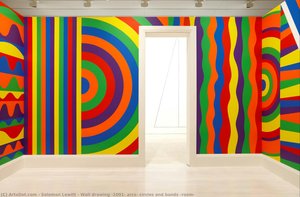
Wall drawing #1091: arcs, circles and bands (room) (2003) od Sol Lewitt

Wall drawing #1091: arcs, circles and bands (room)

2003 · Installation Art · Art Gallery of New South Wales, Sydney

To stand before Wall drawing #1091: arcs, circles and bands (room) is to witness not merely an arrangement of pigment on a surface, but the vibrant echo of artistic reinvention. This monumental piece by Solomon Lewitt captures a moment of profound resurgence in his later career. Where earlier works might have favored a more restrained palette, this drawing explodes with exuberant color—a joyous chromatic symphony applied across the architectural expanse…

3
Distorted Cubes Bozuk Küpler od Sol Lewitt

Distorted Cubes Bozuk Küpler

Painting · Borusan Contemporary, Istanbul

In the realm of conceptual mastery, few works capture the rhythmic pulse of modern abstraction as vibrantly as Sol LeWitt’s Distorted Cubes Bozuk Küpler. This captivating piece serves as a brilliant testament to the artist's ability to transform rigid mathematical precision into a dance of visual delight. At first glance, the viewer is greeted by an intricate mosaic of fourteen distinct colored squares, each meticulously arranged to create a sense…

4
Wall Drawing #391 (1983) od Sol Lewitt

Wall Drawing #391

1983 · Indian Ink · MASS MoCA, Adams

Wall Drawing #391 is an artwork by Solomon Lewitt. Created in April 1983, this two-part drawing occupies a specific space within the MASS MoCA in Adams. The work exists as a structural dialogue between two adjacent surfaces, mapping out a logic that relies on the intersection of planes and the direction of the line.

5
Wall Drawing #831 (1997) od Sol Lewitt

Wall Drawing #831

1997 · Drawing · Guggenheimovo muzeum Bilbao, Bilbao

In the vast landscape of twentieth-century modernism, few names resonate with as much intellectual rigor as Solomon Lewitt. His Wall Drawing #831, created in 1997, serves as a breathtaking testament to the power of the idea over the hand. As a pioneer of both Minimalism and Conceptual Art, Lewitt famously posited that the concept itself is the machine that makes the art. This particular work is not merely a painting…

6
Wall Drawing #915 (1999) od Sol Lewitt

Wall Drawing #915

1999 · Installation Art · MASS MoCA, Adams

Wall Drawing #915 exists as an installation of mathematical precision. Created in 1999, the work utilizes a palette of pastels, anchored by a primary tone of steel blue. The composition relies on geometric patterns and interlocking shapes that transform architectural surfaces into active participants in the art. Through the use of arcs and circles, the piece establishes a rhythmic movement across the wall.

7
Incomplete open cube 5/6 (1974) od Sol Lewitt

Incomplete open cube 5/6

1974 · Metal · Art Gallery of New South Wales, Sydney

Incomplete Open Cube No.5-6 – A Testament to Minimalist Geometry The ‘Incomplete open cubes’ represent a pivotal moment in Sol LeWitt's artistic trajectory, encapsulating the core tenets of his conceptual approach and solidifying his position as one of the pioneers of Minimalism. Created in 1974, this sculpture—a precisely crafted aluminum structure—isn’t merely an object; it’s an embodiment of intellectual rigor distilled into a deceptively simple form. LeWitt himself famously articulated…

8
Kaldor Public Art Project 06: Sol LeWitt 1977 (1977) od Sol Lewitt

Kaldor Public Art Project 06: Sol LeWitt 1977

1977 · Drawing · Kaldor Public Art Projects, Sydney

In the quiet, transformative moment captured in this 1977 photograph, we witness more than just the documentation of a mural; we see the physical manifestation of an idea. Part of the prestigious Kaldor Public Art Project, this work by Solomon LeWitt serves as a profound testament to the power of Conceptualism. The image presents a stark, monochromatic dialogue between two observers and a monumental wall drawing that consumes the architectural…

9
Wall Drawing #146A (2000) od Sol Lewitt

Wall Drawing #146A

2000 · Crayon · MASS MoCA, Adams

In the realm of contemporary minimalism, few names resonate with as much intellectual authority as Solomon LeWitt. His work, particularly the mesmerizing Wall Drawing #14 6A, serves as a profound testament to the power of the concept over the physical object. This particular piece, captured in its striking blue crayon medium, transcends the boundaries of traditional painting to become an immersive environment. As one gazes upon the composition, the distinction…

Výběr umělce Sol Lewitt pokračuje, od 11 do 40

11Pyramid (2005) od Sol LewittPyramid2005 · Art Gallery of New South Wales 12Black with White Lines, Vertical Not Touching (1970) od Sol LewittBlack with White Lines, Vertical Not Touching1970 · MoMA - Museum of Modern Art 13Cubo od Sol LewittCuboCAMUSAC Cassino Museum of Contemporary Art 14Vertical Lines, Not Touching (1970) od Sol LewittVertical Lines, Not Touching1970 · MoMA - Museum of Modern Art 15Objectivity (1962) od Sol LewittObjectivity1962 16Irregular Grid od Sol LewittIrregular GridElgiz Museum of Contemporary Art 17Wall Drawing #822 (1997) od Sol LewittWall Drawing #8221997 · MASS MoCA 18Four Color Woodcuts-Curvy Bands I-IV (1996) od Sol LewittFour Color Woodcuts-Curvy Bands I-IV1996 · Borusan Contemporary 19Kaldor Public Art Project 11: Sol LeWitt 1998 (1998) od Sol LewittKaldor Public Art Project 11: Sol LeWitt 19981998 · Kaldor Public Art Projects 20Blue Vertical (2000) od Sol LewittBlue Vertical2000 21Wal Drawing #999 (2001) od Sol LewittWal Drawing #9992001 · MASS MoCA 22Isometric Figures in Five and Six Colors (2002) od Sol LewittIsometric Figures in Five and Six Colors2002 · Borusan Contemporary 23Wall Drawing #1171 (2005) od Sol LewittWall Drawing #11712005 · MASS MoCA 24Wall Drawing #1185 (2005) od Sol LewittWall Drawing #11852005 · MASS MoCA 25brushstrokes 2 od Sol Lewittbrushstrokes 2CAMUSAC Cassino Museum of Contemporary Art 26Lincoln Center Print od Sol LewittLincoln Center PrintBorusan Contemporary 27brushstrokes od Sol LewittbrushstrokesCAMUSAC Cassino Museum of Contemporary Art 28Wall drawing #338: Two part drawing. The wall is divided vertically into two parts. Each part is divided horizontally and vertically into four equal parts. 1st part: Lines in four directions, one direction in each quarter. 2nd part: Lines in four dir.... (1971) od Sol LewittWall drawing #338: Two part drawing. The wall is divided vertically into two parts. Each part is divided horizontally and vertically into four equal parts. 1st part: Lines in four directions, one direction in each quarter. 2nd part: Lines in four dir....1971 · Art Gallery of New South Wales 29Wall Drawing #340 (1980) od Sol LewittWall Drawing #3401980 · MASS MoCA 30Untitled od Sol LewittUntitled 31Untitled from Squares with a Different Line Direction in Each Half Square (3) od Sol LewittUntitled from Squares with a Different Line Direction in Each Half Square (3) 32Untitled from Squares with a Different Line Direction in Each Half Square od Sol LewittUntitled from Squares with a Different Line Direction in Each Half Square 33Untitled from Squares with a Different Line Direction in Each Half Square (2) od Sol LewittUntitled from Squares with a Different Line Direction in Each Half Square (2) 34Wall Drawing #154, #155, #162, #163, #157, #158 od Sol LewittWall Drawing #154, #155, #162, #163, #157, #158Modern Art Oxford 35Distorted Cubes from Distorted Cubes od Sol LewittDistorted Cubes from Distorted Cubes 36Distorted Cubes from Distorted Cubes (2) od Sol LewittDistorted Cubes from Distorted Cubes (2) 37Irregular tower od Sol LewittIrregular towerCAMUSAC Cassino Museum of Contemporary Art 38Irregular tower od Sol LewittIrregular towerCAMUSAC Cassino Museum of Contemporary Art 39Irregular Arcs, Bands and Loops od Sol LewittIrregular Arcs, Bands and LoopsBorusan Contemporary 40Eight-Pointed Stars od Sol LewittEight-Pointed StarsChrysler Museum of Art

Slavná díla Sol Lewitt podle jednotlivých období

Motivy, které zaujaly Sol Lewitt

Čtyři témata, která se v těchto originálech nejčastěji objevují, z nichž každé má svůj nejlepší příklad.

Muzea, v nichž jsou vystavena originálna umělce Sol Lewitt

8 muzea, v nichž je umístěno nejvíce obrazů z této stránky.

Muzea Město Díla autora Sol Lewitt Obrazy z tohoto seznamu
MASS MoCA, AdamsMASS MoCA Adams 9 Wall Drawing #391, Wall Drawing #915, Wall Drawing #146A
Borusan Contemporary, IstanbulBorusan Contemporary Istanbul 5 Distorted Cubes Bozuk Küpler, Four Color Woodcuts-Curvy Bands I-IV, Isometric Figures in Five and Six Colors
CAMUSAC Cassino Museum of Contemporary Art, CassinoCAMUSAC Cassino Museum of Contemporary Art Cassino 5 Cubo, brushstrokes 2, brushstrokes
Art Gallery of New South Wales, SydneyArt Gallery of New South Wales Sydney 4 Wall drawing #1091: arcs, circles and bands (room), Incomplete open cube 5/6, Pyramid
MoMA - Museum of Modern Art, New YorkMoMA - Museum of Modern Art New York 3 Serial Project #1 ABCD, Black with White Lines, Vertical Not Touching, Vertical Lines, Not Touching
Kaldor Public Art Projects, SydneyKaldor Public Art Projects Sydney 2 Kaldor Public Art Project 06: Sol LeWitt 1977, Kaldor Public Art Project 11: Sol LeWitt 1998
Guggenheimovo muzeum Bilbao, BilbaoGuggenheimovo muzeum Bilbao Bilbao 1 Wall Drawing #831
Elgiz Museum of Contemporary Art, İstanbulElgiz Museum of Contemporary Art İstanbul 1 Irregular Grid

Sol Lewitt dekáda po dekádě: originální díla, která definují každou z nich

Díla podle dekád

Vyberte si dekádu a prohlédněte si originál, který ji definuje.

Otázky sběratelů o obrazech umělce Sol Lewitt

Kterým dílem je Sol Lewitt nejznámější?Odhalit odpověď

Serial Project #1 ABCD (1966), MoMA - Museum of Modern Art, New York. Následují Wall drawing #1091: arcs, circles and bands (room) (2003) a Distorted Cubes Bozuk Küpler.

Kolik let bylo Sol Lewitt, když bylo vytvořeno dílo Serial Project #1 ABCD?Odhalit odpověď

38 let: dílo Serial Project #1 ABCD pochází z roku 1966 a Sol Lewitt se narodil/a v roce 1928.

Kterých deset nejslavnějších obrazů má Sol Lewitt?Odhalit odpověď

Serial Project #1 ABCD, Wall drawing #1091: arcs, circles and bands (room), Distorted Cubes Bozuk Küpler, Wall Drawing #391, Wall Drawing #831, Wall Drawing #915, Incomplete open cube 5/6, Kaldor Public Art Project 06: Sol LeWitt 1977, Wall Drawing #146A a Wall Drawing #793B Certificate. Hodnocení výše uvádí rok a muzeum pro každé z nich.

Kolik obrazů zanechal(a) Sol Lewitt?Odhalit odpověď

Náš katalog obsahuje 42 děl umělce Sol Lewitt z let 1962 až 2005.

Ve kterých muzeích jsou vystavena díla mistrovská umělce Sol Lewitt?Odhalit odpověď

Většinou v MASS MoCA (Adams), Borusan Contemporary (Istanbul) a CAMUSAC Cassino Museum of Contemporary Art (Cassino). V tabulce muzeí výše jsou vypsány všechny.

V jakých letech namaloval Sol Lewitt svá nejznámější díla?Odhalit odpověď

V období 2000s: 8 z celkem 40 děl na této stránce vzniklo právě tehdy, z toho Wall drawing #1091: arcs, circles and bands (room) z nich.

Jaká jsou první a poslední slavná originální díla umělce Sol Lewitt?Odhalit odpověď

Na této stránce je nejstarší dílo z Objectivity (1962) a nejnovější z Pyramid (2005).

Jaká témata si Sol Lewitt vybíral nejčastěji?Odhalit odpověď

Geometric abstraction (8), Conceptual art (7) a Wall drawing (5) napříč 40 díly na této stránce.

Kterou techniku používal(a) Sol Lewitt nejčastěji?Odhalit odpověď

Sculpture, u 2 z 40 děl na této stránce.

K kterému uměleckému směru patří Sol Lewitt?Odhalit odpověď

Minimalism, podle originálů na této stránce.

Která díla umělce Sol Lewitt jsou vystavena v MASS MoCA?Odhalit odpověď

Wall Drawing #391, Wall Drawing #915 a Wall Drawing #146A: muzeum MASS MoCA, Adams má v obsluze 9 děl z této stránky.

Sol Lewitt: život a dílo

Architekt myšlenek: Život a odkaz Sol LeWitta

V rozlehlé krajině modernismu dv twentiethého století vrhla jen málo postav tak dlouhý nebo intelektuálně hluboký stín jako Solomon LeWitt. Narodil se 9. září 1928 v Hartfordu v Connecticutu v rodině židovských imigrantů z Ruska a jeho cesta byla definována snahou o čistou myšlenku nad pouhou fyzickou realizací. Jeho raná léta formovala přísná analytická zvídavost, vlastnost vychovaná během studia na Syracuse University mezi lety 1945 a 1949. Tato akademická základy v matematice a geometrii se později staly samotným srdcem jeho uměleckého jazyka, což mu umožnilo odtrhnout dekorativní nadbytečnosti tradičního umění a odhalit kostlivou krásu logiky a struktury.

LeWittova evoluce jako umělce nebyla náhlým zlomením, ale záměrnou migrací od toho hmatatelného k tomu konceptuálnímu. Zatímco jeho raná zkoumání zahrnovala taktilní povahu malby a kresby, brzy se začal stále více přitahovat k myšlence stojící za stopou, spíše než k samotné stopě. Tento posun znamenal zrod průkopníka, který překlenul propast mezi minimalismem a konceptuálním uměním. Začal vnímat umělce nikoliv jako řemeslníka svázaného rukou, ale jako architekta instrukcí. Prioritizováním mentálního plánu před hotovým objektem LeWitt zpochybnil samotnou definici autorství a naznačil, že jakmile je myšlenka zformulována, její fyzická projev je pouze vedlejším důsledkem.

Revoluce nástěnných kreseb

Konec 60. let 20. století byl svědkem jedné z nejradikálnějších transformací v současném umění s objevením LeWittových ikonických nástěnných kreseb. Odmítavým postoji k trvanlivosti a vzácnosti tradiální sochařské tvorby představil „struktury“ – termín, který preferoval před slovem „sochy“, aby zdůraznil jejich matematickou podstatu – a sérii instrukcí, které mohl vykonat kdokoli vyškolený k jejich následování. Tato díla nebyla pouhou dekorací, ale prožitkem; často byla složena z přesných geometrické vzorů, oblouků a prolínajících se tvarů, které vdechovaly život architektonickým prostorům, jež obývala.

Bejt se dívat na LeWittovu nástěnnou kresbu, znamená vidět logiku proměněnou v poezii. Ať už šlo o syrovou, rytmickou repetici nalezenou v díle Black with White Lines, Vertical Not Touching nebo o živoucí, exuberantní energii díla Wall Drawing #1091: arcs, circles and bands, jeho práce využíval sílu linie k ovládnutí prostoru. Tato díla často spoléhala na systém logických, často matematických instrukcí, které vedly asistenty nebo muzejní instalátory při jejich tvorbě. Tato metoda demokratizovala akt tvorby a zároveň pozvedla význam konceptu, čímž zajistila, že umělecké dílo existuje primárně jako intelektuální jiskra ještě předtím, než se vůbec dotkne stěny.

Trvalý dojem na modernitu

Během své plodné kariéry, která trvala celá desetiletí a zahrnovala mistrovství v grafice, fotografii a instalaci, zůstal LeWitt neochvějný ve svém závazku k jasnosti a přesnosti. Jeho schopnost nacházet hlubokou krásu v těch nejjednodušších formách – jako je nárazová bílá Pyramida nebo komplexní, barevné rytmy jeho nástěnných děl vytvořených kredkou – definovala estetické hranice pozdního 20. století. Dokázal, že umění může být zbaveno svého ega i ornamentu a přesto si zachovat duši, která hluboce rezonuje s lidskou touhou po řádu a objevování.

Historický význam Sol LeWitta nelze přehodnotit. Poskytl slovní zásobu generacím umělců k prozkoumávání hranic mezi myšlenkou a hmotou. Jeho odkaz žije v každém muzeu a galerii, kde se stírá hranice mezi tvůrcem a vykonavatelem a kde je síla myšlenky uznávána jako nejvyšší médium. Když se ohlížíme zpět na jeho život, od jeho počátků v Hartfordu až po jeho poslední dny v New Yorku v roce 2007, vidíme muže, který neuctřel pouze umění, ale který nás naučil, jak spatřit hlubokou architekturu samotné myšlenky.