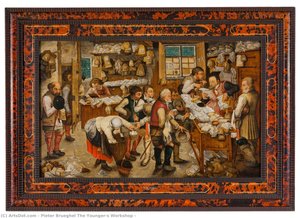
Pieter Brueghel the Younger’s Workshop: A Legacy of Flemish Landscapes
The name Pieter Bruegel the Younger conjures images of vast, teeming landscapes populated by peasants engaged in everyday life – scenes brimming with both rustic charm and unsettling social commentary. However, behind this iconic style lies a complex story of artistic lineage and prolific production, centered around a remarkably successful workshop that flourished in Antwerp during the late 16th and early 17th centuries. This wasn’t merely a studio; it was a powerhouse of artistic output, responsible for an estimated 1,400 paintings – a staggering number that significantly shaped the course of Flemish art and disseminated Bruegel's distinctive vision across Europe.
The workshop’s origins are inextricably linked to Pieter Bruegel the Elder, his father. Born in Brussels around 1564, Pieter the Younger learned the trade at his father’s side, initially assisting with preparatory sketches and underpainting. Following his father's death in 1608, he inherited not only the workshop but also a considerable backlog of unfinished works. Recognizing the commercial potential of his father’s style – particularly the popularity of scenes depicting peasant life – Pieter the Younger skillfully adapted and expanded upon these themes, establishing a highly efficient production system. He didn't simply copy; he developed his own approach, often incorporating elements of Mannerism and creating what are known as “Bruegelian pastiches” – works that deliberately mimic his father’s style while subtly introducing new details or compositional variations.
The Workshop’s Style and Production
The workshop's aesthetic was deeply rooted in the traditions of Pieter Bruegel the Elder, but it evolved into something uniquely its own. While maintaining a strong connection to his father’s core subjects – rural life, harvests, festivals, and even unsettling depictions of death and disaster – the younger Brueghel introduced a greater emphasis on detail, color, and dynamism. His compositions often featured a heightened sense of realism, with meticulously rendered figures and landscapes. Crucially, the workshop operated as a collaborative enterprise, employing numerous assistants who specialized in different aspects of the painting process: some focused on sketching, others on underpainting, while still others were responsible for finishing details or creating entirely new elements within a scene.
The sheer volume of work produced by the workshop speaks to its remarkable efficiency and organizational structure. It’s estimated that around 1,400 paintings bear some connection to Pieter Bruegel the Younger and his team – a testament to their tireless dedication and ability to replicate and reinterpret his father's style on a massive scale. This prolific output made Brueghel’s imagery incredibly accessible, contributing significantly to its widespread dissemination throughout Europe during a period of intense artistic exchange.
Influences and Artistic Connections
Pieter Bruegel the Younger’s work was undeniably shaped by his father's legacy, but he also drew inspiration from other prominent Flemish artists. The influence of Jan Brueghel the Elder, his uncle, is particularly evident in the workshop’s later output – especially in the depiction of flower garlands and still lifes. The meticulous attention to detail and the incorporation of contemporary fashion trends reflect a broader engagement with the artistic currents of the time.
Furthermore, the workshop benefited from collaborations with other leading Flemish painters, including Frans Francken the Younger, who frequently contributed figures and narrative elements to Brueghel’s compositions. These partnerships broadened the scope of the workshop's output and ensured a consistent level of artistic quality across its diverse range of subjects.
Notable Works and Legacy
The Groeninge Museum in Bruges houses an impressive collection of works attributed to Pieter Brueghel the Younger’s workshop, offering visitors a remarkable opportunity to immerse themselves in this prolific artist's oeuvre. These paintings showcase the full range of his stylistic development, from early copies of his father’s work to more original compositions that demonstrate his growing artistic independence.
Beyond Bruges, significant examples of the workshop’s output can be found in museums across Europe, including the Kunsthistorisches Museum in Vienna and the Prado Museum in Madrid. Pieter Brueghel the Younger's legacy extends far beyond the individual paintings themselves; his workshop played a crucial role in popularizing Bruegel’s imagery and establishing him as one of the most important landscape painters of the 16th and 17th centuries. His work continues to resonate today, offering a unique window into the social and cultural realities of early modern Europe.
Otázky a odpovědi
V jakém historickém období působil/a Pieter Brueghel The Younger'S Workshop?
Pieter Brueghel The Younger'S Workshop působil v období Renaissance. Toto období historicky vymezuje uměleckou činnost tohoto autora.
Kde najdu díla umělce Pieter Brueghel The Younger'S Workshop uspořádaná podle barvy?
Díla umělce Pieter Brueghel The Younger'S Workshop si můžete prohlédnout podle barev na jeho stránce Sestavení podle barev.
Mohu si prohlédnout díla umělce Pieter Brueghel The Younger'S Workshop podle tématu?
Díla umělce Pieter Brueghel The Younger'S Workshop si můžete prohlédnout podle tématu na stránce Atlas témat.