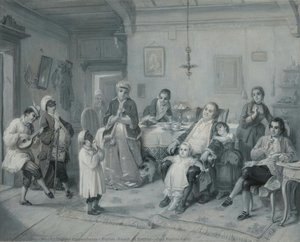
Portrét Moritz Daniel Oppenheim

27 nejslavnějších obrazů autora Moritz Daniel Oppenheim, každý naprosto unikátní

Aktualizováno listopad 2026 · seřazeno podle našeho skóre popularity (vyhledávání, návštěvy a objednávky u každého díla) · 28 děl umělce Moritz Daniel Oppenheim v našem katalogu

Stručně řečeno

Marriage Portrait of Charlotte de Rothschild (1836) je obraz autora Moritz Daniel Oppenheim, který přitahuje nejvíce pohledů; originál se nachází v Izraelské muzeum, Jeruzalém. Poté se zrak přesouvá k The Presentation at the Synagogue (Das Schultragen) (1869) a The Conclusion of the Sabbath (Sabbath-Ausgang) (1866). Z 28 děl umělce Moritz Daniel Oppenheim v našem katalogu je těchto 27 těch nejznámějších; každé z nich je unikátním originálem s uvedením roku vzniku, muzea a důvodu jeho nesmrtelnosti.

1800 – 1882, Hanau German romanticism Nejvíce děl: Židovské muzeum

Top 10 obrazů autora Moritz Daniel Oppenheim podle výběru galerie

1
Marriage Portrait of Charlotte de Rothschild (1836) od Moritz Daniel Oppenheim

Marriage Portrait of Charlotte de Rothschild

1836 · Oil On Canvas · Izraelské muzeum, Jeruzalém

A young woman sits poised in a moment of quiet grace, her presence filling the space with a serene, romantic light. She is draped in voluminous white and silver sleeves that catch the soft, directional light, creating a play of shadows across the delicate folds of her gown. Her skin glows with a luminous quality, contrasting against the deep, lush greens of the fruit tree behind her. A warm gold…

2
The Presentation at the Synagogue (Das Schultragen) (1869) od Moritz Daniel Oppenheim

The Presentation at the Synagogue (Das Schultragen)

1869 · Oil On Canvas · Židovské muzeum, New York City

A small hand reaches out to grasp the cold, metallic finials of a Torah binder. This object, sewn from strips of swaddling cloth used during circumcision, carries the weight of a child's name and a family's hope. Within the grand hall of the synagogue, the air feels heavy with the grey and black tones of an oil painting that captures a singular moment of transition. A father leans toward his…

3
The Conclusion of the Sabbath (Sabbath-Ausgang) (1866) od Moritz Daniel Oppenheim

The Conclusion of the Sabbath (Sabbath-Ausgang)

1866 · Oil On Canvas · Židovské muzeum, New York City

Step closer and observe the quietude within this room. We find ourselves in a domestic space, a dining room caught in that delicate, flickering moment between the sacred rest of the Sabbath and the return to the labors of the week. The scene is centered upon a man lighting candles, a gesture that marks the havdalah ceremony. Around him, a multigenerational family and a Talmud student are gathered, their presence…

4
The Examination (Das Verhören) (1868) od Moritz Daniel Oppenheim

The Examination (Das Verhören)

1868 · Oil On Canvas · Židovské muzeum, New York City

Moritz Daniel Oppenheim's "The Examination," painted in 1868, is more than just a domestic scene; it’s a poignant window into the heart of 19th-century Jewish family life. This intimate portrait, rendered with remarkable sensitivity and detail, captures a moment of quiet contemplation within a warmly lit living space – a space that speaks volumes about tradition, education, and familial bonds. The painting immediately draws the viewer in, not with grand…

5
Portrait of a Young Woman at her Desk (1825) od Moritz Daniel Oppenheim

Portrait of a Young Woman at her Desk

1825 · Oil · Izraelské muzeum, Jeruzalém

A young woman is seated at a desk in this 1825 oil portrait. She is positioned slightly off-center, facing the viewer with a calm, steady expression. Her upper body and hands are the primary focus of this medium shot, captured at eye level. She wears a gown of a deep burgundy hue, the fabric appearing smooth and lustrous under the light. The sleeves and folds of the garment suggest a…

6
Marriage Portrait of Charlotte von Rothschild (1836) od Moritz Daniel Oppenheim

Marriage Portrait of Charlotte von Rothschild

1836 · Oil On Canvas · Izraelské muzeum, Jeruzalém

The Marriage Portrait of Charlotte von Rothschild is an oil on canvas painted by Moritz Daniel Oppenheim in 1836. The sitter is Charlotte von Rothschild, a German-born British socialite. She was a member of the Rothschild banking family of Naples. The portrait captures her at a moment of significant transition, marked by her family's prominent standing.

7
Portrait of Kalmann Meyer Carl von Rothschild (1851) od Moritz Daniel Oppenheim

Portrait of Kalmann Meyer Carl von Rothschild

1851 · Oil On Canvas · Izraelské muzeum, Jeruzalém

The Portrait of Kalmann Meyer Carl von Rothschild is an oil painting by the German artist Moritz Daniel Oppenheim. Created about 1851, this work captures a man of significant standing. Oppenheim was commissioned to paint several portraits of prominent members of the Rothschild banking dynasty, documenting their presence through the lens of mid-nineteenth-century realism.

8
Portrait of Adolph Carl von Rothschild (1850) od Moritz Daniel Oppenheim

Portrait of Adolph Carl von Rothschild

1850 · Oil On Canvas · Izraelské muzeum, Jeruzalém

This work is the Portrait of Adolph Carl von Rothschild, a formal depiction rendered by the German painter Moritz Daniel Oppenheim. Created about 1850, the portrait captures Baron Adolph Carl von Rothschild, a prominent figure within the influential Rothschild banking dynasty. The sitter's presence is marked by a quiet, dignified gravity that reflects his status during the mid-nineteenth century.

9
Jewish Wedding in Frankfurt (1861) od Moritz Daniel Oppenheim

Jewish Wedding in Frankfurt

1861 · Oil · Izraelské muzeum, Jeruzalém

In the painting Jewish Wedding in Frankfurt by Moritz Daniel Oppenheim, the composition utilizes a medium close-up shot that focuses on the upper bodies of two central figures. These figures are positioned in the center of the frame against a dark, indistinct background. The perspective is set at eye-level, establishing a direct connection between the viewer and the subjects. The scene depicts a traditional Jewish wedding ceremony occurring in the…

10
Sabbath Rest (1866) od Moritz Daniel Oppenheim

Sabbath Rest

1866 · Oil On Canvas

The oil on canvas titled Sabbath Rest, also known as Sabbath-Ruhe auf der Gasse, was painted in 1866. This work belongs to the hand of Moritz Daniel Oppenheim, an artist born in 1800 in Hanau, Germany. He lived until 1882 in Frankfurt, Germany. The painting captures a specific moment of stillness, a pause in the rhythm of daily life.

Slavná díla umělce Moritz Daniel Oppenheim, čísla 11 až 27

Slavná díla Moritz Daniel Oppenheim podle jednotlivých období

Motivy, které zaujaly Moritz Daniel Oppenheim

Čtyři témata, která se v těchto originálech nejčastěji objevují, z nichž každé má svůj nejlepší příklad.

Muzea, v nichž jsou vystavena originálna umělce Moritz Daniel Oppenheim

4 muzea, v nichž je umístěno nejvíce obrazů z této stránky.

Muzeum Město Díla autora Moritz Daniel Oppenheim Obrazy z tohoto seznamu
Židovské muzeum, New York CityŽidovské muzeum New York City 12 The Presentation at the Synagogue (Das Schultragen), The Conclusion of the Sabbath (Sabbath-Ausgang), The Examination (Das Verhören)
Izraelské muzeum, JeruzalémIzraelské muzeum Jeruzalém 9 Marriage Portrait of Charlotte de Rothschild, Portrait of a Young Woman at her Desk, Marriage Portrait of Charlotte von Rothschild
Ascott House, Leighton BuzzardAscott House Leighton Buzzard 1 The Elector of Hesse Entrusting Mayer Amschel Rothschild (1743–1812), with His Treasure
National Portrait Gallery, LondýnNational Portrait Gallery Londýn 1 Lionel Nathan de Rothschild

Moritz Daniel Oppenheim napříč desetiletími: jeden unikátní originál pro každou dekádu

Díla podle dekád

Vyberte si dekádu a prohlédněte si originál, který ji definuje.

Obrazy umělce Moritz Daniel Oppenheim: dotazy pro galerii

Kterým nejznámějším dílem je Moritz Daniel Oppenheim?Odhalit odpověď

Marriage Portrait of Charlotte de Rothschild (1836), Izraelské muzeum, Jeruzalém. Následují The Presentation at the Synagogue (Das Schultragen) (1869) a The Conclusion of the Sabbath (Sabbath-Ausgang) (1866).

V jakém věku vytvořil(a) Moritz Daniel Oppenheim dílo Marriage Portrait of Charlotte de Rothschild?Odhalit odpověď

36 let: dílo Marriage Portrait of Charlotte de Rothschild pochází z roku 1836 a Moritz Daniel Oppenheim se narodil/a v roce 1800.

Kterých deset obrazů autora Moritz Daniel Oppenheim je nejznámějších?Odhalit odpověď

Marriage Portrait of Charlotte de Rothschild, The Presentation at the Synagogue (Das Schultragen), The Conclusion of the Sabbath (Sabbath-Ausgang), The Examination (Das Verhören), Portrait of a Young Woman at her Desk, Marriage Portrait of Charlotte von Rothschild, Portrait of Kalmann Meyer Carl von Rothschild, Portrait of Adolph Carl von Rothschild, Jewish Wedding in Frankfurt a Sabbath Rest. Hodnocení výše uvádí rok a muzeum pro každé z nich.

Kolik známých děl má autor Moritz Daniel Oppenheim?Odhalit odpověď

Náš katalog obsahuje 28 děl umělce Moritz Daniel Oppenheim z let 1814 až 1880.

Kde lze vidět nejznámější originály umělce Moritz Daniel Oppenheim?Odhalit odpověď

Většinou v Židovské muzeum (New York City), Izraelské muzeum (Jeruzalém) a Ascott House (Leighton Buzzard). V tabulce muzeí výše jsou vypsány všechny.

V jakém období vytvořil(a) Moritz Daniel Oppenheim svá nejznámější obrazy?Odhalit odpověď

V období 1860s: 10 z celkem 27 děl na této stránce vzniklo právě tehdy, z toho The Presentation at the Synagogue (Das Schultragen) z nich.

Který slavný obraz od Moritz Daniel Oppenheim je nejstarší a který nejnovější?Odhalit odpověď

Na této stránce je nejstarší dílo z Self-Portrait (1814) a nejnovější z The Kindling of the Hanukkah Lights (1880).

Jakým tématům se Moritz Daniel Oppenheim věnoval/a nejčastěji?Odhalit odpověď

Woman (6), Man (6) a Jewish family life (3) napříč 27 díly na této stránce.

Jaké materiály používal(a) Moritz Daniel Oppenheim nejčastěji?Odhalit odpověď

Oil On Canvas, u 13 z 27 děl na této stránce.

K kterému směru patří dílo umělce Moritz Daniel Oppenheim?Odhalit odpověď

German romanticism, podle originálů na této stránce.

Jaká originální díla Moritz Daniel Oppenheim mohu vidět v Židovské muzeum?Odhalit odpověď

The Presentation at the Synagogue (Das Schultragen), The Conclusion of the Sabbath (Sabbath-Ausgang) a The Examination (Das Verhören): muzeum Židovské muzeum, New York City má v obsluze 12 děl z této stránky.

Moritz Daniel Oppenheim: portrét umělce

Vizionář židovské identity

Moritz Daniel Oppenheim (1800–1882) představuje singularní postavu v kronikách německých dějin umění, neboť se stal hlubokým průkopníkem židovské umělecké reprezentace. Narodil se v Hanau v Německu a jeho život i dílo byly hluboce zakořeněny v odhodlání dokumentovat a oslavovat nuance židovského života a kultury během transformativního devatenáctého století. Často byl oslavován jako první židovský malíř, který dosáhl širokého uznání v rámci hlavního uměleckého proudu; jeho tvorba však přesahovala pouhé biografické detaily a vytvořila dílo, které slouží jako životně důležitá vizuální kronika komunity procházející komplexnostmi modernizace při současném úsilí o zachování svých posvátných tradic.

Oppenheimova umělecká cesta začala základním výcvikem u Conrada Westermayra v jeho rodném městě, kde poprvé nasávl principy německé romantické malby. Jeho skutečný profesní vzestup však nastal až po zápisu na Mnichovskou akademii výtvarných umění v sedmnácti letech. Právě v těchto prestižních sálech zdokonaloval svou technickou mistrovnost vedle současníků, jako byli Wilhelm Leibl či Johann Baptist Eberhard Krauss. V snaze rozšířit své obzory se Oppenheim vydal na transformativní zahraniční studijní cestu, kdy zamířil do Paříže za mistrem Jean-Baptiste Regnaultem a následně do Říma. V Itálii, pod vedením světly jako byl Bertel Thorwaldsen či nazarenovský malíř Johann Friedrich Overbeck, se jeho styl vyvinul v sofistikovaným spojení precizní pozorovatelnosti a klasického vlivu. Toto římské období bylo pro něj zásadní, neboť do jeho práce vneslo pocit historické váhy, který později podpořil jeho zobrazení židovských rituálů a každodenního života.

Umění intimity a tradice

Srdce Oppenheimova přínosu do umění spočívá v jeho schopnosti proměnit domácí sféru v pódium pro hluboký kulturní příběh. Jeho malby se často zaměřují na intimní scény židovského rodinného života, zachycující tichou důstojnost rituálu a teplo komunitních pout.

Pod jeho štětcem se to všední stává monumentálním. V dílech jako je Ukončení šabatu (Sabbath-Ausgang) využívá mistrovský realismus a jemný symbolismus k zobrazení dojmového přechodu od posvátného odpočinku šabatu zpět do pozemského světa, čímž pozývá diváka, aby byl svědkem posvátnosti rodinného rituálu. Jeho schopnost proplétat historický kontext s osobní emocí je nejvýraznější v jeho žánrových malbách, které dokumentují specifické kulturní milníky. Například:

  • Svatba (Die Trauung): Úchvatně detailní zobrazení židovské svatby z roku 1866 v frankfurtském ghettu, kde Oppenheim zachycuje nádheru tradičního oděvu a vznešenost svatebního baldachýnu, čímž nabízí vzácný, uchovaný pohled na zanikající způsob života.
  • Návrat dobrovolníka: V tomto ohromujícím olejovém obrazě z roku 1834 zkoumá průsečík židovského dědictví a širších evropských dějin; zobrazuje vojáka vracejícího se z Vojen osvobozovacích do rodiny, která stále žije podle starobylých zvyků, čímž efektivně ilustruje napětí mezi politickými změnami napoleonské éry a trvající náboženskou identitou.

Odkaz a historický význam

Kromě své technické zdatnosti je Oppenheimovo dílo neoddělitelně spjato s hnutím Wissenschaft des Judentums – vědeckým úsilím o ugruntování židovských dějin a kultury jako respektovaného akademického oboru. Jeho malby fungovaly jako vizuální věda, poskytující důstojnou a autentickou reprezentaci komunity, která byla v širším evropském uměleckém kanonu často marginalizována. Zobrazením židovských témat se stejnou úrovní detailu, důstojnosti a romantické grandióznosti, jaká byla obvykle vyhrazena aristokratickým či mytologickým tématům, vyzval tehdejší předsudky a prosadil význam židovské identity v rámci německé kulturní tkáně.

Nakonec je odkaz Moritze Daniela Oppenheima odkazem odolnosti a viditelnosti. On nemaloval pouze scény; on konstruoval vizuální jazyk pro éru přechodu. Jeho schopnost zachytit křehkou rovnováhu mezi starým a novým světem zajišťuje, že jeho dílo zůstává životně důležitým bodem pro pochopení židovské zkušenosti devatenáctého století, což z něj činí nezastupitelnou postavu v historii jak německého romantismu, tak globálního narativu židovského umění.