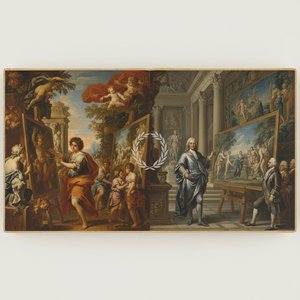
François Louis Joseph Watteau: The Painter of Elegant Leisure
François Louis Joseph Watteau (1731 – 1798), affectionately known as Watteau de Lille, stands as a pivotal figure in the artistic landscape of the Enlightenment era. Born in Valenciennes, France, he ascended to fame primarily through his mastery of fêtes galantes—a genre that captured the fleeting beauty and carefree spirit of aristocratic gatherings—and his exquisitely rendered portraits that imbued their subjects with grace and dignity. His legacy continues to inspire artists today, cementing his place as one of the most celebrated painters of the eighteenth century.
- Early Life & Artistic Training:
- The Rise of Fêtes Galantes:
- Notable Paintings & Artistic Style:
- Influence & Legacy:
Early Life & Artistic Training
Watteau’s formative years were marked by a privileged upbringing within the aristocratic circles of Lille, Belgium. His father, Jean Watteau, was a silk merchant and instilled in François a keen appreciation for craftsmanship and visual aesthetics. Recognizing his son's prodigious talent early on, Jean secured him an apprenticeship with Antoine Goujon, a sculptor renowned for his monumental works at Versailles—a connection that would prove invaluable to Watteau’s artistic development. This mentorship exposed Watteau to the grandeur of
classical sculpture and fostered a foundational understanding of form and technique. He subsequently studied under Nicolas Frémiet, further honing his skills in drawing and
etching, disciplines that would serve as crucial tools throughout his career.
The Rise of Fêtes Galantes
Watteau’s artistic breakthrough occurred during the burgeoning fascination with fêtes galantes—a theatrical genre originating in Paris that celebrated aristocratic leisure and romantic encounters amidst idyllic landscapes. Unlike the formal portraits favored by royal courts, fêtes galantes prioritized atmosphere and emotion, depicting scenes of picnics, promenades, and masked balls populated by elegantly dressed figures engaged in playful pursuits. Watteau skillfully captured the ephemeral beauty of these gatherings, employing delicate brushstrokes and luminous color palettes to convey a sense of carefree joy and sensual delight. He established himself as the undisputed champion of this genre, attracting commissions from wealthy patrons eager to immortalize their social lives on canvas.
Notable Paintings & Artistic Style
Watteau’s oeuvre encompasses an impressive array of paintings—including landscapes, portraits, and mythological scenes—each characterized by a distinctive stylistic approach. His landscapes are imbued with a hazy luminescence reminiscent of Claude Lorrain, reflecting the influence of
Baroque aesthetics while simultaneously embracing Impressionistic techniques. Watteau's masterful use of perspective created illusionistic spaces that transported viewers into fantastical realms. However, it is his portraits that truly captivated audiences—particularly those depicting women—where he achieved an unparalleled level of psychological insight and artistic finesse. He skillfully captured not merely physical likeness but also the inner character of his subjects, conveying their emotions with subtle gestures and expressions. Masterpieces such as “Madame Vigée Le Brun” exemplify Watteau’s ability to transform a simple portrait into a profound meditation on beauty and femininity.
Influence & Legacy
Watteau's impact extended far beyond his own lifetime, profoundly shaping the artistic sensibilities of subsequent generations. His innovative techniques—particularly his
atmospheric perspective and luminous color palettes—inspired painters across Europe, including
Jean-Honoré Fragonard and
François Boucher, who embraced fêtes galantes as their primary expressive medium. Watteau’s aesthetic ideals—characterized by elegance, grace, and a preoccupation with sensual pleasure—became synonymous with the aristocratic culture of the Enlightenment. His paintings continue to resonate with audiences today, serving as enduring symbols of beauty and refinement. Watteau's legacy resides not only in his artistic achievements but also in his pioneering role as a champion of a new artistic vision—one that prioritized emotion and atmosphere alongside meticulous craftsmanship.