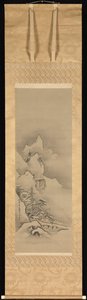
Portrét Kano Tan'Jū

51 nejslavnějších obrazů autora Kano Tan'Jū, každý naprosto unikátní

Aktualizováno listopad 2026 · seřazeno podle našeho skóre popularity (vyhledávání, návštěvy a objednávky u každého díla) · 52 děl umělce Kano Tan'Jū v našem katalogu

Stručně řečeno

Jizō Bosatsu Playing a Flute (601) je obraz autora Kano Tan'Jū, který přitahuje nejvíce pohledů; originál se nachází v Metropolitan Museum of Art, New York. Poté se zrak přesouvá k Connoisseur's Sketchbook by Kano Tan'yū (Tan'yū shukuzu) in Two Volumes a Landscapes of the Four Seasons (1630). Z 52 děl umělce Kano Tan'Jū v našem katalogu je těchto 51 těch nejznámějších; každé z nich je unikátním originálem s uvedením roku vzniku, muzea a důvodu jeho nesmrtelnosti.

1602 – 1674, Kyoto Nejvíce děl: Metropolitan Museum of Art

Top 10 obrazů autora Kano Tan'Jū podle výběru galerie

1
Jizō Bosatsu Playing a Flute (601) od Kano Tan'Jū

Jizō Bosatsu Playing a Flute

601 · Ink · Metropolitan Museum of Art, New York

Introduction to the Artist and Art Movement Kano Tan'yū, born in 1602, was a prominent Japanese painter of the Edo period. He belonged to the prestigious Kanō School art movement, which dominated the Japanese painting scene for over four centuries. The Kanō School style is characterized by its grandeur and monumentality, with an emphasis on bold brushstrokes and vibrant colors. Jizō Bosatsu Playing a Flute: A Rare Depiction One of…

2
Connoisseur's Sketchbook by Kano Tan'yū (Tan'yū shukuzu) in Two Volumes od Kano Tan'Jū

Connoisseur's Sketchbook by Kano Tan'yū (Tan'yū shukuzu) in Two Volumes

Ink · Harvard Art Museums, Cambridge

The Connoisseur's Sketchbook (Tan'yū shukuzu) is presented in two cylindrical volumes. These scrolls are encased in heavy, woven silk or brocade, featuring a deep indigo blue base. The textile surface is decorated with repetitive damask-style motifs, including swirling floral and geometric shapes rendered in metallic gold, bronze, and muted teal. Each volume is secured with a thick, maroon fabric ribbon tied in a knot. White museum identification tags are attached…

3
Landscapes of the Four Seasons (1630) od Kano Tan'Jū

Landscapes of the Four Seasons

1630

The "Landscapes of the Four Seasons" unfolds before us as a pair of six-panel folding screens. This work emerges from the 1630s, a period when the artist Kano Tan'Yū was establishing his presence within the artistic circles of Japan. Born in Kyoto, Japan, in 1602, Kano Tan'Yū brings a specific vision to these panels, one shaped by his high standing as the official painter to the second Tokugawa shogun Hidetada.

4
Birds and Flowers (601) od Kano Tan'Jū

Birds and Flowers

601 · Ink On Paper

Introduction to the Kanō School Style Art Movement The Kanō school style art movement is one of the most famous schools of Japanese painting, with a history that spans from the late 15th century to the Meiji period. The school was founded by Kanō Masanobu and produced a string of major artists over several generations, including Kanō Motonobu, Kanō Eitoku, and Kanō Tan'yu. The Kanō school began by reflecting a…

5
The Sixth Patriarch of Zen at the Moment of Enlightenment (1640) od Kano Tan'Jū

The Sixth Patriarch of Zen at the Moment of Enlightenment

1640 · Ink On Paper · Metropolitan Museum of Art, New York

The artwork titled The Sixth Patriarch of Zen at the Moment of Enlightenment was executed by the artist Kano Tan'Yū. Born in Kyoto, Japan, in 1602, Kano Tan'Yū produced this work in 1635. The painting is a visual representation of a Zen parable concerning Hui-neng, who lived from 638 to 713. As the sixth patriarch of Zen, Hui-neng is the central subject of this composition.

6
Gibbons Reaching for the Moon (1638) od Kano Tan'Jū

Gibbons Reaching for the Moon

1638 · Ink · Clevelandské muzeum umění, Cleveland

A single, slender vine cuts through the vertical space of the silk, a dark line descending from the upper reaches of the frame. Along this vine, a series of long-armed gibbons form a living chain. They cling to the wood, their bodies oriented toward a pale, circular orb at the bottom of the composition. The primates move with a sense of weightlessness, their soft fur rendered in delicate, calligraphic strokes…

7
Sketch for a Painting of Scholars at the Game of Go (1666) od Kano Tan'Jū

Sketch for a Painting of Scholars at the Game of Go

1666 · Ink · Metropolitan Museum of Art, New York

In this vertical composition, Kano Tan'Yū arranges the landscape of Sketch for a Painting of Scholars at the Game of Go to encourage a slow, meditative gaze. The artist employs asymmetrical balance to guide the eye through a sequence of mountains, water, and figures. This arrangement creates a sense of natural movement, leading the viewer from the immediate foreground toward the distant, receding peaks. One figure is positioned near a…

8
“Bluish-Green Fish Scales” (601) od Kano Tan'Jū

“Bluish-Green Fish Scales”

601

Introduction Kano Tan'yu, a pivotal figure in the history of Japanese painting, is best known as the heir to the mantle of the Kano school of painters in the early seventeenth to mid-seventeenth century. His work "Bluish-Green Fish Scales" (Kano Tan'yu: “Bluish-Green Fish Scales”) is a prime example of his masterful ink painting on paper, showcasing the unique texture and beauty of Japanese paper. Artwork Analysis The artwork "Bluish-Green Fish…

9
Sparrow and Bamboo (701) od Kano Tan'Jū

Sparrow and Bamboo

701 · Ink On Paper

This traditional Japanese ink wash painting on paper depicts two sparrows perched upon bamboo branches. The artwork is rendered in a realistic style, utilizing fine details to define the subjects. The birds and the bamboo are executed through varying shades of black ink, which create a sense of texture and depth against a light beige background.

10
Untitled (D2X6YD) (701) od Kano Tan'Jū

Untitled (D2X6YD)

701 · Ink

Untitled (D2X6YD) is a work by the artist Kano Tan'Yū. He emerged from the lineage of the Kanō school, a tradition of brushwork and composition that shaped the visual language of the Edo period. His hand moved with the discipline of a lineage that understood the weight of ink and the silence of empty space.

Slavná díla umělce Kano Tan'Jū, čísla 11 až 51

11The Sixth Patriarch of Zen at the Moment of Enlightenment (1635) od Kano Tan'JūThe Sixth Patriarch of Zen at the Moment of Enlightenment1635 12Landscape with Fisherman (1638) od Kano Tan'JūLandscape with Fisherman1638 13Birds and Flowers (1650) od Kano Tan'JūBirds and Flowers1650 · Metropolitan Museum of Art 14Squirrel on Bamboo (1650) od Kano Tan'JūSquirrel on Bamboo1650 15Squirrel on Bamboo (1650) od Kano Tan'JūSquirrel on Bamboo1650 · Muzeum umění Houston 16Ducks and Reeds (1650) od Kano Tan'JūDucks and Reeds1650 · Metropolitan Museum of Art 17月夜山水図 Landscape in Moonlight (1662) od Kano Tan'Jū月夜山水図 Landscape in Moonlight1662 · Metropolitan Museum of Art 18Untitled (D2X2LQ) (1662) od Kano Tan'JūUntitled (D2X2LQ)1662 · Metropolitan Museum of Art 19Famous Themes for Painting Study Known as “The Garden of Painting” (Gaen) (1670) od Kano Tan'JūFamous Themes for Painting Study Known as “The Garden of Painting” (Gaen)1670 · Metropolitan Museum of Art 20Famous Themes for Painting Study Known as “The Garden of Painting” (Gaen) (1670) od Kano Tan'JūFamous Themes for Painting Study Known as “The Garden of Painting” (Gaen)1670 · Metropolitan Museum of Art 21Dragon in the Clouds (1666) od Kano Tan'JūDragon in the Clouds1666 · Fukuda Art Museum 22Hotei od Kano Tan'JūHoteiMetropolitan Museum of Art 23Sakyamuni Emerging from the Mountain od Kano Tan'JūSakyamuni Emerging from the MountainYale University Art Gallery 24Connoisseur's Sketchbook by Kano Tan'yū (Tan'yū shukuzu), Copies of Buddhist Paintings, Vol. II od Kano Tan'JūConnoisseur's Sketchbook by Kano Tan'yū (Tan'yū shukuzu), Copies of Buddhist Paintings, Vol. IIHarvard Art Museums 25Sketches of the Ten Kings of Hell (Jūō zu) od Kano Tan'JūSketches of the Ten Kings of Hell (Jūō zu)Harvard Art Museums 26Connoisseur's Sketchbook by Kano Tan'yū (Tan'yū shukuzu) od Kano Tan'JūConnoisseur's Sketchbook by Kano Tan'yū (Tan'yū shukuzu)Harvard Art Museums 27Four Sleepers od Kano Tan'JūFour Sleepers 28Fisherman od Kano Tan'JūFishermanMetropolitan Museum of Art 29Sketch for a Painting of Mi Fu Inscribing a Poem on a Rock (1666) od Kano Tan'JūSketch for a Painting of Mi Fu Inscribing a Poem on a Rock1666 · Metropolitan Museum of Art 30Connoisseur's Sketchbook by Kano Tan'yū (Tan'yū shukuzu), Copies of Buddhist Paintings in Two Volumes od Kano Tan'JūConnoisseur's Sketchbook by Kano Tan'yū (Tan'yū shukuzu), Copies of Buddhist Paintings in Two VolumesHarvard Art Museums 31Summer Landscape (1662) od Kano Tan'JūSummer Landscape1662 · Metropolitan Museum of Art 32Portrait of Emperor Shennong (1665) od Kano Tan'JūPortrait of Emperor Shennong1665 · Metropolitan Museum of Art 33Landscape in Moonlight (1662) od Kano Tan'JūLandscape in Moonlight1662 · Metropolitan Museum of Art 34Landscape in Moonlight (1662) od Kano Tan'JūLandscape in Moonlight1662 · Metropolitan Museum of Art 35Phoenixes by Paulownia Trees od Kano Tan'JūPhoenixes by Paulownia Trees 36Bird, Flower and Various Chinese Figure od Kano Tan'JūBird, Flower and Various Chinese FigureYale University Art Gallery 37Cloudy Mountain od Kano Tan'JūCloudy MountainYale University Art Gallery 38Landscape of the Four Seasons (Shiki sansui zu) od Kano Tan'JūLandscape of the Four Seasons (Shiki sansui zu)Harvard Art Museums 39Connoisseur's Sketchbook by Kano Tan'yū (Tan'yū shukuzu) od Kano Tan'JūConnoisseur's Sketchbook by Kano Tan'yū (Tan'yū shukuzu)Harvard Art Museums 40Connoisseur's Sketchbook by Kano Tan'yū (Tan'yū shukuzu) od Kano Tan'JūConnoisseur's Sketchbook by Kano Tan'yū (Tan'yū shukuzu)Harvard Art Museums 41Connoisseur's Sketchbook by Kano Tan'yū (Tan'yū shukuzu) od Kano Tan'JūConnoisseur's Sketchbook by Kano Tan'yū (Tan'yū shukuzu)Harvard Art Museums 42Connoisseur's Sketchbook by Kano Tan'yū (Tan'yū shukuzu), Copies of Buddhist Paintings, Vol. I od Kano Tan'JūConnoisseur's Sketchbook by Kano Tan'yū (Tan'yū shukuzu), Copies of Buddhist Paintings, Vol. IHarvard Art Museums 43Flowering Peonies and Descending Bird od Kano Tan'JūFlowering Peonies and Descending BirdHarvard Art Museums 44Broken-Ink Landscape (Haboku sansui zu) od Kano Tan'JūBroken-Ink Landscape (Haboku sansui zu)Harvard Art Museums 45Connoisseur's Sketchbook by Kano Tan'yū (Tan'yū shukuzu) od Kano Tan'JūConnoisseur's Sketchbook by Kano Tan'yū (Tan'yū shukuzu)Harvard Art Museums 46Tan’yu shukuzu (Sketches by Tan'yu) od Kano Tan'JūTan’yu shukuzu (Sketches by Tan'yu)Harvard Art Museums 47Landscapes of the Four Seasons od Kano Tan'JūLandscapes of the Four Seasons 48Sparrow and Bamboo od Kano Tan'JūSparrow and BambooMetropolitan Museum of Art 49笛吹地蔵図 Jizō Bosatsu Playing a Flute od Kano Tan'Jū笛吹地蔵図 Jizō Bosatsu Playing a Flute 50Shennong (Jiu Nō), Legendary Emperor of China od Kano Tan'JūShennong (Jiu Nō), Legendary Emperor of China 51Mount Fuji od Kano Tan'JūMount FujiShizuoka Prefectural Museum of Art

Motivy, které zaujaly Kano Tan'Jū

Čtyři témata, která se v těchto originálech nejčastěji objevují, z nichž každé má svůj nejlepší příklad.

Muzea, v nichž jsou vystavena originálna umělce Kano Tan'Jū

7 muzea, v nichž je umístěno nejvíce obrazů z této stránky.

Muzeum Město Díla autora Kano Tan'Jū Obrazy z tohoto seznamu
Metropolitan Museum of Art, New YorkMetropolitan Museum of Art New York 17 Jizō Bosatsu Playing a Flute, The Sixth Patriarch of Zen at the Moment of Enlightenment, Sketch for a Painting of Scholars at the Game of Go
Harvard Art Museums, CambridgeHarvard Art Museums Cambridge 14 Connoisseur's Sketchbook by Kano Tan'yū (Tan'yū shukuzu) in Two Volumes, Connoisseur's Sketchbook by Kano Tan'yū (Tan'yū shukuzu), Copies of Buddhist Paintings, Vol. II, Sketches of the Ten Kings of Hell (Jūō zu)
Yale University Art Gallery, New HavenYale University Art Gallery New Haven 3 Sakyamuni Emerging from the Mountain, Bird, Flower and Various Chinese Figure, Cloudy Mountain
Clevelandské muzeum umění, ClevelandClevelandské muzeum umění Cleveland 1 Gibbons Reaching for the Moon
Muzeum umění Houston, HoustonMuzeum umění Houston Houston 1 Squirrel on Bamboo
Fukuda Art Museum, KyotoFukuda Art Museum Kyoto 1 Dragon in the Clouds
Shizuoka Prefectural Museum of Art, ShizuokaShizuoka Prefectural Museum of Art Shizuoka 1 Mount Fuji

Kano Tan'Jū napříč desetiletími: jeden unikátní originál pro každou dekádu

Díla podle dekád

Vyberte si dekádu a prohlédněte si originál, který ji definuje.

Obrazy umělce Kano Tan'Jū: dotazy pro galerii

Kterým nejznámějším dílem je Kano Tan'Jū?Odhalit odpověď

Jizō Bosatsu Playing a Flute (601), Metropolitan Museum of Art, New York. Následují Connoisseur's Sketchbook by Kano Tan'yū (Tan'yū shukuzu) in Two Volumes a Landscapes of the Four Seasons (1630).

Kterých deset obrazů autora Kano Tan'Jū je nejznámějších?Odhalit odpověď

Jizō Bosatsu Playing a Flute, Connoisseur's Sketchbook by Kano Tan'yū (Tan'yū shukuzu) in Two Volumes, Landscapes of the Four Seasons, Birds and Flowers, The Sixth Patriarch of Zen at the Moment of Enlightenment, Gibbons Reaching for the Moon, Sketch for a Painting of Scholars at the Game of Go, “Bluish-Green Fish Scales”, Sparrow and Bamboo a Untitled (D2X6YD). Hodnocení výše uvádí rok a muzeum pro každé z nich.

Kolik známých děl má autor Kano Tan'Jū?Odhalit odpověď

Náš katalog obsahuje 52 děl umělce Kano Tan'Jū z let 1630 až 1670.

Kde lze vidět nejznámější originály umělce Kano Tan'Jū?Odhalit odpověď

Většinou v Metropolitan Museum of Art (New York), Harvard Art Museums (Cambridge) a Yale University Art Gallery (New Haven). V tabulce muzeí výše jsou vypsány všechny.

V jakém období vytvořil(a) Kano Tan'Jū svá nejznámější obrazy?Odhalit odpověď

V období 1660s: 9 z celkem 51 děl na této stránce vzniklo právě tehdy, z toho Sketch for a Painting of Scholars at the Game of Go z nich.

Který slavný obraz od Kano Tan'Jū je nejstarší a který nejnovější?Odhalit odpověď

Na této stránce je nejstarší dílo z Landscapes of the Four Seasons (1630) a nejnovější z Famous Themes for Painting Study Known as “The Garden of Painting” (Gaen) (1670).

Jakým tématům se Kano Tan'Jū věnoval/a nejčastěji?Odhalit odpověď

Birds (6), Person (5) a Branches (5) napříč 51 díly na této stránce.

Jaké materiály používal(a) Kano Tan'Jū nejčastěji?Odhalit odpověď

Ink, u 9 z 51 děl na této stránce.

Jaká originální díla Kano Tan'Jū mohu vidět v Metropolitan Museum of Art?Odhalit odpověď

Jizō Bosatsu Playing a Flute, The Sixth Patriarch of Zen at the Moment of Enlightenment a Sketch for a Painting of Scholars at the Game of Go: muzeum Metropolitan Museum of Art, New York má v obsluze 17 děl z této stránky.

Kano Tan'Jū: portrét umělce

Early Life and Lineage

Kanō Tan’yū, born in Kyoto in 1602, emerged from a lineage steeped in the traditions of the Kanō school—the most influential force in Japanese painting for centuries. His father, Kano Takanobu, was a prominent artist within this established system, and Tan’yū inherited not only his artistic skill but also a profound understanding of the aesthetic principles that had defined generations of painters. The Kanō school, originating with Kanō Masanobu in the 15th century, blended elements of Zen Buddhism, Chinese landscape painting, and classical Japanese styles. Tan'yū’s early training would have been rigorous, focusing on meticulous brushwork, an understanding of compositional balance, and a deep respect for historical precedents. However, he wasn’t simply destined to replicate the past; his career would be marked by a unique synthesis of tradition and innovation.

The Kajibashi Style and Shogunate Patronage

At the remarkably young age of seventeen, Tan’yū received an appointment as painter to the Tokugawa shogunate. This pivotal moment dramatically altered the course of his artistic development. He was granted an estate in Edo (modern-day Tokyo) called Kajibashi, and it became synonymous with a distinct branch of the Kanō school—the Kajibashi-Kano style. This patronage wasn’t merely financial; it came with the responsibility of establishing a new visual language that reflected the power and authority of the shogunate. Tan'yū responded by deliberately returning to earlier, more restrained forms of Kanō painting, eschewing some of the flamboyant excesses that had crept into the style during the late 16th century. He favored historical subjects—particularly those embodying Confucian ethical precepts—and landscapes imbued with a sense of solemn dignity.

Large-Scale Commissions and Architectural Decoration

Tan’yū's influence extended far beyond individual paintings; he became renowned for his large-scale decorative projects within the castles and palaces of the Tokugawa regime. He left an indelible mark on Nijō Castle in Kyoto, decorating its walls with scenes that celebrated the shogunate’s authority and legitimacy. Similar commissions followed at Nagoya Castle and the Kyoto Imperial Palace. These weren't isolated artistic endeavors; they were integral to the political messaging of the era. The paintings served as powerful visual statements, reinforcing the shogun’s position and projecting an image of stability and cultural refinement. His approach involved not only his own hand but also that of a growing workshop—a testament to the scale of these undertakings and his role as a master organizer.

Themes and Techniques: A Synthesis of Tradition

Tan'yū’s paintings are characterized by a remarkable balance between technical virtuosity and philosophical depth. He excelled in both monochrome ink wash painting (sumi-e) and colorful, detailed compositions. His subject matter often revolved around historical figures—Confucius and his disciples being particularly favored—and scenes from nature, such as landscapes populated with tigers, birds, and bamboo. The tiger motif, for example, wasn’t simply a display of artistic skill; it symbolized courage, strength, and protection—qualities highly valued by the warrior class. His technique involved meticulous brushwork, subtle gradations of tone, and a masterful use of negative space. He was also known for his numerous sketches of flora and fauna, demonstrating an acute observational ability that informed his larger compositions. His style is often described as conservative, but this conservatism wasn’t stagnation; it was a deliberate effort to revive the core principles of the Kanō school while adapting them to the needs of his time.

Legacy and Historical Significance

Kanō Tan’yū died in Edo in 1674, leaving behind a legacy that profoundly shaped Japanese painting for generations. He established the dominant style of Edo-period art, laying the foundation for a vast organization of official shogunate painters. His emphasis on historical subjects and Confucian values resonated with the ruling class, solidifying his position as a cultural icon. While later artists would explore new avenues of expression, Tan’yū's influence remained pervasive. He is remembered not only as a skilled painter but also as a master collector, a shrewd administrator, and a pivotal figure in the development of Japanese art history. His work continues to be admired for its technical brilliance, philosophical depth, and enduring aesthetic appeal.