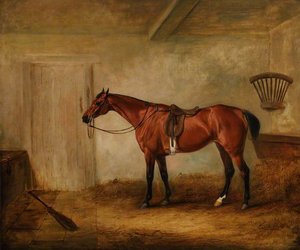
Portrét John Ferneley, Snr

38 nejslavnějších obrazů autora John Ferneley, Snr, každý naprosto unikátní

Aktualizováno listopad 2026 · seřazeno podle našeho skóre popularity (vyhledávání, návštěvy a objednávky u každého díla) · 48 děl umělce John Ferneley, Snr v našem katalogu

Stručně řečeno

Hunt Scurry (1832) je obraz autora John Ferneley, Snr, který přitahuje nejvíce pohledů. Poté se zrak přesouvá k Two Racehorses, Called 'Sambo' and 'Pilot' (1830) a Chestnut Racehorses Called 'Rufus' and 'Leporello' (1830). Z 48 děl umělce John Ferneley, Snr v našem katalogu je těchto 38 těch nejznámějších; každé z nich je unikátním originálem s uvedením roku vzniku, muzea a důvodu jeho nesmrtelnosti.

1814 – 1862, Thrussington Contemporary realism Nejvíce děl: National Trust

Top 10 obrazů autora John Ferneley, Snr podle výběru galerie

1
Hunt Scurry (1832) od John Ferneley, Snr

Hunt Scurry

1832 · Oil

The scene unfolds in Hunt Scurry, a work by the British artist John Ferneley, Snr. Painted about 1832, this piece captures a moment of intense pursuit across the English countryside. The air feels heavy with the anticipation of the chase as horses and hounds move through the landscape. It is a window into the traditional English sport of hunting, a pastime that defines the rhythm of rural life in this…

2
Two Racehorses, Called 'Sambo' and 'Pilot' (1830) od John Ferneley, Snr

Two Racehorses, Called 'Sambo' and 'Pilot'

1830 · Oil On Canvas · National Trust, Guildford

In this 1830 oil on canvas, we find ourselves in a quiet, pastoral moment that feels almost suspended in time. Two racehorses, Sambo and Pilot, occupy the center of the composition, their muscular forms rendered with a profound sense of weight and reality. They are not merely subjects of a portrait; they possess a physical gravity that commands the space they inhabit. One horse stands slightly behind the other, creating…

3
Chestnut Racehorses Called 'Rufus' and 'Leporello' (1830) od John Ferneley, Snr

Chestnut Racehorses Called 'Rufus' and 'Leporello'

1830 · Oil · National Trust, Guildford

Chestnut Racehorses Called 'Rufus' and 'Leporello' is an oil painting by the English artist John Ferneley, Snr. Executed about 1830, the work belongs to a period when the artist established himself as a specialist in portraying sporting horses and hunting scenes. His technical focus centered on the anatomical precision of equine subjects and the specificities of rural pursuits.

4
A Chestnut Racehorse Called 'Undine' (1831) od John Ferneley, Snr

A Chestnut Racehorse Called 'Undine'

1831 · Oil · National Trust, Guildford

A Chestnut Racehorse Called 'Undine' is a portrait by the English painter John Ferneley, Snr. Created about 1831, the work captures a specific equine subject within a quiet, indoor setting. The canvas focuses on the singular presence of the horse, rendered with the precision of a man who understood the anatomy of the stable and the field.

5
Two Racehorses, Called 'Cock Robin' and 'Langar' (1834) od John Ferneley, Snr

Two Racehorses, Called 'Cock Robin' and 'Langar'

1834 · Oil · National Trust, Guildford

The scene unfolds through the brushstrokes of Two Racehorses, Called 'Cock Robin' and 'Langar', a work that captures a quiet moment of equine connection. This painting is the creation of John Ferneley, Snr, a man whose hand brings the spirit of the English countryside to life. He renders the animals with a precision that makes their presence feel immediate and real. One can almost sense the stillness of the air…

6
Two Racehorses, Called 'The Sheriff' and 'Bensh' (1835) od John Ferneley, Snr

Two Racehorses, Called 'The Sheriff' and 'Bensh'

1835 · Oil · National Trust, Guildford

In this 1835 composition, we find ourselves in a quiet pastoral landscape where the energy of the animal kingdom takes center stage. The scene is anchored by two horses, each possessing a distinct character and presence. To the left, a bay horse moves with a sense of purpose, its white blaze catching the light as it gallops toward the viewer. Its white sock on the right hind leg provides a…

7
A Dandie Dinmont Terrier (1848) od John Ferneley, Snr

A Dandie Dinmont Terrier

1848 · Oil · Yale Center for British Art, New Haven

A Dandie Dinmont Terrier emerges from the canvas, a singular presence captured by the hand of John Ferneley, Snr. This oil painting, dating from about 1848, finds the subject in a moment of quiet alertness. The artist, born in 1814, brings a meticulous eye to the textures of the natural world, focusing his attention on the specific character of this canine. Every stroke of the brush works to define the…

8
Playmate (1847) od John Ferneley, Snr

Playmate

1847 · Oil

In this 1847 work, we find ourselves drawn into a secluded woodland setting where a single dog occupies the center of our attention. The animal is captured in a moment of heightened alertness, its head lifted and eyes scanning the surrounding trees. There is a palpable sense of curiosity in its posture, as if it has just caught a scent or a distant sound amidst the stillness of the forest.…

9
A Bay Hunter (1848) od John Ferneley, Snr

A Bay Hunter

1848 · Oil · National Trust, Guildford

In this 1848 oil painting, A Bay Hunter emerges from the shadows of a doorway. The work is by the English painter John Ferneley, Snr, a man whose brush captured the quiet, heavy moments of equestrian life. Here, the focus rests entirely on a single brown horse. It stands still, its presence filling the space with a sense of patient waiting. The animal wears saddles upon its back, suggesting a…

10
A Bay Racehorse Called 'Nightmare' (1850) od John Ferneley, Snr

A Bay Racehorse Called 'Nightmare'

1850 · Oil On Canvas · National Trust, Guildford

A Bay Racehorse Called 'Nightmare' is an oil painting by John Ferneley, Snr. Created about 1850, the work belongs to the mid-Victorian period of British sporting art. The artist, born in 1814, was a specialist in portraying equestrian subjects and hunting scenes.

Slavná díla umělce John Ferneley, Snr, čísla 11 až 38

11Troop Sergeant Major, the 7th (Princess Royal's) Dragoon Guards (1857) od John Ferneley, SnrTroop Sergeant Major, the 7th (Princess Royal's) Dragoon Guards1857 · York Army Museum 12Lieutenant Colonel Arthur Bentinck, the 7th (Princess Royal's) Dragoon Guards (1857) od John Ferneley, SnrLieutenant Colonel Arthur Bentinck, the 7th (Princess Royal's) Dragoon Guards1857 · York Army Museum 13Lieutenant Colonel Arthur Bentinck, Commanding the 7th (Princess Royal's) Dragoon Guards (1854–1857) (1857) od John Ferneley, SnrLieutenant Colonel Arthur Bentinck, Commanding the 7th (Princess Royal's) Dragoon Guards (1854–1857)1857 · York Army Museum 14Heaton Park Races od John Ferneley, SnrHeaton Park RacesNational Gallery of Art 15Mr. C. N. Hogg's Claxton and a Groom in a Stable od John Ferneley, SnrMr. C. N. Hogg's Claxton and a Groom in a Stable 16The Marriott Family od John Ferneley, SnrThe Marriott Family 17A Saddled Bay Hunter In A Stableyard od John Ferneley, SnrA Saddled Bay Hunter In A Stableyard 18Mr George Marriott On His Bay Hunter Taking A Fence od John Ferneley, SnrMr George Marriott On His Bay Hunter Taking A Fence 19Portrait of a chestnut hunter in a stable, with a groom and terrier od John Ferneley, SnrPortrait of a chestnut hunter in a stable, with a groom and terrier 20The Bays, Manchester (1843) od John Ferneley, SnrThe Bays, Manchester1843 21The 4th Royal Irish Dragoon Guards (1848) od John Ferneley, SnrThe 4th Royal Irish Dragoon Guards1848 · York Army Museum 22kingfisher and the lad od John Ferneley, Snrkingfisher and the lad 23portrait of the racehorse harkaway od John Ferneley, Snrportrait of the racehorse harkaway 24of champions od John Ferneley, Snrof champions 25A Portrait of the Racehorse Harkaway, the Winner of the 1838 Goodwood Cup od John Ferneley, SnrA Portrait of the Racehorse Harkaway, the Winner of the 1838 Goodwood Cup 26Hunter In Wooded Landscape od John Ferneley, SnrHunter In Wooded Landscape 27Emlius, Winter of the 1832 Derby, held by a Groom at Doncaster od John Ferneley, SnrEmlius, Winter of the 1832 Derby, held by a Groom at Doncaster 28The Rossendale Hunt od John Ferneley, SnrThe Rossendale Hunt 29Cecil, a favorite Hunter of the Earl of Jersey in a Landscape od John Ferneley, SnrCecil, a favorite Hunter of the Earl of Jersey in a Landscape 30Henry Combe Compton (1789 1855) leading a bay hunter, with hounds od John Ferneley, SnrHenry Combe Compton (1789 1855) leading a bay hunter, with hounds 31Henry Combe Compton (1789 1855) mounted on bay hunter, with hounds od John Ferneley, SnrHenry Combe Compton (1789 1855) mounted on bay hunter, with hounds 32Sir John Thorold's Bay Hunters With Their Groom In A Stable od John Ferneley, SnrSir John Thorold's Bay Hunters With Their Groom In A Stable 33Lady Thorold's Hunter and Shetland Pony with Groom od John Ferneley, SnrLady Thorold's Hunter and Shetland Pony with Groom 34Portrait of Sir Henry Goodricke, 7th Baronet, clearing a fence on his grey hunter od John Ferneley, SnrPortrait of Sir Henry Goodricke, 7th Baronet, clearing a fence on his grey hunter 35The Marquess of Huntly's Fleabitten Grey Hunter od John Ferneley, SnrThe Marquess of Huntly's Fleabitten Grey Hunter 36The Marquis of Cleveland's Chorister , winner of the 1831 St. Leger, held by his trainer John Smith, with jockey John Bartham Day, at Doncaster od John Ferneley, SnrThe Marquis of Cleveland's Chorister , winner of the 1831 St. Leger, held by his trainer John Smith, with jockey John Bartham Day, at Doncaster 37Lord Lonsdale's Fleabitten Grey Hunter, Brass , at Cottesmore with the Cottesmore Hounds od John Ferneley, SnrLord Lonsdale's Fleabitten Grey Hunter, Brass , at Cottesmore with the Cottesmore Hounds 38Portrait of Sir William Mordaunt Sturt Milner, 4th Bt. (1779 1855) with two Clumber spaniels out shooting od John Ferneley, SnrPortrait of Sir William Mordaunt Sturt Milner, 4th Bt. (1779 1855) with two Clumber spaniels out shooting

Slavná díla John Ferneley, Snr podle jednotlivých období

Motivy, které zaujaly John Ferneley, Snr

Čtyři témata, která se v těchto originálech nejčastěji objevují, z nichž každé má svůj nejlepší příklad.

Muzea, v nichž jsou vystavena originálna umělce John Ferneley, Snr

4 muzea, v nichž je umístěno nejvíce obrazů z této stránky.

Muzeum Město Díla autora John Ferneley, Snr Obrazy z tohoto seznamu
National Trust, GuildfordNational Trust Guildford 7 Two Racehorses, Called 'Sambo' and 'Pilot', Chestnut Racehorses Called 'Rufus' and 'Leporello', A Chestnut Racehorse Called 'Undine'
York Army Museum, YorkYork Army Museum York 4 Troop Sergeant Major, the 7th (Princess Royal's) Dragoon Guards, Lieutenant Colonel Arthur Bentinck, the 7th (Princess Royal's) Dragoon Guards, Lieutenant Colonel Arthur Bentinck, Commanding the 7th (Princess Royal's) Dragoon Guards (1854–1857)
Yale Center for British Art, New HavenYale Center for British Art New Haven 1 A Dandie Dinmont Terrier
National Gallery of Art, WashingtonNational Gallery of Art Washington 1 Heaton Park Races

John Ferneley, Snr napříč desetiletími: jeden unikátní originál pro každou dekádu

Díla podle dekád

Vyberte si dekádu a prohlédněte si originál, který ji definuje.

Obrazy umělce John Ferneley, Snr: dotazy pro galerii

Kterým nejznámějším dílem je John Ferneley, Snr?Odhalit odpověď

Hunt Scurry (1832). Následují Two Racehorses, Called 'Sambo' and 'Pilot' (1830) a Chestnut Racehorses Called 'Rufus' and 'Leporello' (1830).

V jakém věku vytvořil(a) John Ferneley, Snr dílo Hunt Scurry?Odhalit odpověď

18 let: dílo Hunt Scurry pochází z roku 1832 a John Ferneley, Snr se narodil/a v roce 1814.

Kterých deset obrazů autora John Ferneley, Snr je nejznámějších?Odhalit odpověď

Hunt Scurry, Two Racehorses, Called 'Sambo' and 'Pilot', Chestnut Racehorses Called 'Rufus' and 'Leporello', A Chestnut Racehorse Called 'Undine', Two Racehorses, Called 'Cock Robin' and 'Langar', Two Racehorses, Called 'The Sheriff' and 'Bensh', A Dandie Dinmont Terrier, Playmate, A Bay Hunter a A Bay Racehorse Called 'Nightmare'. Hodnocení výše uvádí rok a muzeum pro každé z nich.

Kolik známých děl má autor John Ferneley, Snr?Odhalit odpověď

Náš katalog obsahuje 48 děl umělce John Ferneley, Snr z let 1830 až 1857.

Kde lze vidět nejznámější originály umělce John Ferneley, Snr?Odhalit odpověď

Většinou v National Trust (Guildford), York Army Museum (York) a Yale Center for British Art (New Haven). V tabulce muzeí výše jsou vypsány všechny.

V jakém období vytvořil(a) John Ferneley, Snr svá nejznámější obrazy?Odhalit odpověď

V období 1830s: 6 z celkem 38 děl na této stránce vzniklo právě tehdy, z toho Hunt Scurry z nich.

Který slavný obraz od John Ferneley, Snr je nejstarší a který nejnovější?Odhalit odpověď

Na této stránce je nejstarší dílo z Two Racehorses, Called 'Sambo' and 'Pilot' (1830) a nejnovější z Troop Sergeant Major, the 7th (Princess Royal's) Dragoon Guards (1857).

Jakým tématům se John Ferneley, Snr věnoval/a nejčastěji?Odhalit odpověď

Horse (9), Landscape (8) a Sky (4) napříč 38 díly na této stránce.

Jaké materiály používal(a) John Ferneley, Snr nejčastěji?Odhalit odpověď

Oil, u 8 z 38 děl na této stránce.

K kterému směru patří dílo umělce John Ferneley, Snr?Odhalit odpověď

Contemporary realism a Realism, podle originálů na této stránce.

Jaká originální díla John Ferneley, Snr mohu vidět v National Trust?Odhalit odpověď

Two Racehorses, Called 'Sambo' and 'Pilot', Chestnut Racehorses Called 'Rufus' and 'Leporello' a A Chestnut Racehorse Called 'Undine': muzeum National Trust, Guildford má v obsluze 7 děl z této stránky.

John Ferneley, Snr: portrét umělce

John Ferneley, Snr (1814-1862): Malíř lovnicko-aristokratické elegance

John Ferneley, Snr (1814-1862) představuje klíčovou postavu britského sportovního malířství, která v sobě ztělesňuje romantického ducha viktoriánské éry a s neporovnatelnou přesností zachycuje velkolepčnost venkovských aktivit. Jeho umělecká cesta, která se začala odvíjet v Thrussingtonu v Leicestershire, byla formována na pozadí rostoucí fascinace jezdáckou portrétní fotografií a precizně vykreslenými loveckými scénami – vášní, která definovala celé jeho dílo. Předčasný úmrtí v Melton Mowbray v roce 1860 tragicky přerušilo jeho plodnou kariéru, přestože jeho odkaz trvá jako jeden z nejslavnějších dokumentů aristokratických tradic jeho doby.

Formativní roky Ferneleyho byly poznamenány privilegovaným upbringingem v rodině hluboce zasazené do zemědělského podnikání a uměleckého vnímání. Jeho vzdělání se zaměřovalo především na kresbu a malbu, pod vedením otce, který v Johnovi brzy rozpoznal vrozený talent. Tato základní výchova mu vtisla precizní pozornost k detailu – vlastnost, která se stala synonymem pro jeho nezaměnitelný styl.

Nárůst sportovní malby a Ferneleyův nezaměnitelný styl

Středina 19. století svědectila o neuvěřitelném rozmachu zájmu o jeździecké sporty a aristokratické volnočasové aktivity, což podnucovalo rostoucí poptávku po uměleckých ztvárněních těchto témat. Ferneley tento trend mistrovsky využil a vybudoval si postavení jednoho z předních představitelů sportovní malby – žánru charakterizovaného dramatickými kompozicemi a virtuózním vykreslením koní a jezdců v dynamických pózách. Na rozdíl od mnoha tehdejších současníků, kteří upřednostňovali idealizované portréty, Ferneley kladl důraz na anatomickou přesnost a texturální realismus, když s nesmírnou pečlivostí zrekonstruoval svalstvo koní a zachytil jemné nuance světla a stínu na jejich srsti. Jeho plátna pulzovala životem a nesla nejen vizuální informaci, ale i emocionální rezonanci, která odrážela samotný vzrušující zážitek z lovu.

Ferneleyova reputace vyletěla vzhůru, jak získával zakázky od významných rodin po celém Anglicku – včetně hrabatů z Derby a Northumberland – kteří si přáli uctít své statky a lovecké výpravy. Mezi jeho nejslavnější díla patří „Lov v Ascadale“, zachycující úchvatnou scénu psích honičů pronásledujících jel v náročném terénu skotských vysočin, a „Portrét koně“, představující nádherně vykreslený zvěřecí subjekt zahalený do měkkého odpoledního světla. Tyto obrazy jsou dokonalým příkladem Ferneleyovy technické zdatnosti a umělecké vize, které demonstrují jeho schopnost proměnit pouhé pozorování v hluboce působící umění.

Technika a vlivy

Ferneley vycházel ze svých technických kořenů hluboko v tradicích starých mistrů, zejména pak ve díle Rembrandta a Rubensa. Využíval metodu vrstveného glazování – nanášení tenkých barevných lazur přes mnoho následných vrstev – čímž dosahoval světelné gradace tónů a bezprecedentní hloubky textury. Tento pracný proces vyžadoval značalou trpělivost i precizní dovednost, avšak přinášel výsledky, které okouzlovaly diváky svým dechberoucím realismem. Umělecká citlivost Ferneley byla dále formována jeho spojením s romantickým směrem, který vedle pečlivé pozorování prosazoval emoce a představivost – tuto dualitu lze vidět v jeho portrétech koní i lidských postav.
  • Odkaz a historický význam:
  • Přínos Johna Ferneley, Snr pro britské umění je nepopourčitelný. Jeho obrazy slouží jako cenné dokumenty viktoriánského společenského života, které zachycují rituály a tradice spojené s aristokratickou lovenou činností – koníčkem, který měl za jeho života nesmírný vliv. Je však důležitější, že Ferneleyova neochvějná oddanost anatomické přesnosti a texturálnímu realismu ho ugruntovala jako průkopníka v žánru sportovní malby, čímž inspiroval celé generace následných umělců. Jeho díla jsou i nadále obdivována pro svou krásu a technickou brilanci, což mu zajistilo místo mezi nejtrvalejšími postavami v dějinách britského umění.

Další poznatky k prozkoumávání

Pro ty, kteří si přejí do života a díla umělce Ferneley vstoupit ještě hlouběji, nabízejí odborné zdroje například tyto publikace:

• „John Ferneley Snr“ od Davida Passmore (Philip Wilson Press, 1987)
• „British Sporting Art: The Rise of Animal Painting in Britain“ pod vedením Richarda Woodcocka (Victoria & Albert Museum Publishing, 2003)