Portrét Jenny Holzer

15 nejslavnějších obrazů autora Jenny Holzer, výběr z galerie

Aktualizováno listopad 2026 · seřazeno podle našeho skóre popularity (vyhledávání, návštěvy a objednávky u každého díla) · 16 děl umělce Jenny Holzer v našem katalogu

Stručně řečeno

Z všech originálů, které Jenny Holzer zanechal, je nejslavnější Survival Series: Men don’t protect… (1989), který se nachází ve sbírce Guggenheimovo muzeum Bilbao, Bilbao. Hned za ním následují Hm paris a Electric Sign from the series Under the Rock (1986). Náš katalog obsahuje 16 děl umělce Jenny Holzer; galerie si zachovala 15 děl, která obdivuje celý svět, přičemž každé je znázorněno s datem vzniku, názevem muzea a jeho příběhem.

narozen 1950, Gallipolis Neo-conceptualism Nejvíce děl: Guggenheimovo muzeum Bilbao

10 nejlepších obrazů umělce Jenny Holzer: výběr galerie

1
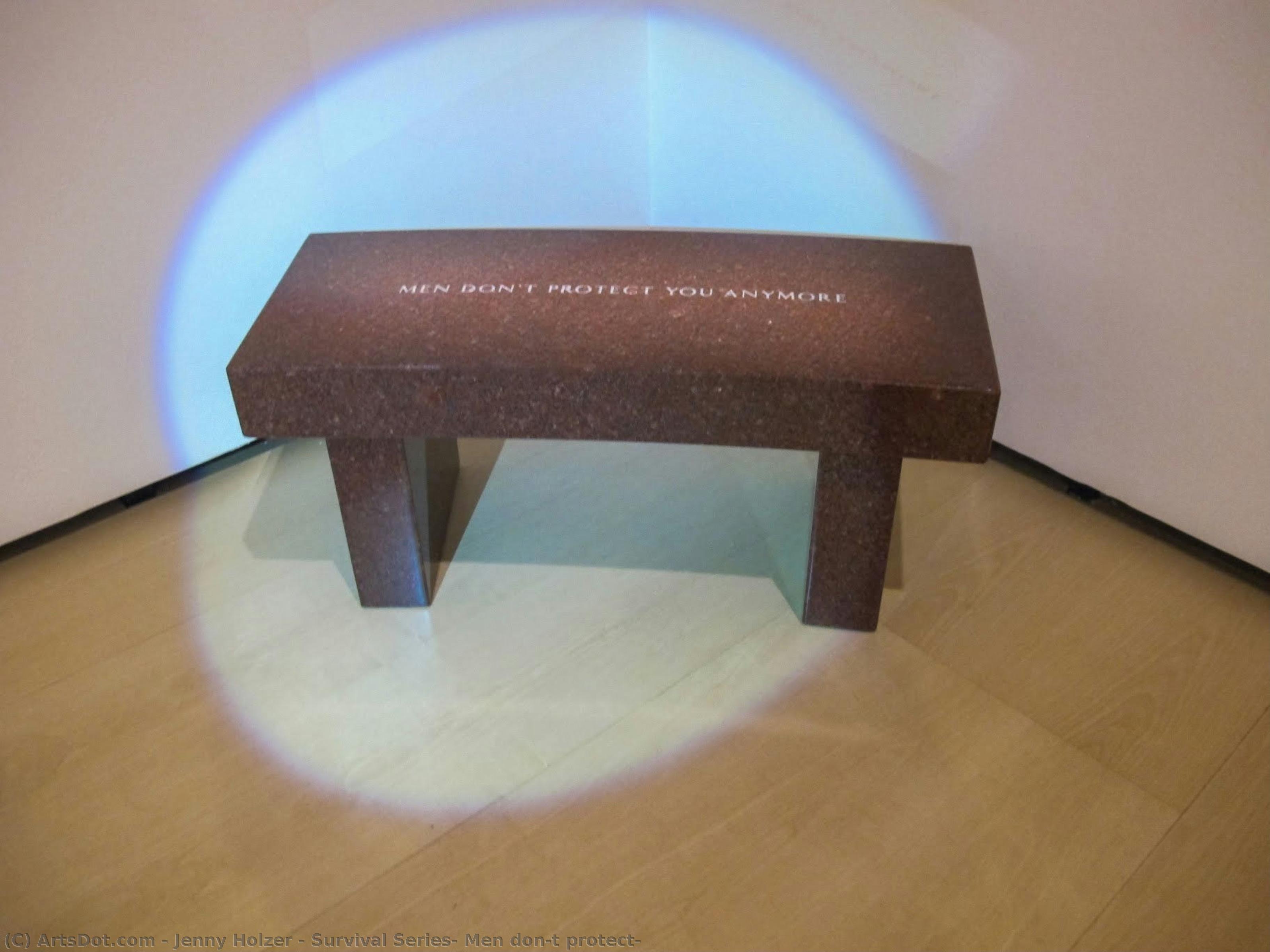
Survival Series: Men don’t protect… (1989) od Jenny Holzer

Survival Series: Men don’t protect…

1989 · Mixed Media · Guggenheimovo muzeum Bilbao, Bilbao

Jenny Holzer’s work possesses an undeniable immediacy, transforming mundane architectural elements into potent canvases for philosophical discourse. This piece, Survival Series: Men don’t protect…, is a striking meditation rendered upon the cool, enduring surface of granite. It captures the ephemeral nature of spoken promises against the permanence of stone. The very act of inscribing words—a declaration, a warning, a lament—onto such a solid material creates an inherent tension that defines…

2
Hm paris od Jenny Holzer

Hm paris

Photography

In this work, titled Hm paris, we encounter the precise, language-driven approach of Jenny Holzer. The piece engages with the way text occupies space, moving beyond the traditional boundaries of the canvas to interact with the architecture of the environment. It is a quiet but firm intervention into the visual landscape, utilizing the medium of digital display to present fragmented, abstract text along a minimalist handrail.

3
Electric Sign from the series Under the Rock (1986) od Jenny Holzer

Electric Sign from the series Under the Rock

1986 · Other-None · MoMA - Museum of Modern Art, New York

Jenny Holzer's "Electric Sign from the series Under the Rock," a deceptively simple neon installation, isn’t merely a display of light and text; it’s a carefully constructed interrogation of language, power, and the very fabric of public discourse. Created in 1986, this piece embodies the core tenets of Holzer's neo-conceptualist practice – a deliberate blurring of art and life, where words become visual statements demanding immediate engagement. The work’s starkness—a…

4
Living Series: It can be startling to see someone’s breath… (1989) od Jenny Holzer

Living Series: It can be startling to see someone’s breath…

1989 · Stone · Guggenheimovo muzeum Bilbao, Bilbao

In the realm of contemporary neo-conceptualism, few voices resonate with as much profound authority as Jenny Holzer. Her work, particularly within the Living Series, transcends the boundaries of traditional sculpture to become an immersive experience that bridges the gap between public discourse and private reflection. The piece titled "It can be startling to see someone’s breath…" is not merely an object of contemplation but a physical manifestation of thought itself.…

5
Arno Pair (2010) od Jenny Holzer

Arno Pair

2010 · Acrylic On Canvas · Guggenheimovo muzeum Bilbao, Bilbao

Jenny Holzer’s “Arno Pair,” created in 2010, is more than just a visually striking artwork; it’s an invitation to contemplate the enduring power of language and its poignant resonance within public space. Donated to the Collection, this piece serves as a powerful complement to her earlier installation, "Installation for Bilbao," demonstrating Holzer's consistent exploration of themes surrounding communication, loss, and the shifting boundaries between private experience and collective consciousness. The…

6
Survival Series: Let your hand wander… (1989) od Jenny Holzer

Survival Series: Let your hand wander…

Jenny Holzer’s “Survival Series,” particularly exemplified by works like the iconic red granite bench, isn’t merely a piece of public art; it’s an invitation to a profound dialogue with ourselves and the world around us. Beginning in 1983, this series represents a pivotal moment in Holzer's career – a shift away from ephemeral street posters towards a more enduring, tactile engagement with the viewer. The core concept is deceptively simple:…

Výběr umělce Jenny Holzer pokračuje, od 11 do 15

Motivy, které zaujaly Jenny Holzer

Čtyři témata, která se v těchto originálech nejčastěji objevují, z nichž každé má svůj nejlepší příklad.

Muzea, v nichž jsou vystavena originálna umělce Jenny Holzer

2 muzea, v nichž je umístěno nejvíce obrazů z této stránky.

Muzeum Město Díla autora Jenny Holzer Obrazy z tohoto seznamu
Guggenheimovo muzeum Bilbao, BilbaoGuggenheimovo muzeum Bilbao Bilbao 4 Survival Series: Men don’t protect…, Living Series: It can be startling to see someone’s breath…, Arno Pair
MoMA - Museum of Modern Art, New YorkMoMA - Museum of Modern Art New York 1 Electric Sign from the series Under the Rock

Jenny Holzer dekáda po dekádě: originální díla, která definují každou z nich

Díla podle dekád

Vyberte si dekádu a prohlédněte si originál, který ji definuje.

Otázky sběratelů o obrazech umělce Jenny Holzer

Kterým dílem je Jenny Holzer nejznámější?Odhalit odpověď

Survival Series: Men don’t protect… (1989), Guggenheimovo muzeum Bilbao, Bilbao. Následují Hm paris a Electric Sign from the series Under the Rock (1986).

Kolik let bylo Jenny Holzer, když bylo vytvořeno dílo Survival Series: Men don’t protect…?Odhalit odpověď

39 let: dílo Survival Series: Men don’t protect… pochází z roku 1989 a Jenny Holzer se narodil/a v roce 1950.

Kterých deset nejslavnějších obrazů má Jenny Holzer?Odhalit odpověď

Survival Series: Men don’t protect…, Hm paris, Electric Sign from the series Under the Rock, Living Series: It can be startling to see someone’s breath…, Arno Pair, Survival Series: Let your hand wander…, Left Palm and Knife Edge 000417, PALM, FINGERS & FINGERTIPS (RIGHT HAND) 000394, RIGHT HAND DOD-050577 a Left Hand DOD-044401. Hodnocení výše uvádí rok a muzeum pro každé z nich.

Kolik obrazů zanechal(a) Jenny Holzer?Odhalit odpověď

Náš katalog obsahuje 16 děl umělce Jenny Holzer z let 1986 až 2012.

Ve kterých muzeích jsou vystavena díla mistrovská umělce Jenny Holzer?Odhalit odpověď

Většinou v Guggenheimovo muzeum Bilbao (Bilbao) a MoMA - Museum of Modern Art (New York). V tabulce muzeí výše jsou vypsány všechny.

V jakých letech namaloval Jenny Holzer svá nejznámější díla?Odhalit odpověď

V období 2000s: 5 z celkem 15 děl na této stránce vzniklo právě tehdy, z toho Left Palm and Knife Edge 000417 z nich.

Jaká jsou první a poslední slavná originální díla umělce Jenny Holzer?Odhalit odpověď

Na této stránce je nejstarší dílo z Electric Sign from the series Under the Rock (1986) a nejnovější z Accordingly (2012).

Jaká témata si Jenny Holzer vybíral nejčastěji?Odhalit odpověď

Language (4), Public space (3) a Public art (3) napříč 15 díly na této stránce.

K kterému uměleckému směru patří Jenny Holzer?Odhalit odpověď

Neo-conceptualism, podle originálů na této stránce.

Která díla umělce Jenny Holzer jsou vystavena v Guggenheimovo muzeum Bilbao?Odhalit odpověď

Survival Series: Men don’t protect…, Living Series: It can be startling to see someone’s breath… a Arno Pair: muzeum Guggenheimovo muzeum Bilbao, Bilbao má v obsluze 4 děl z této stránky.

Jenny Holzer: život a dílo

Jenny Holzer: Architect of Public Thought

Jenny Holzer, a name synonymous with provocative public art and the potent deployment of language, stands as a pivotal figure in neo-conceptualism. Born in Gallipolis, Ohio, in 1950, her journey from aspiring painter to globally recognized artist is marked by a relentless interrogation of power, society, and the very nature of communication. Holzer’s work isn't merely visual; it’s an immersive experience designed to challenge viewers, sparking reflection and demanding engagement with complex ideas. Her career, spanning decades and encompassing diverse media – from billboards and LED projections to stone benches and painted signs – has cemented her legacy as a vital voice in contemporary art.

Early Influences and Artistic Beginnings

Holzer’s artistic roots were initially planted in the traditional world of painting. She began formal training at Duke University, Durham, North Carolina, followed by studies at the University of Chicago and Ohio University, where she honed her skills in drawing, printmaking, and painting. However, a pivotal shift occurred during her time at the Rhode Island School of Design (RISD) in 1974-75. It was here that she began to experiment with language as a primary artistic medium, moving beyond representational imagery and embracing the directness of text. This nascent interest coincided with her relocation to New York City in 1976, where she joined the Whitney Museum’s Independent Study Program – a crucible for experimental art practices. Crucially, Holzer found work as a typesetter for Laundry News, a laundromat-industry trade newspaper, providing a grounding in typography and printmaking that would later inform her distinctive visual style.

The Rise of “Truisms” and Public Intervention

Holzer’s breakthrough arrived with the creation of *Truisms* (1977-79), a series of nearly 300 aphoristic statements printed on white paper in black italic script and wheat-pasted onto buildings, walls, and fences throughout Manhattan. These deceptively simple pronouncements – often drawn from her extensive reading list at the Whitney Independent Study Program – served as a radical intervention into the urban landscape. *Truisms* weren’t intended to be aesthetically pleasing; their power lay in their bluntness, challenging viewers to question assumptions about truth, knowledge, and societal norms. The anonymity of the project further amplified its impact, fostering a sense of collective engagement and critical dialogue. This early work established Holzer's core methodology: deploying concise, often unsettling statements within public spaces to provoke thought and challenge conventional perspectives.

Expanding the Medium: LED Projections and Beyond

Following *Truisms*, Holzer continued to explore the possibilities of language in public space. The *Living* series (1980-82), presented on aluminum and bronze plaques, addressed the mundane necessities of daily life – eating, breathing, sleeping, and human relationships – with a stark, matter-of-fact tone. This period also saw Holzer’s first foray into electronic signage, culminating in her iconic display at Times Square in 1982. From this point forward, LED projections became a central element of her practice, allowing for dynamic, site-specific installations that responded to the architecture and context of their surroundings. Holzer's work has since diversified dramatically, incorporating traditional media such as painting, stone benches, and even a race car for BMW, demonstrating an ongoing commitment to experimentation and pushing the boundaries of artistic expression.

Legacy and Critical Significance

Jenny Holzer’s impact on contemporary art is undeniable. She belongs to a generation of artists who sought new ways to integrate narrative and commentary into visual objects, challenging traditional notions of representation. Her work has been exhibited worldwide, including at major institutions such as the Guggenheim Museum in New York and the Neue Nationalgalerie in Berlin. Holzer’s exploration of themes like power, gender, war, and surveillance continues to resonate deeply with audiences today, prompting critical reflection on the social and political forces shaping our world. Her legacy extends beyond individual artworks; she has fundamentally altered the way public space is perceived and utilized as a site for artistic intervention, solidifying her position as a pioneering voice in neo-conceptualism and a vital commentator on the complexities of modern society.