Portrét Jan Baptist Weenix

78 nejslavnějších obrazů autora Jan Baptist Weenix, výběr z galerie

Aktualizováno listopad 2026 · seřazeno podle našeho skóre popularity (vyhledávání, návštěvy a objednávky u každého díla) · 86 děl umělce Jan Baptist Weenix v našem katalogu

Stručně řečeno

Z všech originálů, které Jan Baptist Weenix zanechal, je nejslavnější Tobit, asleep under a vine, is blinded (1642), který se nachází ve sbírce Museum Boijmans Van Beuningen, Rotterdam. Hned za ním následují Italian landscape with shelter and antiques ruins (1658) a Still Life with a Dead Swan (1651). Náš katalog obsahuje 86 děl umělce Jan Baptist Weenix; galerie si zachovala 78 děl, která obdivuje celý svět, přičemž každé je znázorněno s datem vzniku, názevem muzea a jeho příběhem.

1621 – 1659, Amsterdam Dutch golden age Nejvíce děl: Bavarské státní sbírky malby

10 nejlepších obrazů umělce Jan Baptist Weenix: výběr galerie

1
Tobit, asleep under a vine, is blinded (1642) od Jan Baptist Weenix

Tobit, asleep under a vine, is blinded

1642 · Oil On Canvas · Museum Boijmans Van Beuningen, Rotterdam

A single man reclines in the heavy shade of a vine. He is Tobit, lost to a deep, unsuspecting sleep. The air around him feels thick, weighted by the muted tones of ochre and forest green. Sunlight does not flood this scene; instead, it pierces through the foliage in sharp, controlled beams, illuminating the textures of his slumped posture and the coarse fabric of his clothing. He rests amidst a…

2
Italian landscape with shelter and antiques ruins (1658) od Jan Baptist Weenix

Italian landscape with shelter and antiques ruins

1658 · Oil On Panel · Mauritshuis, Haag

The oil on panel painting titled Italian landscape with shelter and antiques ruins was executed by the artist Jan Baptist Weenix in 1658. This landscape painting depicts a specific pastoral setting within an Italianate environment. The scene is populated by a group of peasants and various livestock, including sheep and goats. These figures are situated near a rustic cottage and several ancient architectural ruins that occupy the landscape.

3
Still Life with a Dead Swan (1651) od Jan Baptist Weenix

Still Life with a Dead Swan

1651 · Oil On Canvas · Detroit Institute of Arts, Detroit

The painting Still Life with a Dead Swan by Jan Baptist Weenix captures a heavy, silent moment of the hunt. Created about 1651, the work presents a collection of fallen game as a trophy of the chase. A white swan rests at the center, its pale plumage a stark contrast to the darker forms surrounding it. This central figure is accompanied by a turkey, two partridges, and a small finch,…

4
Tobit Sleeping Under the Vine (1641) od Jan Baptist Weenix

Tobit Sleeping Under the Vine

1641 · Oil · Museum Catharijneconvent, Utrecht

In this work, titled Tobit Sleeping Under the Vine, we encounter a significant piece by the Dutch Golden Age painter Jan Baptist Weenix. Created around 1642, the painting belongs to the Baroque period, a time when the interplay of light and shadow began to define the dramatic tension of Northern European art. Weenix, born in Amsterdam, Netherlands, brought a disciplined approach to his subjects, often blending meticulous observation with a…

5
The Scissors Grinder (1641) od Jan Baptist Weenix

The Scissors Grinder

1641 · Oil · Bavarské státní sbírky malby, Mnichov

The air feels heavy with the scent of damp stone and the rhythmic, metallic scrape of steel against stone. Under a vast, expansive sky, a group of figures gathers within the skeletal remains of a classical ruin. A man leans into his work, operating a grinding wheel that cuts through the quietude of the scene. Beside him, a woman sits in repose, while a small child stands close by, watching…

6
Hunters Near Ruins (1648) od Jan Baptist Weenix

Hunters Near Ruins

1648 · Oil On Canvas · Clevelandské muzeum umění, Cleveland

Hunters Near Ruins is an oil on canvas painting by Jan Baptist Weenix. The work is dated 1648. This piece belongs to the Dutch Golden Age, a period during which the artist developed a specific approach to landscape and human figures.

7
Portrait of René Descartes (1647) od Jan Baptist Weenix

Portrait of René Descartes

1647 · Oil · Centraal Museum, Utrecht

In this 1647 oil painting, Jan Baptist Weenix captures the French philosopher René Descartes. The subject appears in a medium close-up, his presence defined by a heavy, somber stillness. He is an elderly man, his face marked by the weight of thought and the passage of years. A bright white collar cuts through the darkness of his attire, framing a pale countenance that emerges from a deep, umber shadow.

8
Monument at a Harbour (1648) od Jan Baptist Weenix

Monument at a Harbour

1648 · Oil · Statens Museum for Kunst, Kodaň

The composition relies on strong vertical elements, primarily through imposing columns and a central, highly ornate pedestal topped with a large urn. These structures anchor the scene, providing a sense of scale against the scattered human figures in the foreground and middle ground. Through a use of deep recession, the perspective draws the eye past a colonnade toward a distant, hazy horizon where the masts of ships are visible.

9
Harbour with Antique Ruins (1648) od Jan Baptist Weenix

Harbour with Antique Ruins

1648 · Oil On Canvas · Nationalmuseum, Stockholm

The scene unfolds in 1648, a moment captured in the oil on canvas known as Harbour with Antique Ruins. This work belongs to the hand of Jan Baptist Weenix, an artist who brings the weight of history into a living, breathing maritime setting. The painting presents a world where the weathered stone of classical antiquity meets the constant, rhythmic movement of a working harbor. It is a vision of a…

10
The Angel Raphael Leaving Tobias's Family (1648) od Jan Baptist Weenix

The Angel Raphael Leaving Tobias's Family

1648 · Oil · Nationalmuseum, Stockholm

In "The Angel Raphael Leaving Tobias's Family" by Jan Baptist Weenix, a divine departure unfolds with sudden, celestial energy. The scene captures the exact moment the Angel Raphael ascends toward the heavens, leaving the family below in a state of profound awe and reverence. A powerful diagonal movement pulls the eye from the lower left foreground upward toward the upper left, where the angelic figure climbs into a swirling formation…

Výběr umělce Jan Baptist Weenix pokračuje, od 11 do 78

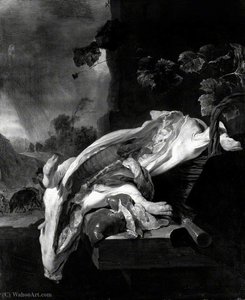
11vegetable-sellers at the house-door, 5 figures (1646) od Jan Baptist Weenixvegetable-sellers at the house-door, 5 figures1646 12caravane near the shore (1646) od Jan Baptist Weenixcaravane near the shore1646 13Mother and Child (1647) od Jan Baptist WeenixMother and Child1647 14Circumcision of Moses' son (1640) od Jan Baptist WeenixCircumcision of Moses' son1640 · Národní muzeum ve Varšavě 15Still Life with Game, Hunter and Two Dogs (1652) od Jan Baptist WeenixStill Life with Game, Hunter and Two Dogs1652 · Bavarské státní sbírky malby 16Butterfly Dog and Dead Bird (1649) od Jan Baptist WeenixButterfly Dog and Dead Bird1649 · Museum Mayer van den Bergh 17Pleasure boating (1650) od Jan Baptist WeenixPleasure boating1650 18The Sleeping Shepherdess (1658) od Jan Baptist WeenixThe Sleeping Shepherdess1658 · National Gallery of Ireland 19Roman Tinker (1656) od Jan Baptist WeenixRoman Tinker1656 · Städel Museum 20The love letter (1650) od Jan Baptist WeenixThe love letter1650 · Národní muzeum umění, architektury a designu 21Italian Harbour (1651) od Jan Baptist WeenixItalian Harbour1651 · Státní Ermitáž 22Italian Peasants among Ruins (1650) od Jan Baptist WeenixItalian Peasants among Ruins1650 · Detroit Institute of Arts 23Sleeping girl (1656) od Jan Baptist WeenixSleeping girl1656 · Bavarské státní sbírky malby 24Rest on the Flight into Egypt (1657) od Jan Baptist WeenixRest on the Flight into Egypt1657 · Museum Boijmans Van Beuningen 25Merry Company on a Ferry (1649) od Jan Baptist WeenixMerry Company on a Ferry1649 · Museum Gouda 26Battle at the foot of the mountain. (1650) od Jan Baptist WeenixBattle at the foot of the mountain.1650 · Národní muzeum ve Varšavě 27Christina Lepper de Kempenaer and Her Children (1653) od Jan Baptist WeenixChristina Lepper de Kempenaer and Her Children1653 28Italian port scene, 1649 (1649) od Jan Baptist WeenixItalian port scene, 16491649 · Centraal Museum 29Italian Landscape with Horsemen by a Spring (1657) od Jan Baptist WeenixItalian Landscape with Horsemen by a Spring1657 · Centraal Museum 30Before the walls of Rome (1650) od Jan Baptist WeenixBefore the walls of Rome1650 · National Museum in Wrocław 31Portrait of a man with a letter (1650) od Jan Baptist WeenixPortrait of a man with a letter1650 · Agnes Etherington Art Center 32A Landscape with a Ford (1660) od Jan Baptist WeenixA Landscape with a Ford1660 · Oblastní galerie v Liberci 33In the Campagna (1669) od Jan Baptist WeenixIn the Campagna1669 · National Gallery of Ireland 34Dead Fowl Being Eaten by a Cat (1653) od Jan Baptist WeenixDead Fowl Being Eaten by a Cat1653 · Städel Museum 35Departure of an Oriental Entourage (1647) od Jan Baptist WeenixDeparture of an Oriental Entourage1647 · Louvre 36Display of Dead Game (1641) od Jan Baptist WeenixDisplay of Dead Game1641 · Petit Palais 37Dead Game (1641) od Jan Baptist WeenixDead Game1641 38River Landscape with a Ferry (1650) od Jan Baptist WeenixRiver Landscape with a Ferry1650 · Montreal Museum of Fine Arts 39Still Life with Dead Game and Poultry (1656) od Jan Baptist WeenixStill Life with Dead Game and Poultry1656 · Centraal Museum 40Still Life with Fowl (1650) od Jan Baptist WeenixStill Life with Fowl1650 · Museum of Fine Arts Ghent (MSK) 41Marine with a Venetian Bucintoro (1650) od Jan Baptist WeenixMarine with a Venetian Bucintoro1650 · Staatliche Kunsthalle Karlsruhe 42The Dutch Ambassador on his Way to Isfahan, Jan Baptist Weenix, 1653 - 1659 (1659) od Jan Baptist WeenixThe Dutch Ambassador on his Way to Isfahan, Jan Baptist Weenix, 1653 - 16591659 · Rijksmuseum 43After the Hunt, Jan Baptist Weenix, c. 1656 (1656) od Jan Baptist WeenixAfter the Hunt, Jan Baptist Weenix, c. 16561656 · Rijksmuseum 44Still Life with White Mouse (1680) od Jan Baptist WeenixStill Life with White Mouse1680 · Galéria umenia Ernesta Zmetáka v Nových Zámkoch 45Still Life with Game od Jan Baptist WeenixStill Life with GameHarvard Art Museums 46The Ford in the River (1647) od Jan Baptist WeenixThe Ford in the River1647 · Státní Ermitáž 47Harbor View with Rider in Oriental Dress, od Jan Baptist WeenixHarbor View with Rider in Oriental Dress,Groninger Museum 48The Holy Women at the Tomb od Jan Baptist WeenixThe Holy Women at the TombNational Gallery of Ireland 49An Italian Seaport od Jan Baptist WeenixAn Italian SeaportKrálovské muzeum výtvarného umění Antverpy 50Architectural interior with foreign shippers, ruins and a shipyard beyond od Jan Baptist WeenixArchitectural interior with foreign shippers, ruins and a shipyard beyond 51Study of a sheep od Jan Baptist WeenixStudy of a sheep 52A pig's carcase od Jan Baptist WeenixA pig's carcase 53The Tinker and His Dog od Jan Baptist WeenixThe Tinker and His Dog 54Landscape with Peasants and Animals od Jan Baptist WeenixLandscape with Peasants and Animals 55Dead Partridge (1650) od Jan Baptist WeenixDead Partridge1650 · Mauritshuis 56Goat Lying Down, Jan Baptist Weenix, 1645 - 1660 (1660) od Jan Baptist WeenixGoat Lying Down, Jan Baptist Weenix, 1645 - 16601660 · Rijksmuseum 57A Dog and a Cat near a partially disembowelled Deer, Jan Baptist Weenix, 1645 - 1660 (1660) od Jan Baptist WeenixA Dog and a Cat near a partially disembowelled Deer, Jan Baptist Weenix, 1645 - 16601660 · Rijksmuseum 58Still Life with Dead Poultry, Lidded Pitcher and Passglas od Jan Baptist WeenixStill Life with Dead Poultry, Lidded Pitcher and PassglasBavarské státní sbírky malby 59Game-piece od Jan Baptist WeenixGame-pieceNational Gallery of Ireland 60Dead game and hunting tackle in landscape od Jan Baptist WeenixDead game and hunting tackle in landscape 61Hound with a Joint of Meat and a Cat Looking on od Jan Baptist WeenixHound with a Joint of Meat and a Cat Looking on 62Bouquet of flowers od Jan Baptist WeenixBouquet of flowersGemäldegalerie 63Shipping in Harbour od Jan Baptist WeenixShipping in Harbour 64Herons and Lapwings od Jan Baptist WeenixHerons and Lapwings 65Still Life of Dead Game in a Landscape with a Huntsman od Jan Baptist WeenixStill Life of Dead Game in a Landscape with a Huntsman 66An italian port scene od Jan Baptist WeenixAn italian port scene 67Shepherds and Flocks among Classical Ruins od Jan Baptist WeenixShepherds and Flocks among Classical Ruins 68A Coast Scene with Classical Ruins od Jan Baptist WeenixA Coast Scene with Classical RuinsWallace Collection 69Still Life with Dead Game od Jan Baptist WeenixStill Life with Dead Game 70Hounds and an Owl with Dead Birds and Sculptures in a Landscape od Jan Baptist WeenixHounds and an Owl with Dead Birds and Sculptures in a Landscape 71Still Life with Dead Birds od Jan Baptist WeenixStill Life with Dead Birds 72Family in a Mediterranean Seaport od Jan Baptist WeenixFamily in a Mediterranean Seaport 73Figures near a Seaport od Jan Baptist WeenixFigures near a SeaportScottish National Gallery 74A Huntsman cutting up a Dead Deer, with Two Deerhounds od Jan Baptist WeenixA Huntsman cutting up a Dead Deer, with Two DeerhoundsNational Gallery 75Ancient Ruins od Jan Baptist WeenixAncient RuinsSzépművészeti Múzeum 76Figures among ruins od Jan Baptist WeenixFigures among ruinsThe Kremer Collection 77Ancient Ruins (detail) od Jan Baptist WeenixAncient Ruins (detail)Szépművészeti Múzeum 78Girl as Shepherdess (1650) od Jan Baptist WeenixGirl as Shepherdess1650 · Musée de Picardie

Slavná díla Jan Baptist Weenix podle jednotlivých období

Motivy, které zaujaly Jan Baptist Weenix

Čtyři témata, která se v těchto originálech nejčastěji objevují, z nichž každé má svůj nejlepší příklad.

Muzea, v nichž jsou vystavena originálna umělce Jan Baptist Weenix

8 muzea, v nichž je umístěno nejvíce obrazů z této stránky.

Muzeum Město Díla autora Jan Baptist Weenix Obrazy z tohoto seznamu
Bavarské státní sbírky malby, MnichovBavarské státní sbírky malby Mnichov 4 The Scissors Grinder, Still Life with Game, Hunter and Two Dogs, Sleeping girl
Centraal Museum, UtrechtCentraal Museum Utrecht 4 Portrait of René Descartes, Italian port scene, 1649, Italian Landscape with Horsemen by a Spring
National Gallery of Ireland, DublinNational Gallery of Ireland Dublin 4 The Sleeping Shepherdess, In the Campagna, The Holy Women at the Tomb
Rijksmuseum, AmsterdamRijksmuseum Amsterdam 4 The Dutch Ambassador on his Way to Isfahan, Jan Baptist Weenix, 1653 - 1659, After the Hunt, Jan Baptist Weenix, c. 1656, Goat Lying Down, Jan Baptist Weenix, 1645 - 1660
Museum Boijmans Van Beuningen, RotterdamMuseum Boijmans Van Beuningen Rotterdam 2 Tobit, asleep under a vine, is blinded, Rest on the Flight into Egypt
Mauritshuis, HaagMauritshuis Haag 2 Italian landscape with shelter and antiques ruins, Dead Partridge
Detroit Institute of Arts, DetroitDetroit Institute of Arts Detroit 2 Still Life with a Dead Swan, Italian Peasants among Ruins
Nationalmuseum, StockholmNationalmuseum Stockholm 2 Harbour with Antique Ruins, The Angel Raphael Leaving Tobias's Family

Jan Baptist Weenix rok po roce: originální díla, která definují každou éru

Od 1640 do 1659, Jan Baptist Weenix tvořil po dobu 20 let: tato výběrová kolekce sleduje tuto dlouhou kariéru rok po roce prostřednictvím jeho nejlepších originálů.

Díla podle roku

Vyberte rok a prohlédněte si originály.

Otázky sběratelů o obrazech umělce Jan Baptist Weenix

Kterým dílem je Jan Baptist Weenix nejznámější?Odhalit odpověď

Tobit, asleep under a vine, is blinded (1642), Museum Boijmans Van Beuningen, Rotterdam. Následují Italian landscape with shelter and antiques ruins (1658) a Still Life with a Dead Swan (1651).

Kolik let bylo Jan Baptist Weenix, když bylo vytvořeno dílo Tobit, asleep under a vine, is blinded?Odhalit odpověď

21 let: dílo Tobit, asleep under a vine, is blinded pochází z roku 1642 a Jan Baptist Weenix se narodil/a v roce 1621.

Kterých deset nejslavnějších obrazů má Jan Baptist Weenix?Odhalit odpověď

Tobit, asleep under a vine, is blinded, Italian landscape with shelter and antiques ruins, Still Life with a Dead Swan, Tobit Sleeping Under the Vine, The Scissors Grinder, Hunters Near Ruins, Portrait of René Descartes, Monument at a Harbour, Harbour with Antique Ruins a The Angel Raphael Leaving Tobias's Family. Hodnocení výše uvádí rok a muzeum pro každé z nich.

Kolik obrazů zanechal(a) Jan Baptist Weenix?Odhalit odpověď

Náš katalog obsahuje 86 děl umělce Jan Baptist Weenix z let 1640 až 1659.

Ve kterých muzeích jsou vystavena díla mistrovská umělce Jan Baptist Weenix?Odhalit odpověď

Většinou v Bavarské státní sbírky malby (Mnichov), Centraal Museum (Utrecht) a National Gallery of Ireland (Dublin). V tabulce muzeí výše jsou vypsány všechny.

V jakých letech namaloval Jan Baptist Weenix svá nejznámější díla?Odhalit odpověď

V období 1650: 11 z celkem 78 děl na této stránce vzniklo právě tehdy, z toho Pleasure boating z nich.

Jaká jsou první a poslední slavná originální díla umělce Jan Baptist Weenix?Odhalit odpověď

Na této stránce je nejstarší dílo z Circumcision of Moses' son (1640) a nejnovější z The Dutch Ambassador on his Way to Isfahan, Jan Baptist Weenix, 1653 - 1659 (1659).

Jaká témata si Jan Baptist Weenix vybíral nejčastěji?Odhalit odpověď

Landscape (18), Ruins (17) a Sky (13) napříč 78 díly na této stránce.

Kterou techniku používal(a) Jan Baptist Weenix nejčastěji?Odhalit odpověď

Oil On Canvas, u 30 z 78 děl na této stránce.

K kterému uměleckému směru patří Jan Baptist Weenix?Odhalit odpověď

Dutch golden age a Baroque, podle originálů na této stránce.

Která díla umělce Jan Baptist Weenix jsou vystavena v Bavarské státní sbírky malby?Odhalit odpověď

The Scissors Grinder, Still Life with Game, Hunter and Two Dogs a Sleeping girl: muzeum Bavarské státní sbírky malby, Mnichov má v obsluze 4 děl z této stránky.

Jan Baptist Weenix: život a dílo

Vizionář holandského zlatého věku

Jan Baptist Weenix představuje singularní postavu holandského zlatého věku, oslavovanou pro své nezaměnitelné spojení precizní pozorovatelnosti a představivivé vize. Ačkoliv bylo jeho umělecké dílo ve srovnání se sousedy jako Rembrandt či Vermeer relativně skromné, Weenixův přínos do historie nizozemského umění je nepopiratelný – zejména díky jeho průkopnickému zkoumání italských krajin protkaných lidskými postavami, čímž vytvořil stylistický precedens, který rezonoval v následujících generacích. Narodil se v roce 1621 v Amsterdamu poblíž rušného přístavu a pocházel z rodiny architektů, což je linie, která pravděpodobně formovala jeho raná léta uprostřed intelektuálního i strukturálního fermentu tehdejší doby.

Navzdory osobním překážkám – historické záznamy naznačují, že kvůli zdravotnímu stavu měl potíže s řečí – Weenix disponoval vášnivým zájmem o literaturu a umění, který v něm podpořila matka, jež pro něj aktivně zajistila učení u Jana Mickera, zetě Rembrandta. Toto rané vzdělávání v něm zakořenilo disciplinovaný přístup k kresbě a pozorování, který se stal trvalou známkou jeho díla. Svá schopnosti dále zdokonaloval v Utrechtu pod vedením Abrahama Bloemaerta a následně se vrátil do Amsterdamu, aby studoval u Claes Cornelizoona Moeyaerta, čímž upevnil své základy v rámci tehdejších převládajících uměleckých proudů Nizozemí.

Cesta skrze světlo a krajinu

Trajektorie Weenixovy kariéry byla hluboce změněna jeho cestováním, zřejmě nejvýrazněji jeho quite do Říma v roce 1643 společně s Nicolaesem Pieterszoon Berchemem. Tato expedice mu umožnila setkat se s živým intelektuálním a uměleckým prostředím cechu Bentvueghels, což byla zkušenost, která ho posunula k mnohem širší stylistické rozmanitosti. V Římě přijal italský styl, charakterizovaný teplým, zlatavým světlem a klasickými krajinami, které nádherně kontrastovaly s chladnějšími a temnějšími tóny tradičního holandského malířství. Toto období římského vlivu mu umožnilo ovládnout umění „italské krajiny“, kde byla syrová krása jižní Evropy přetvářena skrze severoevropskou optiku.

Jeho dílo z této éry často propojovalo velkolepost klasických scén s intimními lidskými prvky. Ať už zachycoval přístavní scény, které šeptaly o námořním obchodu, nebo rozlehlé výhledy vyvolávající pocit nadčasovosti, Weenix disponoval jedinečným darem zachytit atmosféru místa. Jeho mistrovství se však neomezovalo pouze na nekonečné obzory; byl stejně zdatný v zachycování tiché, často až hmatatelné reality života prostřednictvím svých still životů. Jeho zobrazení zvěře a zvířat byla poznamenána překvapivým realismem, kde každá textura – od hrubé srsti loveckého psa až po jemný lesk peří – byla vykreslena s dechbernou přesností.

Odkaz realismu a uměleckého génia

Význam Jana Baptista Weenixe spočívá v jeho schopnosti překlenout propast mezi syrovým realismem holandské tradice a idealizovanou krásou italského hnutí. Jeho všestrannost mu umožnila pohybovat se mezi rozmanitými tématy, od dramatického napětí nalezeného v dílech jako Po lovu až po tichou, téměř melancholickou intenzitu jeho zvířecích studií. Skrze jeho štětec je divák pozván do světa, kde se hranice mezi pozorovaným přírodním světem a představovanou klasickou minulostí nádherně rozmazávají.

Při pohledu na jeho život a dílo definuje jeho trvalou důležitost několik klíčových prvků:

  • Stylistická inovace: Byl průkopníkem v integraci prvků italské krajiny do holandské tradice, čímž vytvořil nový vizuální jazyk pro své současníky.
  • Technické mistrovství: Jeho disciplinované vzdělávání mu umožnilo dosáhnout mimořádné úrovně detailu jak v rozsáhlých krajinách, tak v intimních still life.
  • Všestrannost: Schopnost plynule přecházet mezi přístavními scénami, loveckými motivy a portréty zvířat prokazuje vzácnou šíři talentu.
  • Historický dopad: Jako člen cechu Bentvueghels pomáhal podporovat mezinárodní výměnu uměleckých myšlenek, která definovala svět umění 17. století.

Ačkoliv byl jeho život relativně krátký a skončil v roce 1661, otisk zanechaný Janem Baptistem Weenixem zůstává viditelný v evoluci malování krajiny. Naučil budoucí generace, jak se na horizont nedívat pouze jako na hranici, ale jako na plátno pro světlo, historii a lidské emoce.