Portrét James Peel

Obrazy autora James Peel: 41 nejznámějších díel podle pohledu galerie

Aktualizováno listopad 2026 · seřazeno podle našeho skóre popularity (vyhledávání, návštěvy a objednávky u každého díla) · 41 děl umělce James Peel v našem katalogu

Stručně řečeno

Z pohledu galerie je nejslavnějším dílem James Peel obraz Landscape in the Glaslyn Valley (1877). The Tinker (1842) a Snowdon (1870) doplňují trio, které každé oko okamžitě pozná. Z 41 děl umělce James Peel v našem katalogu představuje galerie níže 41 nejznámějších děl, z nichž každé je originálem s uvedením roku vzniku, muzea a toho, co jej činí jedinečným.

1811 – 1906, Newcastle upon Tyne Romanticism Nejvíce děl: Darlington Library

Top 10 obrazů umělce James Peel v naší galerii

1
Landscape in the Glaslyn Valley (1877) od James Peel

Landscape in the Glaslyn Valley

1877 · Oil On Canvas

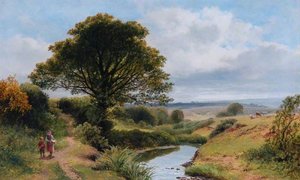
Landscape in the Glaslyn Valley is a work by the English painter James Peel. Created about 1877, this oil on canvas presents a quiet, natural scene that captures the essence of a specific topography. The composition focuses on the interplay between the ruggedness of the mountains and the steady presence of the river valley below.

2
The Tinker (1842) od James Peel

The Tinker

1842 · Oil · Darlington Library, Darlington

A man and a child occupy the foreground of this 1842 composition, positioned before a building with a single visible window. The man, likely a traveling tinker, sits on the ground amidst his tools, holding a bucket. His posture suggests a brief respite from the labor of his trade. Nearby, a suitcase rests in the lower left corner, while a chair and a bowl sit close to the central figure.…

3
Snowdon (1870) od James Peel

Snowdon

We are looking at Snowdon, a work by James Peel dating from 1870. This piece reflects the artist's deep connection to the landscapes of the United Kingdom, particularly the rugged terrains of Wales. Peel was born in Newcastle upon Tyne, United Kingdom, and his career was defined by a sincere, naturalistic approach to the British countryside. He spent much of his life observing the subtle shifts in light and atmosphere…

5
Landscape with a River (1877) od James Peel

Landscape with a River

1877 · Oil On Canvas

Landscape with a River is a work by the English painter James Peel. Created in 1877, the painting captures a serene countryside scene featuring a church positioned in the background. The composition focuses on a peaceful atmosphere where trees surround the structure and five cows graze near the water's edge.

6
Pont y Pant and the Lledr Valley (1877) od James Peel

Pont y Pant and the Lledr Valley

1877 · Oil On Canvas · Laing Art Gallery, Newcastle upon Tyne

Pont y Pant and the Lledr Valley is a landscape painting by the English artist James Peel. Created in 1877, the work captures a specific corner of the Welsh countryside. The scene focuses on a valley where the river flows through the center of the composition. Mountains rise in the background, framing the terrain.

Obrazy autora James Peel, seřazeny od 11 do 41

Motivy, které zaujaly James Peel

Čtyři témata, která se v těchto originálech nejčastěji objevují, z nichž každé má svůj nejlepší příklad.

Muzea, v nichž jsou vystavena originálna umělce James Peel

8 muzea, v nichž je umístěno nejvíce obrazů z této stránky.

Muzeum Město Díla autora James Peel Obrazy z tohoto seznamu
Darlington Library, DarlingtonDarlington Library Darlington 8 The Tinker, Landscape with Cows, Landscape with Fisherman
Laing Art Gallery, Newcastle upon TyneLaing Art Gallery Newcastle upon Tyne 4 Pont y Pant and the Lledr Valley, Mill near Sheppard, Devon, Cotherstone, Yorkshire
Llyfrgell Genedlaethol Cymru / The National Library of Wales, AberystwythLlyfrgell Genedlaethol Cymru / The National Library of Wales Aberystwyth 3 Snowdon, Hauling Logs near Rhuddlan Castle, Moel Siabod, North Wales
Sunderland Museum - Winter Gardens, SunderlandSunderland Museum - Winter Gardens Sunderland 3 Landscape in Cumberland, Sunrise on Loughrigg, Cumbria, Borrowdale, Cumbria
Harris Museum - Art Gallery, PrestonHarris Museum - Art Gallery Preston 1 Totteridge, near Hampstead
Campbeltown Museum, CampbeltownCampbeltown Museum Campbeltown 1 James McAllister Hall ( )
Wolverhampton Art Gallery, WolverhamptonWolverhampton Art Gallery Wolverhampton 1 Near Rosthwaite
Leeds Art Gallery, LeedsLeeds Art Gallery Leeds 1 Cyfyng Falls

James Peel, jeden ikonický obraz na každé desetiletí

Díla podle dekád

Vyberte si dekádu a prohlédněte si originál, který ji definuje.

Obrazy umělce James Peel: odpovědi galerie

Který obraz autora James Peel je nejslavnější ze všech?Odhalit odpověď

Landscape in the Glaslyn Valley (1877). Následují The Tinker (1842) a Snowdon (1870).

Kolik let bylo James Peel, když dokončil/a Landscape in the Glaslyn Valley?Odhalit odpověď

66 let: dílo Landscape in the Glaslyn Valley pochází z roku 1877 a James Peel se narodil/a v roce 1811.

Kterých 10 nejlepších obrazů má James Peel?Odhalit odpověď

Landscape in the Glaslyn Valley, The Tinker, Snowdon, Hauling Logs near Rhuddlan Castle, Landscape with a River, Pont y Pant and the Lledr Valley, Landscape River and Mountains, Totteridge, near Hampstead, Landscape a Landscape with Cows. Hodnocení výše uvádí rok a muzeum pro každé z nich.

Kolik děl vytvořil/a James Peel?Odhalit odpověď

Náš katalog obsahuje 41 děl umělce James Peel z let 1842 až 1900.

Kde jsou vystavena nejznámější originály umělce James Peel?Odhalit odpověď

Většinou v Darlington Library (Darlington), Laing Art Gallery (Newcastle upon Tyne) a Llyfrgell Genedlaethol Cymru / The National Library of Wales (Aberystwyth). V tabulce muzeí výše jsou vypsány všechny.

Kdy James Peel vytvořil své nejslavnější obrazy?Odhalit odpověď

V období 1870s: 6 z celkem 41 děl na této stránce vzniklo právě tehdy, z toho Landscape in the Glaslyn Valley z nich.

Která jsou nejstarší a nejnovější slavná díla umělce James Peel?Odhalit odpověď

Na této stránce je nejstarší dílo z The Tinker (1842) a nejnovější z Landscape River and Mountains (1900).

Kterým tématům se James Peel věnoval(a) nejčastěji?Odhalit odpověď

Landscape (5), River (4) a Trees (3) napříč 41 díly na této stránce.

V jaké technice tvořil(a) James Peel nejčastěji?Odhalit odpověď

Oil On Canvas, u 4 z 41 děl na této stránce.

S jakým směrem je spojen(a) James Peel?Odhalit odpověď

Romanticism, podle originálů na této stránce.

Jaká originální díla James Peel má v obsluze Darlington Library?Odhalit odpověď

The Tinker, Landscape with Cows a Landscape with Fisherman: muzeum Darlington Library, Darlington má v obsluze 8 děl z této stránky.

James Peel: umělec

James Peel: A Painter of Northern Light

Born in Newcastle upon Tyne in 1811, James Peel’s life and artistic journey were inextricably linked to the rugged beauty of northern England – specifically, Northumberland, Yorkshire, and Wales. His early years, steeped in the industrial heritage of his father's woollen drapery business, provided a grounding in observation and an appreciation for the changing landscapes around him. Unlike many artists of his era who sought grand, idealized vistas, Peel’s work possessed a remarkable intimacy, capturing not just the scenery but also the subtle textures, atmospheric conditions, and quiet rhythms of rural life. His artistic development was nurtured by Alexander Dalziel, a skilled wood engraver, who recognized Peel's innate talent for drawing and encouraged his pursuit of painting.

Peel’s formal training began at Bruce’s School in Newcastle, where he honed his skills alongside notable figures like Sir Charles Mark Palmer and John Collingwood Bruce. However, it was a move to London in 1840 that truly propelled his career forward. Initially drawn to portraiture – producing striking copies of works by Wilkie Collins, including ‘Blind Fiddler’ and ‘The Village Festival,’ both housed within the National Gallery – Peel soon gravitated towards landscape painting. This shift reflected a deeper connection with the natural world, an impulse he would consistently pursue throughout his career.

A Palette of Northern Moods

Peel's artistic style is characterized by a remarkable sensitivity to light and atmosphere. He wasn’t interested in dramatic sunsets or sweeping vistas; instead, he meticulously rendered the subtle shifts in color and tone that defined the northern skies – the bruised purples of impending rain, the hazy greys of misty mornings, and the golden hues of late afternoon. His brushwork was precise yet fluid, conveying a sense of immediacy and spontaneity. He frequently depicted scenes of everyday rural life: shepherds tending their flocks, farmers working in their fields, and villagers engaged in their routines. These weren’t romanticized depictions; they were honest portrayals of a hardworking people living in harmony with the land.

A key element of Peel's technique was his masterful rendering of trees – an obsession that became almost synonymous with his name. He possessed an extraordinary ability to capture their intricate forms, the play of light and shadow on their bark, and the way they stood sentinel against the sky. Works like ‘A Lane in Berwickshire’ and ‘Cotherstone, Yorkshire,’ now residing in the Laing Art Gallery in Newcastle, exemplify this skill, showcasing a deep understanding of tree structure and an almost tactile quality to his brushstrokes.

Royal Recognition and Artistic Circles

Peel's dedication and talent quickly gained him recognition within the established art world. He began exhibiting at the Royal Academy in 1843 and subsequently joined the Royal Society of British Artists, a prestigious organization that championed English landscape painting. His work was consistently praised for its sincerity, technical skill, and evocative portrayal of northern landscapes. He wasn’t merely documenting scenery; he was conveying a feeling – a sense of quiet contemplation, rustic charm, and deep connection to the land.

Peel's artistic circle extended beyond the Royal Academy. He actively participated in “free” exhibitions organized by figures like Ford Madox Brown and William Bell Scott, challenging the established norms of the art market and advocating for greater accessibility to art. These initiatives demonstrated his commitment to fostering a vibrant and inclusive artistic community.

Legacy and Enduring Appeal

James Peel died in Reading in 1906, leaving behind a substantial body of work that continues to resonate with viewers today. His paintings are not grand statements but intimate glimpses into the heart of northern England – a region he loved deeply and captured with remarkable honesty and skill. His influence can be seen in subsequent generations of landscape artists who sought to emulate his sensitivity to light, his meticulous technique, and his profound appreciation for the beauty of the natural world.

Peel’s legacy extends beyond his artistic achievements. He represents a pivotal moment in British art history – a time when landscape painting moved away from idealized representations and embraced a more direct and personal approach. His work serves as a reminder that true artistry lies not just in technical skill but also in the ability to capture the essence of a place and its people.