Portrét James Bell

8 nejslavnějších obrazů autora James Bell, každý naprosto unikátní

Aktualizováno listopad 2026 · seřazeno podle našeho skóre popularity (vyhledávání, návštěvy a objednávky u každého díla) · 8 děl umělce James Bell v našem katalogu

Stručně řečeno

St Peter's Cathedral, East Road, Lancaster (1880) je obraz autora James Bell, který přitahuje nejvíce pohledů. Poté se zrak přesouvá k Lancaster from the Aqueduct Bridge (1880) a SS 'Shandon', Cardiff. Z 8 děl umělce James Bell v našem katalogu je těchto 8 těch nejznámějších; každé z nich je unikátním originálem s uvedením roku vzniku, muzea a důvodu jeho nesmrtelnosti.

1850 – 1910 Nejvíce děl: Sunderland Museum - Winter Gardens

Top 10 obrazů autora James Bell podle výběru galerie

1
St Peter's Cathedral, East Road, Lancaster (1880) od James Bell

St Peter's Cathedral, East Road, Lancaster

1880 · Oil

This 1880 painting, titled St Peter's Cathedral, East Road, Lancaster, captures a bustling urban scene centered around a church. The composition features a large steeple and a prominent clock tower rising in the background. The architecture of the church appears old-fashioned, serving as the focal point of the streetscape.

2
Lancaster from the Aqueduct Bridge (1880) od James Bell

Lancaster from the Aqueduct Bridge

1880 · Oil On Canvas

An elevated perspective from the Aqueduct Bridge looks down upon the landscape of Lancaster. A winding river meanders through the terrain, its surface reflecting a soft, overcast sky. The composition is defined by the interplay of light and shadow across rolling hills and lush green fields. Dense vegetation and scattered trees provide a sense of depth, leading the eye toward the distant outskirts of the city where subtle architectural forms…

3
SS 'Shandon', Cardiff od James Bell

SS 'Shandon', Cardiff

Oil

In this intimate maritime portrait, the steamship 'SS Shandon' is captured mid-voyage, its hull cutting through a sea of muted blue-grey. The vessel, rendered in soft beige and cream tones, occupies the center of a circular, decorative frame that lends the piece the character of a commemorative souvenir. There is a quiet dignity in the way the ship is positioned, its mast flying a single flag against a pale, diffused…

4
SS 'Consols', Liverpool od James Bell

SS 'Consols', Liverpool

Oil On Canvas

This circular decorative painting depicts the steamship SS 'Consols' sailing upon the sea. The vessel is positioned centrally, appearing to move across the water with the city of Liverpool visible in the background. The composition is enclosed within an ornate wreath frame that incorporates floral elements and heraldic details. Within this wreath, the text ‘W.T. & Co. Consols’ and ‘Liverpool’ is prominently displayed. The scene is rendered with a flattened…

5
SS 'J. W. Taylor', Sunderland od James Bell

SS 'J. W. Taylor', Sunderland

The painting depicts the SS 'J. W. Taylor' while it is docked in Sunderland. The ship is the central subject, rendered in a color scheme of blue and white with gold accents. Two guns are visible in the composition, one positioned on the left side and another toward the bottom right corner. The scene is presented within a decorative border that features blue flowers and the name N. D. McIntyre.…

6
RMS 'Boulama' od James Bell

RMS 'Boulama'

Painting

The RMS 'Boulama' rests heavily in the waters of Liverpool, a massive presence of iron and steam held steady against the tide. There is a stillness here, the kind that exists only when a great vessel is momentarily relieved of its duty to the open sea. The ship dominates the view, its dark hull cutting a formidable silhouette against the sky. A blue border frames the scene, carrying the name…

7
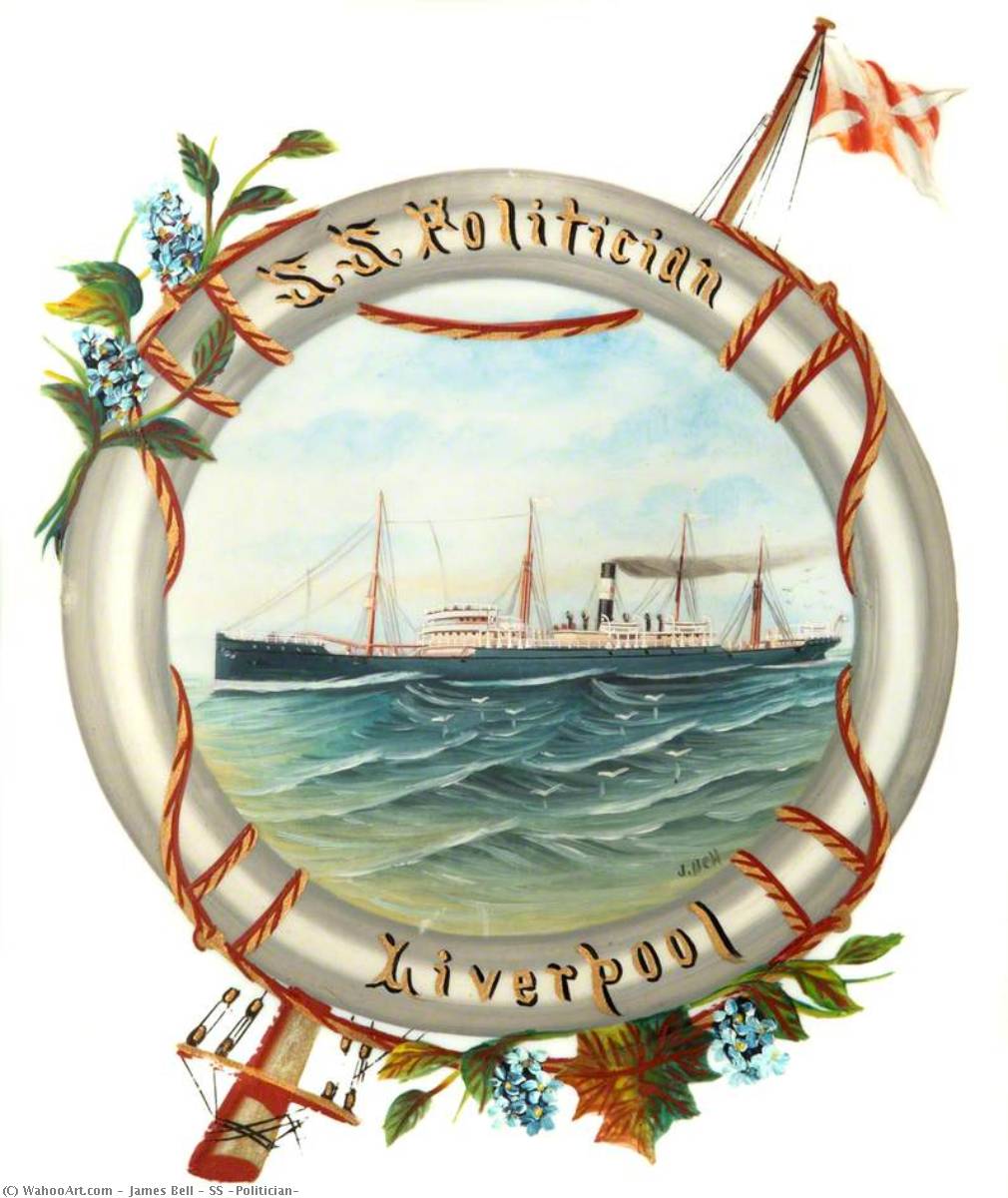
SS 'Politician' od James Bell

SS 'Politician'

Oil

The painting depicts the SS 'Politician', a vessel currently displayed at the Merseyside Maritime Museum in Liverpool, United Kingdom. The artwork features a large ship characterized by multiple masts and sails. A notable detail on the side of the ship is a clock. The composition is presented in color, showcasing the intricate details of the ship and its surrounding environment.

8
RMS 'Atlantic' od James Bell

RMS 'Atlantic'

Oil

To stand before this oil painting is to encounter the sheer scale of the RMS 'Atlantic'. James Bell captures the vessel not as a static object, but as a living entity navigating the vastness of the sea. The work focuses on the imposing silhouette of the ocean liner, emphasizing its massive proportions and the way it commands the space around it. There is a certain weight to the composition, a…

Motivy, které zaujaly James Bell

Čtyři témata, která se v těchto originálech nejčastěji objevují, z nichž každé má svůj nejlepší příklad.

Muzea, v nichž jsou vystavena originálna umělce James Bell

Muzeum s největším počtem obrazů na této stránce.

Muzeum Město Díla autora James Bell Obrazy z tohoto seznamu
Sunderland Museum - Winter Gardens, SunderlandSunderland Museum - Winter Gardens Sunderland 1 SS 'J. W. Taylor', Sunderland

James Bell v průběhu let: unikátní originály každého díla

Všechny originály umělce James Bell s datem 1880 zobrazené zde patří k jednomu roku, 1880: jsou uspořádány podle míry slavnosti.

Díla podle roku

Vyberte rok a prohlédněte si originály.

Obrazy umělce James Bell: dotazy pro galerii

Kterým nejznámějším dílem je James Bell?Odhalit odpověď

St Peter's Cathedral, East Road, Lancaster (1880). Následují Lancaster from the Aqueduct Bridge (1880) a SS 'Shandon', Cardiff.

V jakém věku vytvořil(a) James Bell dílo St Peter's Cathedral, East Road, Lancaster?Odhalit odpověď

30 let: dílo St Peter's Cathedral, East Road, Lancaster pochází z roku 1880 a James Bell se narodil/a v roce 1850.

Kolik známých děl má autor James Bell?Odhalit odpověď

Náš katalog obsahuje 8 děl od James Bell.

Kde lze vidět nejznámější originály umělce James Bell?Odhalit odpověď

Většinou v Sunderland Museum - Winter Gardens (Sunderland). V tabulce muzeí výše jsou vypsány všechny.

V jakém období vytvořil(a) James Bell svá nejznámější obrazy?Odhalit odpověď

V období 1880: 2 z celkem 8 děl na této stránce vzniklo právě tehdy, z toho St Peter's Cathedral, East Road, Lancaster z nich.

Jakým tématům se James Bell věnoval/a nejčastěji?Odhalit odpověď

Water (6), Ship (5) a Sea (4) napříč 8 díly na této stránce.

Jaké materiály používal(a) James Bell nejčastěji?Odhalit odpověď

Oil, u 5 z 8 děl na této stránce.

James Bell: portrét umělce

James Bell: The Master of the Moving Sea

James Bell (1850-1910) wasn’t merely a marine artist; he was a conduit to the very soul of the sea. Born in Glasgow, Scotland, into a family steeped in trade and commerce – his father a customs collector – Bell's early life instilled within him an appreciation for ships, their journeys, and the vital role they played in connecting nations. This foundation, coupled with a keen observational eye and a masterful understanding of light and atmosphere, propelled him to become one of the most celebrated depictions of maritime life in 19th-century Britain. His canvases aren’t simply records of vessels; they are imbued with a palpable sense of motion, drama, and the raw power of nature – elements that continue to resonate deeply with viewers today.

Bell's artistic journey began modestly, likely influenced by the prevailing trends of academic painting at the time. However, he quickly developed a distinctive style characterized by loose brushwork, vibrant color palettes, and an almost obsessive attention to detail when it came to capturing the nuances of weather and wave action. Unlike many of his contemporaries who favored idealized or romanticized scenes, Bell embraced the often-turbulent realities of seafaring – the spray of the waves, the billowing sails, the weathered faces of the crew. This commitment to realism, combined with a deep understanding of light’s transformative effects on water, created an unparalleled sense of immediacy and authenticity in his work.

A Career Defined by Vessels

Bell's career blossomed primarily during the late Victorian era, a period marked by significant expansion of British maritime trade. He established himself as a prolific artist, producing hundreds of paintings depicting a diverse range of vessels – from elegant clipper ships and sturdy merchantmen to imposing warships and humble fishing boats. His subjects weren’t limited to grand naval engagements; he frequently captured scenes of everyday life aboard ships, offering intimate glimpses into the routines, challenges, and camaraderie of sailors. Notable amongst his commissions were numerous paintings for shipping companies, illustrating their vessels and promoting trade routes – a testament to his commercial success and recognition within the industry.

Among his most iconic works are depictions of the ‘Politician’ and ‘Atlantic’, two legendary ships that played pivotal roles in British naval history. The ‘Politician,’ a swift and agile warship, is rendered with breathtaking dynamism, capturing its speed and maneuverability as it cuts through the waves. Similarly, Bell's portrayal of the ‘Atlantic’ – a massive ocean liner – conveys both its imposing size and the sense of adventure associated with transatlantic voyages. These paintings are not merely illustrations; they are powerful evocations of the ships themselves, imbued with a life force that transcends their static representation on canvas.

Technique and Influence

Bell’s technique was characterized by a remarkable ability to blend observation with artistic license. He meticulously studied his subjects – often sketching directly from life aboard ships – but he wasn't afraid to exaggerate or simplify forms to achieve the desired effect. His brushwork is loose and expressive, creating a sense of movement and texture that is particularly evident in his depictions of water. He employed a vibrant color palette, utilizing shades of blue, green, and gray to capture the shifting moods of the sea. The use of light was central to his approach; he skillfully manipulated highlights and shadows to create depth, drama, and a sense of atmosphere.

Bell’s influence on subsequent generations of marine artists is undeniable. His emphasis on realism, dynamic composition, and atmospheric effects paved the way for later painters such as Albert Goodson and William Frederick Richmond. His work also demonstrated the potential of painting to capture not just the physical appearance of a ship but also its spirit – its history, its purpose, and its connection to the vastness of the ocean.

A Legacy on Canvas

James Bell’s legacy extends far beyond his individual paintings. His work provides invaluable insights into the maritime world of the Victorian era, offering a glimpse into the lives of sailors, shipbuilders, and merchants who shaped Britain's global empire. His paintings are housed in major collections around the world – including the National Maritime Museum in Greenwich and the Glasgow City Archives – ensuring that his artistic vision continues to inspire and captivate audiences today. Bell’s ability to translate the raw power and beauty of the sea onto canvas solidifies his place as a true master of maritime art, a painter who truly understood the soul of the moving sea.