Portrét Hugues Merle

Obrazy autora Hugues Merle: 61 nejznámějších díel podle pohledu galerie

Aktualizováno listopad 2026 · seřazeno podle našeho skóre popularity (vyhledávání, návštěvy a objednávky u každého díla) · 64 děl umělce Hugues Merle v našem katalogu

Stručně řečeno

Z pohledu galerie je nejslavnějším dílem Hugues Merle obraz The Lunatic Of Étretat. Children Playing in a Park (1860) a Hebe After The Fall doplňují trio, které každé oko okamžitě pozná. Z 64 děl umělce Hugues Merle v našem katalogu představuje galerie níže 61 nejznámějších děl, z nichž každé je originálem s uvedením roku vzniku, muzea a toho, co jej činí jedinečným.

1822 – 1881, La Sône Academic realism Nejvíce děl: Amsterdam Museum

Top 10 obrazů umělce Hugues Merle v naší galerii

1
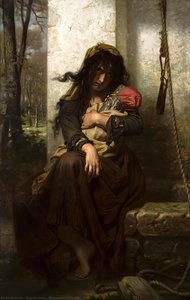
The Lunatic Of Étretat od Hugues Merle

The Lunatic Of Étretat

Oil On Canvas

In this 1871 oil on canvas, we encounter a scene of profound emotional weight. A woman sits amidst a desolate landscape, her form conveying a sense of heavy, unyielding grief. She holds a child close to her, a gesture that suggests both a desperate need for connection and a crushing sense of loss. The composition is stark, marked by the presence of a weathered log and the suggestion of a…

2
Children Playing in a Park (1860) od Hugues Merle

Children Playing in a Park

1860 · Oil On Canvas

The oil on canvas titled Children Playing in a Park was painted by Hugues Merle. This work dates to about 1860. It captures a quiet moment of youth within a lush green field, where the light settles upon the grass and the figures of children.

3
Hebe After The Fall od Hugues Merle

Hebe After The Fall

Engraving

The figure of Hebe, the Greek goddess of youth, is captured in a moment of profound transition. Following a mythological stumble that stripped her of her divine role as cupbearer, she is depicted in the immediate aftermath of her loss of status. Her posture is one of quiet distress; a hand rests against her forehead in a gesture of contemplation or shame, while her gaze remains lowered. The composition emphasizes…

4
Shepherdess with dog in the Alps (1859) od Hugues Merle

Shepherdess with dog in the Alps

1859 · Oil · Amsterdam Museum, Amsterdam

In this 1859 composition, we find ourselves transported to a rugged, mountainous landscape where the air feels thin and still. A young shepherdess occupies the center of the frame, her presence marked by a certain melancholic grace. She is dressed in rustic attire, her form rendered with a soft, painterly touch that suggests the gentle contours of her youth. Beside her, a dark-furred dog rests, providing a grounding, companionable weight…

5
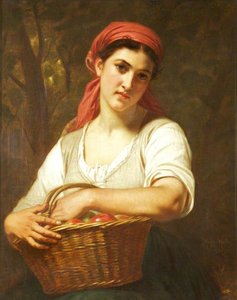
Italian girl (1863) od Hugues Merle

Italian girl

1863 · Oil

A young woman sits in a moment of profound stillness, her presence commanding the space between the viewer and the vast, hazy horizon. She is an Italian girl, captured in a medium shot that feels intimate, almost as if she has just paused her thoughts to meet our eyes. Her gaze is direct and soulful, carrying a weight of quiet dignity and a touch of melancholy that lingers in the…

6
Reading (1869) od Hugues Merle

Reading

1869 · Oil On Canvas

In this intimate oil painting from 1869, we find ourselves drawn into a dimly lit room where the air seems heavy with a soft, hushed stillness. A young woman sits at the center of the composition, her presence anchoring a triangular arrangement of figures that speaks to a profound sense of domestic tranquility. She is accompanied by two children, their forms overlapping in a way that creates a palpable sense…

7
Mother and Child (1864) od Hugues Merle

Mother and Child

1864 · Oil On Canvas

A soft, directional light spills from the upper left, washing over a scene of profound domestic peace. A young woman sits in a moment of stillness, her body curved gently around a small child. They are locked in a private, silent exchange, their attention drawn to a small book or paper held between them. The atmosphere feels heavy with a sense of nurturing and innocence. Every line is soft, blending…

9
Queen Esther (1875) od Hugues Merle

Queen Esther

1875 · Oil On Canvas

The air in the room feels heavy with anticipation as the light catches the delicate translucency of a white veil. Queen Esther sits in a moment of profound stillness, her gaze lifted upward toward an unseen source of light or perhaps a divine presence. Her skin possesses a porcelain-like clarity, glowing against the deep, dark shadows that surround her. Every detail of her presence speaks of a quiet, internal struggle…

10
Saint Elizabeth of Hungary (1879) od Hugues Merle

Saint Elizabeth of Hungary

1879 · Oil On Canvas · Detroit Institute of Arts, Detroit

Saint Elizabeth of Hungary is an oil on canvas work by the French artist Hugues Merle. Executed in 1879, the portrait captures the subject in a moment of pious devotion, characterized by an upward gaze and clasped hands. Merle, who lived from 1823 to 1881, was a prominent figure in the Parisian art scene, known for his ability to render sentimental and moral narratives through the lens of Academic realism.

Obrazy autora Hugues Merle, seřazeny od 11 do 61

Slavná díla Hugues Merle podle jednotlivých období

Motivy, které zaujaly Hugues Merle

Čtyři témata, která se v těchto originálech nejčastěji objevují, z nichž každé má svůj nejlepší příklad.

Muzea, v nichž jsou vystavena originálna umělce Hugues Merle

8 muzea, v nichž je umístěno nejvíce obrazů z této stránky.

Muzeum Město Díla autora Hugues Merle Obrazy z tohoto seznamu
Amsterdam Museum, AmsterdamAmsterdam Museum Amsterdam 1 Shepherdess with dog in the Alps
Detroit Institute of Arts, DetroitDetroit Institute of Arts Detroit 1 Saint Elizabeth of Hungary
Brooklyn Museum, BrooklynBrooklyn Museum Brooklyn 1 Thoughts of the Future
New York Historical Society, New YorkNew York Historical Society New York 1 Marguerite
Metropolitan Museum of Art, New YorkMetropolitan Museum of Art New York 1 Falling Leaves, Allegory of Autumn
Chrysler Museum of Art, NorfolkChrysler Museum of Art Norfolk 1 The Lunatic of Etretat
Musée d'Orsay, PařížMusée d'Orsay Paříž 1 A Beggar Woman
Dallas Museum of Art, DallasDallas Museum of Art Dallas 1 Young Woman And Child

Hugues Merle, jeden ikonický obraz na každé desetiletí

Díla podle dekád

Vyberte si dekádu a prohlédněte si originál, který ji definuje.

Obrazy umělce Hugues Merle: odpovědi galerie

Který obraz autora Hugues Merle je nejslavnější ze všech?Odhalit odpověď

The Lunatic Of Étretat. Následují Children Playing in a Park (1860) a Hebe After The Fall.

Kterých 10 nejlepších obrazů má Hugues Merle?Odhalit odpověď

The Lunatic Of Étretat, Children Playing in a Park, Hebe After The Fall, Shepherdess with dog in the Alps, Italian girl, Reading, Mother and Child, Mother and Child, Queen Esther a Saint Elizabeth of Hungary. Hodnocení výše uvádí rok a muzeum pro každé z nich.

Kolik děl vytvořil/a Hugues Merle?Odhalit odpověď

Náš katalog obsahuje 64 děl umělce Hugues Merle z let 1859 až 1879.

Kde jsou vystavena nejznámější originály umělce Hugues Merle?Odhalit odpověď

Většinou v Amsterdam Museum (Amsterdam), Detroit Institute of Arts (Detroit) a Brooklyn Museum (Brooklyn). V tabulce muzeí výše jsou vypsány všechny.

Kdy Hugues Merle vytvořil své nejslavnější obrazy?Odhalit odpověď

V období 1860s: 6 z celkem 61 děl na této stránce vzniklo právě tehdy, z toho Children Playing in a Park z nich.

Která jsou nejstarší a nejnovější slavná díla umělce Hugues Merle?Odhalit odpověď

Na této stránce je nejstarší dílo z Shepherdess with dog in the Alps (1859) a nejnovější z Saint Elizabeth of Hungary (1879).

Kterým tématům se Hugues Merle věnoval(a) nejčastěji?Odhalit odpověď

Woman (14), Girls (5) a Child (4) napříč 61 díly na této stránce.

V jaké technice tvořil(a) Hugues Merle nejčastěji?Odhalit odpověď

Oil On Canvas, u 9 z 61 děl na této stránce.

S jakým směrem je spojen(a) Hugues Merle?Odhalit odpověď

Academic realism, podle originálů na této stránce.

Hugues Merle: umělec

A Life Dedicated to Sentiment: The World of Hugues Merle

Hugues Merle emerged from the artistic landscape of 19th-century France as a painter deeply attuned to the prevailing currents of Academic realism and sentimental narrative. Born in 1823 in Saint Martin, a small corner of French territory nestled within the Caribbean, his early life remains somewhat shrouded in mystery – details are scarce, yet it’s likely he received some form of artistic training within his community, perhaps influenced by the Abbey Church nearby, a significant landmark steeped in medieval history. However, it was upon arriving in Paris that Merle’s artistic journey truly began to unfold. He sought tutelage under Léon Cogniet, a respected figure known for his historical and genre scenes, and this foundational training instilled in him a dedication to precise draftsmanship and compelling storytelling. This period wasn't merely about technical skill; it was an immersion into the core tenets of Academic painting—a world where classical ideals met with meticulous observation of the natural world.

The Salon Years and Rising Recognition

Merle’s entry into the Parisian art scene was marked by his debut at the prestigious Salon in 1847, a pivotal moment for any aspiring artist. This wasn't simply an exhibition; it was a proving ground where reputations were forged and careers launched. He continued to exhibit regularly throughout his career, steadily gaining recognition for his skillful technique and emotionally resonant compositions. His paintings weren’t grand historical epics or revolutionary statements—they were intimate glimpses into domestic life, often portraying women and children engaged in activities that evoked feelings of tenderness, piety, or virtue. This focus on the sentimental resonated with a public eager for art that affirmed traditional values and offered solace amidst a rapidly changing world. His talent didn’t go unnoticed by the Salon's judging panel; he was awarded second-class prizes in both 1861 and 1863, accolades that signaled his growing stature within the artistic community. The ultimate recognition came in 1866 when he was made a Chevalier of the Legion of Honor—a testament to his established reputation and contribution to French art.

Durand-Ruel’s Patronage and Artistic Circles

A crucial turning point in Merle's career arrived through his connection with Paul Durand-Ruel, one of the most influential art dealers of the 19th century. Beginning around 1862, Durand-Ruel began acquiring paintings by Merle, recognizing the artist’s talent and potential. More than just a commercial relationship, this was a partnership that propelled Merle into the heart of Parisian artistic circles. Durand-Ruel played a key role in introducing him to William-Adolphe Bouguereau, another leading Academic painter whose work shared similar themes and stylistic qualities. This connection solidified Merle’s position within the art world and contributed significantly to his increasing success. The esteem was mutual; Durand-Ruel even commissioned several portraits of himself, his wife, and their son from Merle during the mid-1860s—a clear indication of the trust and admiration he held for the artist.

Themes, Style, and Lasting Legacy

Merle’s paintings are characterized by a profound sensitivity to human emotion and a masterful command of realism. He excelled at depicting scenes of family life, religious devotion, and moral virtue, often choosing subjects that celebrated the bonds between mothers and children or explored themes of innocence and piety. Works like Reading The Bible, The Neapolitan Girl, and Maternal Love exemplify his ability to imbue everyday moments with a sense of grace and emotional depth. His dedication to realistic representation, meticulous attention to detail in rendering figures and textures, frequently drew comparisons to Bouguereau—a testament to the quality and refinement of his technique. While often overshadowed by his more famous contemporary, Merle established himself as a considerable rival in subject matter and treatment. He offered viewers paintings that were both technically accomplished and emotionally engaging, providing valuable insights into 19th-century French society and its values. Furthermore, the artistic legacy continued through his son, Georges Merle, who also became a painter, ensuring that the family’s creative spirit endured beyond Hugues's death in 1881. His work remains as a poignant reminder of an era where art sought to uplift, inspire, and celebrate the beauty found within the ordinary moments of life.

Notable Works

  • Jephtha’s Daughter: A romanticized oil painting showcasing classical beauty and sorrow.
  • Susannah At Her Bath: A stunning Pre-Raphaelite style depiction of a nude figure in serene waters, demonstrating realism and soft lighting.
  • The Neapolitan Girl: An academic-style portrait capturing the essence of a young woman in traditional Italian attire.
  • Reading The Bible: A serene depiction of women engaged in scripture, evoking feelings of piety and tranquility.
  • Maternal Love: An emotionally resonant scene celebrating the profound bond between mother and child.
  • Les Orphelines: A poignant portrayal of orphaned children, touching upon themes of vulnerability and compassion.