


1


Aktualizováno listopad 2026 · seřazeno podle našeho skóre popularity (vyhledávání, návštěvy a objednávky u každého díla) · 28 děl umělce Henri Evenepoel v našem katalogu
Stručně řečeno
Man in Red (1894) je obraz autora Henri Evenepoel, který přitahuje nejvíce pohledů; originál se nachází v Musées Royaux Des Beaux, Brusel. Poté se zrak přesouvá k My Ill Grandfather (1892) a Charles Milcendeau (1899). Z 28 děl umělce Henri Evenepoel v našem katalogu je těchto 28 těch nejznámějších; každé z nich je unikátním originálem s uvedením roku vzniku, muzea a důvodu jeho nesmrtelnosti.


This portrait, titled Charles Milcendeau, was painted by Henri Evenepoel in 1899. It captures a specific individual, Charles Edmond Théodore Soullans, who is known to us through this work as Charles Milcendeau. The painting offers a direct encounter with the subject, presented in a way that feels both personal and quiet.


 Count Aymer de la Chevalerie1896 · Královské muzeum výtvarného umění Antverpy
12
 The running girl1895 · Královské muzeum výtvarného umění Antverpy
13
 Wrestling Barrack at a Fair1898 · Královské muzeum výtvarného umění Antverpy
14
 The Poulterer1897 · Královské muzeum výtvarného umění Antverpy
15
 The Box1896 · Královské muzeum výtvarného umění Antverpy
16
 Portrait of Edward Tuck, Vice-Consul of the United States in Paris1899 · Museum of Fine Arts Ghent (MSK)
17
 Sunday at the Bois de Boulogne1899 · Královské muzeum výtvarného umění Antverpy
18
 Sunday in the Bois de Boulogne1891
19
 Portrait with the Green Chair1897 · Královské muzeum výtvarného umění Antverpy
20
 Orange Market at Blida1898 · Královské muzea krásných umění v Belgii
21
 Avenue de la Motte-Picquet in Paris1897 · Královské muzeum výtvarného umění Antverpy
22
 Sunday Fair at Les Invalides1897 · Královské muzeum výtvarného umění Antverpy
23
 Mendiant. Algerie1897
24
 Veterans' Festival1898 · Musées Royaux des Beaux-Arts
25
 Henriette in a Large Hat1899 · Musées Royaux Des Beaux
26
 La chambre de l'artiste
27
 Charles in a Striped Jersey1898
28
 The Spaniard in Paris1899 · Museum of Fine Arts Ghent (MSK)
8 muzea, v nichž je umístěno nejvíce obrazů z této stránky.
| Muzeum | Město | Díla autora Henri Evenepoel | Obrazy z tohoto seznamu |
|---|---|---|---|
 Královské muzeum výtvarného umění Antverpy |
Antverpy | 12 | My Ill Grandfather, Louise in Mourning, Returning from Work at Sunset |
 Museum of Fine Arts Ghent (MSK) |
Ghent | 4 | Portrait of Hélène Roulet, the Wife of the Artist Adolphe Crespin, The Clown, Portrait of Edward Tuck, Vice-Consul of the United States in Paris |
 Musées Royaux Des Beaux |
Brusel | 2 | Man in Red, Henriette in a Large Hat |
 Královské muzea krásných umění v Belgii |
Brusel | 2 | Pictures - Portrait of Louis Charles Crespin, Orange Market at Blida |
 Musée d'Orsay |
Paříž | 1 | Charles Milcendeau |
 Städel Museum |
Frankfurt nad Mohanem | 1 | In the Café d'Harcourt in Paris |
 Muzeum umění Houston |
Houston | 1 | At the Moulin Rouge |
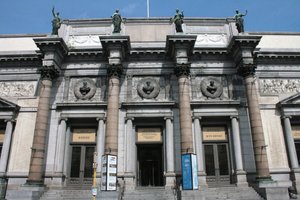 Musées Royaux des Beaux-Arts |
Brusel | 1 | Veterans' Festival |
Originální díla s datováním Henri Evenepoel, která jsou zde zobrazena, pokrývají období zhruba deseti let, od 1891 do 1899: oko je sleduje rok po roce.
Vyberte rok a prohlédněte si originály.

Více od 1896
This portrait, titled Charles Milcendeau, was painted by Henri Evenepoel in 1899. It captures a specific individual, Charles Edmond Théodore Soullans, who is known to us through this work as Charles Milcendeau. The painting offers a direct encounter with the subject, presented in a way that feels both personal and quiet.
Více od 1899
Man in Red (1894), Musées Royaux Des Beaux, Brusel. Následují My Ill Grandfather (1892) a Charles Milcendeau (1899).
22 let: dílo Man in Red pochází z roku 1894 a Henri Evenepoel se narodil/a v roce 1872.
Man in Red, My Ill Grandfather, Charles Milcendeau, In the Café d'Harcourt in Paris, Pictures - Portrait of Louis Charles Crespin, At the Moulin Rouge, Portrait of Hélène Roulet, the Wife of the Artist Adolphe Crespin, The Clown, Louise in Mourning a Returning from Work at Sunset. Hodnocení výše uvádí rok a muzeum pro každé z nich.
Náš katalog obsahuje 28 děl umělce Henri Evenepoel z let 1891 až 1899.
Většinou v Královské muzeum výtvarného umění Antverpy (Antverpy), Museum of Fine Arts Ghent (MSK) (Ghent) a Musées Royaux Des Beaux (Brusel). V tabulce muzeí výše jsou vypsány všechny.
V období 1897: 7 z celkem 28 děl na této stránce vzniklo právě tehdy, z toho In the Café d'Harcourt in Paris z nich.
Na této stránce je nejstarší dílo z Sunday in the Bois de Boulogne (1891) a nejnovější z Charles Milcendeau (1899).
My Ill Grandfather, Louise in Mourning a Returning from Work at Sunset: muzeum Královské muzeum výtvarného umění Antverpy, Antverpy má v obsluze 12 děl z této stránky.


