Portrét Hans Holbein Starší

Obrazy autora Hans Holbein Starší: 65 nejznámějších díel podle pohledu galerie

Aktualizováno listopad 2026 · seřazeno podle našeho skóre popularity (vyhledávání, návštěvy a objednávky u každého díla) · 65 děl umělce Hans Holbein Starší v našem katalogu

Stručně řečeno

Z pohledu galerie je nejslavnějším dílem Hans Holbein Starší obrazem Grey Passion (1500), jehož originál je vystaven v Staatsgalerie Stuttgart v obci Stuttgart. Kaisheim Descent from the Cross (1500) a Katherine Altar: Martyrdom of Saint Peter (1512) doplňují trio, které každé oko okamžitě pozná. Z 65 děl umělce Hans Holbein Starší v našem katalogu představuje galerie níže 65 nejznámějších děl, z nichž každé je originálem s uvedením roku vzniku, muzea a toho, co jej činí jedinečným.

1465 – 1524, Augsburg Northern renaissance Nejvíce děl: Bavarské státní sbírky malby

Top 10 obrazů umělce Hans Holbein Starší v naší galerii

1
Grey Passion (1500) od Hans Holbein Starší

Grey Passion

1500 · Oil · Staatsgalerie Stuttgart, Stuttgart

The Grey Passion is a series of twelve panels created by Hans Holbein the Elder between 1494 and 1500. These paintings illustrate the Passion of Christ, forming the wings of a larger altarpiece. The original structure was a triptych, designed to surround a central element. This centerpiece consisted of a sculpture by Gregor Erhart, which is now lost.

2
Kaisheim Descent from the Cross (1500) od Hans Holbein Starší

Kaisheim Descent from the Cross

1500 · Oil On Panel · Bavarské státní sbírky malby, Mnichov

A heavy silence hangs over the wooden beams. The body of Christ hangs limp, a pale weight being lowered from the cross. Shadows cling to the deep folds of crimson and dark green drapery, swallowing the periphery in a somber gloom. Every line follows the downward pull of gravity, tracing the path from the rigid geometry of the timber to the slumped, organic curves of the mourners. At the base,…

3
Katherine Altar: Martyrdom of Saint Peter (1512) od Hans Holbein Starší

Katherine Altar: Martyrdom of Saint Peter

1512 · Oil On Panel · Bavarské státní sbírky malby, Mnichov

Created in 1512, this work belongs to the Northern Renaissance. It reflects the transition from late Gothic traditions toward a more realistic, humanistic approach. The painting emphasizes the visceral details of the human body and the specific textures of material goods. This style is characteristic of early 16th-century German painting, where precision in draftsmanship was a primary concern. The subject matter focuses on religious devotion through the depiction of sacrifice…

4
Kaisheim Crucifixion (1500) od Hans Holbein Starší

Kaisheim Crucifixion

1500 · Oil On Panel · Bavarské státní sbírky malby, Mnichov

The Kaisheim Crucifixion is a dramatic religious painting from 1500 that captures a moment of profound sorrow. The composition is defined by a strong verticality, centering on the figure of Christ on the cross against a dark, near-black background. This high-contrast setting serves to illuminate his pale body, making him the focal point of the work. The color palette is composed of deep reds, stark whites, and heavy blacks, accented…

6
Burial of Kaisheim (1500) od Hans Holbein Starší

Burial of Kaisheim

1500 · Oil On Panel · Bavarské státní sbírky malby, Mnichov

In this somber composition from 1500, we find ourselves drawn into a tight, vertical arrangement of mourning. The scene depicts the Lamentation, a moment of profound sorrow where the physical presence of the deceased Christ is the focal point. There is a palpable sense of claustrophobia here; the figures are packed closely together, their grief pressing inward upon the viewer. The color palette relies on deep, saturated tones—crimson reds, dark…

7
Epitaph of the Vetter Sisters (1499) od Hans Holbein Starší

Epitaph of the Vetter Sisters

1499 · Oil On Panel · Bavarské státní sbírky malby, Mnichov

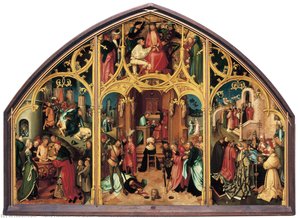
The Epitaph of the Vetter Sisters emerges from the shadows of the late Gothic era, a large-scale altarpiece that commands the space it occupies. Painted by Hans Holbein The Elder, this work dates to about 1499. It exists as a complex, multi-tiered narrative, unfolding through a series of interconnected vignettes that guide the eye across its structured, pointed, arched frame. The scale of the piece carries a weight that demands…

8
Frankfurt Dominican Altarpiece: Flagellation (1501) od Hans Holbein Starší

Frankfurt Dominican Altarpiece: Flagellation

1501 · Mixed Technique · Städel Museum, Frankfurt nad Mohanem

The Frankfurt Dominican Altarpiece: Flagellation is a significant work by Hans Holbein The Elder, dating to 1501. This painting was originally commissioned by the Dominican Convent for the High Altar of the Dominican Church in Frankfurt am Main. It remains a profound example of the artist's early period, executed during a time when his technical precision was already becoming a defining characteristic of his hand.

9
Frankfurt Dominican Altarpiece: The Entry into Jerusalem (1501) od Hans Holbein Starší

Frankfurt Dominican Altarpiece: The Entry into Jerusalem

1501 · Oil · Städel Museum, Frankfurt nad Mohanem

The Frankfurt Dominican Altarpiece: The Entry into Jerusalem is a significant work by Hans Holbein the Elder, executed in 1501. This piece functioned as the High Altar of the Dominican Church of Frankfurt. It forms a central part of a larger Passion cycle, designed to communicate the narrative of the Passion through a series of related panels.

10
Frankfurt Dominican Altarpiece: Ecce Homo (1501) od Hans Holbein Starší

Frankfurt Dominican Altarpiece: Ecce Homo

1501 · Oil On Panel · Städel Museum, Frankfurt nad Mohanem

Frankfurt Dominican Altarpiece: Ecce Homo is a work by Hans Holbein The Elder, executed in 1501. The piece belongs to the Northern Renaissance tradition, emerging from the artist's early career in the German region. It was created during a period when the transition from Late Gothic sensibilities toward Renaissance humanism was reshaping the visual language of religious art.

Obrazy autora Hans Holbein Starší, seřazeny od 11 do 65

11Frankfurt Dominican Altarpiece: The Cleansing of the Temple (1501) od Hans Holbein StaršíFrankfurt Dominican Altarpiece: The Cleansing of the Temple1501 · Städel Museum 12Frankfurt Dominican Altarpiece: Christ’s Arrest (1501) od Hans Holbein StaršíFrankfurt Dominican Altarpiece: Christ’s Arrest1501 · Städel Museum 13Frankfurt Dominican Altarpiece: Christ Washing St Peter's Feet (1501) od Hans Holbein StaršíFrankfurt Dominican Altarpiece: Christ Washing St Peter's Feet1501 · Städel Museum 14Frankfurt Dominican Altarpiece: Christ before Pontius Pilate (1501) od Hans Holbein StaršíFrankfurt Dominican Altarpiece: Christ before Pontius Pilate1501 · Städel Museum 15Frankfurt Dominican Altarpiece: Christ Crowned with Thorns (1501) od Hans Holbein StaršíFrankfurt Dominican Altarpiece: Christ Crowned with Thorns1501 · Städel Museum 16Frankfurt Dominican Altarpiece: Bearing of the Cross (1501) od Hans Holbein StaršíFrankfurt Dominican Altarpiece: Bearing of the Cross1501 · Städel Museum 17Frankfurt Dominican Altarpiece: The Agony in the Garden (1501) od Hans Holbein StaršíFrankfurt Dominican Altarpiece: The Agony in the Garden1501 · Städel Museum 18Frankfurt Dominican Altarpiece: Tree of Jesse (lower part) (1501) od Hans Holbein StaršíFrankfurt Dominican Altarpiece: Tree of Jesse (lower part)1501 · Städel Museum 19Frankfurt Dominican Altarpiece: Resurrection (1501) od Hans Holbein StaršíFrankfurt Dominican Altarpiece: Resurrection1501 · Städel Museum 20Frankfurt Dominican Altarpiece: Lineage of the Dominican Order (lower part) (1501) od Hans Holbein StaršíFrankfurt Dominican Altarpiece: Lineage of the Dominican Order (lower part)1501 · Städel Museum 21Frankfurt Dominican Altarpiece: Sunday view (1501) od Hans Holbein StaršíFrankfurt Dominican Altarpiece: Sunday view1501 · Städel Museum 22Frankfurt Dominican Altarpiece: Tree of Jesse (upper part) (1501) od Hans Holbein StaršíFrankfurt Dominican Altarpiece: Tree of Jesse (upper part)1501 · Städel Museum 23Basilica Santa Maria Maggiore (1499) od Hans Holbein StaršíBasilica Santa Maria Maggiore1499 · Bavarské státní sbírky malby 24The Virgin Mary as the Mother of Sorrows (1495) od Hans Holbein StaršíThe Virgin Mary as the Mother of Sorrows1495 · Gemäldegalerie 25Good Deeds of Empress Kunigunde (1506) od Hans Holbein StaršíGood Deeds of Empress Kunigunde1506 · Bavarské státní sbírky malby 26Kaisheim Altar: Birth of Christ (1502) od Hans Holbein StaršíKaisheim Altar: Birth of Christ1502 · Bavarské státní sbírky malby 27Kaisheim Altar: Christ before Pilate (1502) od Hans Holbein StaršíKaisheim Altar: Christ before Pilate1502 · Bavarské státní sbírky malby 28Epitaph of the Walther Sisters: Feeding of the Five Thousand (1502) od Hans Holbein StaršíEpitaph of the Walther Sisters: Feeding of the Five Thousand1502 · Bavarské státní sbírky malby 29Epitaph of the Walther Sisters: Healing of the Possessed (1502) od Hans Holbein StaršíEpitaph of the Walther Sisters: Healing of the Possessed1502 · Bavarské státní sbírky malby 30Votive Image of Ulrich Schwarz: Christ and Mary as Intercessors before God the Father (1503) od Hans Holbein StaršíVotive Image of Ulrich Schwarz: Christ and Mary as Intercessors before God the Father1503 · Bavarské státní sbírky malby 31Kaisheim Altar: Annunciation of Mary (1502) od Hans Holbein StaršíKaisheim Altar: Annunciation of Mary1502 · Bavarské státní sbírky malby 32Kaisheim Altar: Capture of Christ (1502) od Hans Holbein StaršíKaisheim Altar: Capture of Christ1502 · Bavarské státní sbírky malby 33Kaisheim Altar: Crowning of Christ with Thorns (1502) od Hans Holbein StaršíKaisheim Altar: Crowning of Christ with Thorns1502 · Bavarské státní sbírky malby 34Emperor Henry Condemns the Empress to Trial by Ordeal (1506) od Hans Holbein StaršíEmperor Henry Condemns the Empress to Trial by Ordeal1506 · Bavarské státní sbírky malby 35Emperor Henry Asks the Empress for Forgiveness (1506) od Hans Holbein StaršíEmperor Henry Asks the Empress for Forgiveness1506 · Bavarské státní sbírky malby 36Epitaph of the Walther Sisters: Transfiguration of Christ (1502) od Hans Holbein StaršíEpitaph of the Walther Sisters: Transfiguration of Christ1502 · Bavarské státní sbírky malby 37Death of Emperor Heinrich (1506) od Hans Holbein StaršíDeath of Emperor Heinrich1506 · Bavarské státní sbírky malby 38Devils Inform a Hermit That They Could Not Lay Hold of the Soul of the Emperor (1506) od Hans Holbein StaršíDevils Inform a Hermit That They Could Not Lay Hold of the Soul of the Emperor1506 · Bavarské státní sbírky malby 39The Devil in the Form of a Youth in the Chamber of Empress Kunigunde (1506) od Hans Holbein StaršíThe Devil in the Form of a Youth in the Chamber of Empress Kunigunde1506 · Bavarské státní sbírky malby 40Katharinenaltar: Saint Ulrich and Conrad (1512) od Hans Holbein StaršíKatharinenaltar: Saint Ulrich and Conrad1512 · Bavarské státní sbírky malby 41Kaisheim Altar: Visitation of Mary (1502) od Hans Holbein StaršíKaisheim Altar: Visitation of Mary1502 · Bavarské státní sbírky malby 42Kaisheim Altar: Carrying of the Cross of Christ (1502) od Hans Holbein StaršíKaisheim Altar: Carrying of the Cross of Christ1502 · Bavarské státní sbírky malby 43Kaisheim Altar: Presentation in the Temple (1502) od Hans Holbein StaršíKaisheim Altar: Presentation in the Temple1502 · Bavarské státní sbírky malby 44Kaisheim Altar: Christ on the Mount of Olives (1502) od Hans Holbein StaršíKaisheim Altar: Christ on the Mount of Olives1502 · Bavarské státní sbírky malby 45Kaisheim Altar: Resurrection of Christ (1502) od Hans Holbein StaršíKaisheim Altar: Resurrection of Christ1502 · Bavarské státní sbírky malby 46Kaisheim Altar: Adoration of the Magi (1502) od Hans Holbein StaršíKaisheim Altar: Adoration of the Magi1502 · Bavarské státní sbírky malby 47Empress Kunigunde Accused of Adultery (1506) od Hans Holbein StaršíEmpress Kunigunde Accused of Adultery1506 · Bavarské státní sbírky malby 48Kaisheim Altar: Death of Mary (1502) od Hans Holbein StaršíKaisheim Altar: Death of Mary1502 · Bavarské státní sbírky malby 49Kaisheim Altar: Temple Walk of Mary (1502) od Hans Holbein StaršíKaisheim Altar: Temple Walk of Mary1502 · Bavarské státní sbírky malby 50Kaisheim Altar: Ecce Homo (1502) od Hans Holbein StaršíKaisheim Altar: Ecce Homo1502 · Bavarské státní sbírky malby 51Kaisheim Altar: Circumcision of Christ (1502) od Hans Holbein StaršíKaisheim Altar: Circumcision of Christ1502 · Bavarské státní sbírky malby 52Empress Kunigunde Walks Over Glowing Plowshares (1506) od Hans Holbein StaršíEmpress Kunigunde Walks Over Glowing Plowshares1506 · Bavarské státní sbírky malby 53Catherine Altar: Martyrdom of Saint Catherine (1512) od Hans Holbein StaršíCatherine Altar: Martyrdom of Saint Catherine1512 · Bavarské státní sbírky malby 54Kaisheim Altar: Flagellation of Christ (1502) od Hans Holbein StaršíKaisheim Altar: Flagellation of Christ1502 · Bavarské státní sbírky malby 55Mary with the Child (1502) od Hans Holbein StaršíMary with the Child1502 · Bavarské státní sbírky malby 56Virgin with Child by Hans Holbein the Elder, Museu Nacional de Arte Antiga (1519) od Hans Holbein StaršíVirgin with Child by Hans Holbein the Elder, Museu Nacional de Arte Antiga1519 · Národní muzeum starého umění 57Portrait of a Member of the Weiss Family of Augsburg (1522) od Hans Holbein StaršíPortrait of a Member of the Weiss Family of Augsburg1522 · Städel Museum 58Basilica San Paolo Fuori Le Mura (1504) od Hans Holbein StaršíBasilica San Paolo Fuori Le Mura1504 · Bavarské státní sbírky malby 59Ecce Homo (Grey Passion-6) (1500) od Hans Holbein StaršíEcce Homo (Grey Passion-6)1500 · Staatsgalerie Stuttgart 60Bildnis Der Nonne Veronika Vetter (1499) od Hans Holbein StaršíBildnis Der Nonne Veronika Vetter1499 61Christ in silence (Grey Passion-9) (1500) od Hans Holbein StaršíChrist in silence (Grey Passion-9)1500 · Staatsgalerie Stuttgart 62Maria Der Verkündigung (Sebastiansaltar) (1516) od Hans Holbein StaršíMaria Der Verkündigung (Sebastiansaltar)1516 · Bavarské státní sbírky malby 63Portrait of a Wife of An Unknown Stonemason (1505) od Hans Holbein StaršíPortrait of a Wife of An Unknown Stonemason1505 64Grey Passion (1500) od Hans Holbein StaršíGrey Passion1500 · Staatsgalerie Stuttgart 65The crown of thorns (Grey Passion-5) (1500) od Hans Holbein StaršíThe crown of thorns (Grey Passion-5)1500 · Staatsgalerie Stuttgart

Slavná díla Hans Holbein Starší podle jednotlivých období

Motivy, které zaujaly Hans Holbein Starší

Čtyři témata, která se v těchto originálech nejčastěji objevují, z nichž každé má svůj nejlepší příklad.

Muzea, v nichž jsou vystavena originálna umělce Hans Holbein Starší

5 muzea, v nichž je umístěno nejvíce obrazů z této stránky.

Muzeum Město Díla autora Hans Holbein Starší Obrazy z tohoto seznamu
Bavarské státní sbírky malby, MnichovBavarské státní sbírky malby Mnichov 40 Kaisheim Descent from the Cross, Katherine Altar: Martyrdom of Saint Peter, Kaisheim Crucifixion
Städel Museum, Frankfurt nad MohanemStädel Museum Frankfurt nad Mohanem 16 Frankfurt Dominican Altarpiece: Flagellation, Frankfurt Dominican Altarpiece: The Entry into Jerusalem, Frankfurt Dominican Altarpiece: Ecce Homo
Staatsgalerie Stuttgart, StuttgartStaatsgalerie Stuttgart Stuttgart 5 Grey Passion, Ecce Homo (Grey Passion-6), Christ in silence (Grey Passion-9)
Gemäldegalerie, BerlínGemäldegalerie Berlín 1 The Virgin Mary as the Mother of Sorrows
Národní muzeum starého umění, LisabonNárodní muzeum starého umění Lisabon 1 Virgin with Child by Hans Holbein the Elder, Museu Nacional de Arte Antiga

Hans Holbein Starší, jeden ikonický obraz na každé desetiletí

Díla podle dekád

Vyberte si dekádu a prohlédněte si originál, který ji definuje.

Obrazy umělce Hans Holbein Starší: odpovědi galerie

Který obraz autora Hans Holbein Starší je nejslavnější ze všech?Odhalit odpověď

Grey Passion (1500), Staatsgalerie Stuttgart, Stuttgart. Následují Kaisheim Descent from the Cross (1500) a Katherine Altar: Martyrdom of Saint Peter (1512).

Kolik let bylo Hans Holbein Starší, když dokončil/a Grey Passion?Odhalit odpověď

35 let: dílo Grey Passion pochází z roku 1500 a Hans Holbein Starší se narodil/a v roce 1465.

Kterých 10 nejlepších obrazů má Hans Holbein Starší?Odhalit odpověď

Grey Passion, Kaisheim Descent from the Cross, Katherine Altar: Martyrdom of Saint Peter, Kaisheim Crucifixion, Katherine Altar: Saint Anne Self-Third, Burial of Kaisheim, Epitaph of the Vetter Sisters, Frankfurt Dominican Altarpiece: Flagellation, Frankfurt Dominican Altarpiece: The Entry into Jerusalem a Frankfurt Dominican Altarpiece: Ecce Homo. Hodnocení výše uvádí rok a muzeum pro každé z nich.

Kolik děl vytvořil/a Hans Holbein Starší?Odhalit odpověď

Náš katalog obsahuje 65 děl umělce Hans Holbein Starší z let 1495 až 1522.

Kde jsou vystavena nejznámější originály umělce Hans Holbein Starší?Odhalit odpověď

Většinou v Bavarské státní sbírky malby (Mnichov), Städel Museum (Frankfurt nad Mohanem) a Staatsgalerie Stuttgart (Stuttgart). V tabulce muzeí výše jsou vypsány všechny.

Kdy Hans Holbein Starší vytvořil své nejslavnější obrazy?Odhalit odpověď

V období 1500s: 54 z celkem 65 děl na této stránce vzniklo právě tehdy, z toho Grey Passion z nich.

Která jsou nejstarší a nejnovější slavná díla umělce Hans Holbein Starší?Odhalit odpověď

Na této stránce je nejstarší dílo z The Virgin Mary as the Mother of Sorrows (1495) a nejnovější z Portrait of a Member of the Weiss Family of Augsburg (1522).

Kterým tématům se Hans Holbein Starší věnoval(a) nejčastěji?Odhalit odpověď

People (21), Drapery (18) a Figures (15) napříč 65 díly na této stránce.

V jaké technice tvořil(a) Hans Holbein Starší nejčastěji?Odhalit odpověď

Oil On Panel, u 40 z 65 děl na této stránce.

S jakým směrem je spojen(a) Hans Holbein Starší?Odhalit odpověď

Northern renaissance, podle originálů na této stránce.

Jaká originální díla Hans Holbein Starší má v obsluze Bavarské státní sbírky malby?Odhalit odpověď

Kaisheim Descent from the Cross, Katherine Altar: Martyrdom of Saint Peter a Kaisheim Crucifixion: muzeum Bavarské státní sbírky malby, Mnichov má v obsluze 40 děl z této stránky.

Hans Holbein Starší: umělec

Mistr portrétu severní renesance: Hans Holbein Starší

Hans Holbein Starší, jméno, které je synonymem pro precizní detail a hluboký psychologický vhled, stojí jako jedna z nejdůležitějších postav přechodu od pozdní gotiky k vrcholné renesance. Narodil se v německém Augsburgu kolem roku 1465 – přestože přesná data zůstávají nejasná – a rozkvétal v období obrovských uměleckých změn, které překlenuly propast mezi náboženským žilným duchem středověkého světa a rodícím se humanismem renesance. Jeho raný život je částečně zahalen tajemstvím; je však známo, že svou první kroky učil v dílně svého otce, Hansa Holbeina mladšího (kterého si nelze pamatovat s jeho slavnějším synem), váženého malíře a grafika. Tento rodinný základ mu vtiskl hlubokou úctu k přesné kresbě a poskytl mu brzyjší mistrovství v technikách, jako je tempera a olejomalba. Samotné Augsburg bylo živoucím uměleckým centrem, které podchvalovalo prostředí, kde inovace prosperovala vedle upevněných tradic. Holbeinovy počáteční díla toto prostředí zrcadlí – jsou to detailní oltáře a devoceční panely charakterizované složitou ornamentikou a typicky severoevropskou senzibilitou. Rychle si získal uznání pro svou schopnost vykreslit textury s ohromujícím realismem, od jemných záhybků látky až po lesk leštěného kovu.

Cesta německými zeměmi: Baslism a okolí

Holbeinova kariéra jej zaváděla skrze několik významných německých měst, z nichž každé zanechalo nesmazatelnou stopu v jeho uměleckém vývoji. Působil v Ulmě, Kolíně nad Rýnem a nakonec se v roce 1516 usadili v Baselu. Toto období se ukázalo jako klíčové. Basel byl tehdy pulzujícím středem humanistického myšlení, který přitahoval učence, tiskáře i umělce. Styl Hansa Holbeina Staršího se v této době začal vyvíjet pod vlivem italských mistrů renesance, jejichž díla se městem šířila prostřednictvím grafik a cestujících umělců. Ačkoliv pokračoval v tvorbě náboženských obrazů, jeho pozornost se stále více přesouvávala k portrétnímu malarství – žánru, který mu umožnil zkoumat komplexitu lidské povahy s dosud nesmírnou hloubkou. Stal se vysoce žádaným mezi baselskou elitou, která si nechávala zachytit svou podobu v portrétech, jež nebyly pouhými reprezentacemi, ale hlubokými psychologickými studií. Jeho práce s barvami se stávala sofistikovanější a začal experimentovat s novými kompozičními technikami, často umisťoval své subjekty na neutrální pozadí, aby podtrhl jejich individualitu. Právě v této době se Holbein také ponořil do dřetivého světa knižní ilustrace, zejména při tvorbě série Tanec smrti, která představuje mocnou meditaci nad smrtelností a vykazuje jeho mimořádné grafické schopnosti i schopnost společenského komentáře. Tato série, s její syrovou obrazovostí a alegorickými postavami, upevnila jeho pověst umělce schopného pracovat s hlubokými filozofickými tématy.

Anglický dvůr a umělecký triumf

V roce 1526 se Holbein vydal na svou první cestu do Anglie, což byl zážitek, který dramaticky změnil celou jeho profesní dráhu. Původně hledal ochranu a podporu u sira Thomase More, významného humanistického vědce a státníka. Toto spojení mu otevřelo dveře k zakázkám od dalších členů anglického dvora, včetně krále Jindřicha VIII. a nejvyšších šlechticů. Portréty Tudorské elity jsou bezpochyby jeho nejslavnějšími díly – jsou to mistrovská díla realismu, diplomacie a hlubokého psychologického vhledu. Holbein disponoval neuvěřitelnou schopností zachytit nejen fyzickou podobu svých modelů, ale také jejich osobnost, ambice a společenské postavení. Jeho portrét Jindřicha VIII. je například mocným vyjádřením královské autority, které vyzařuje impozantní přítomnost krále a jeho neochvějnou moc. Holbeinova technika v Anglii spočívala v pokročilém vrstvení tenkých olejových glazur na pečlivě připravené panely, čímž vytvářel povrchy smilyvující se až neuvěřitelným, životem pulzujícím detailem. Naučil se také mistrovsky pracovat se symbolickými prvky v portrétech, kterými jemně komunikoval informace o statusu a přesvědčení svých subjektů. Jeho úspěch na anglickém dvore se stal základem pro období relativního prosperity a umělecké svobody.

Odkaz a nesmrtelný vliv

Hans Holbein Starší zemřel v Augsburgu v roce 1543 a zanechal po sobě odkaz, který i dnes neustále inspiruje umělce po celém světě. Ačkoliv jeho syn, Hans Holbein mladší, dosáhl ještě větší slávy, zásluhy staršího Holbeina byly naprosto zásadní pro rozvoj portrétní tvorby a grafického umění severní renesance. Jeho precizní technika, psychologická hloubka a schopnost zachytit složitost lidského charakteru jej vyrazovaly z řad jeho současníků. Jeho vliv lze spatřit v dílech pozdějších mistrů, včetně Rembrandta a Van Dycka, kteří obdivovali jeho mistrovství v práci se světlem a stínem i jeho schopnost vyjádřit osobnost skrze portrét. Série Tanec smrti zůstává mocným svědectvím jeho grafických dovedností a společenského komentáře. Navíc Holbeinovy portréty Tudorovské elity poskytují nepostradatelný vhled do osobností a mocenských dynamik šestnáctthleťvské Anglie. Nebyl to pouze malíř; byl to kronikář jedné éry, který zachytil jejího ducha v každém tahu štětcem i v každém dřetivu.
  • Mistrovský realismus a neuvěřitelná pozornost k detailu.
  • Průkopnický psychologický vhled do portrétní tvorby.
  • Významný přínos k knižní ilustraci prostřednictvím série Tanec smrti.
  • Propojení estetiky gotiky a renesančních uměleckých stylů.
Jeho dílo je i nadále oslavováno pro svou technickou brilanci, intelektuální hloubku a nesmrtelnou krásu.