Early Life and Artistic Beginnings
Gyula Batthyány, born in Ikervár on May 10th, 1887, inherited a lineage steeped in Hungarian history and aristocracy. His father, Count Lajos Batthyány, was a prominent figure—governor of Fiume and a member of parliament—while his mother, Countess Ilona Andrássy, further cemented the family’s position within Hungary's elite circles. Perhaps most significantly, he was the great-grandson of Lajos Batthyány, the nation’s first Prime Minister, a connection that would subtly inform his later artistic explorations of Hungarian identity and society. Even in early childhood, a precocious talent manifested; by the age of three, young Gyula had already begun to draw, hinting at the creative path he was destined to follow. His formal education commenced at the prestigious Hungarian Academy of Fine Arts, where he studied under the guidance of
János Vaszary. However, his artistic horizons extended beyond Hungary’s borders. In 1907, he ventured to Munich to learn from
Angelo Jank, and subsequently spent time at the Académie Julian in Paris (1910-1913), forging friendships with luminaries like
Léon Bakst—a relationship that would profoundly shape his aesthetic sensibilities. A year after his Parisian studies, Batthyány’s work was already garnering attention, exhibited at the Ernst Museum in Budapest, signaling the emergence of a distinctive artistic voice.
A Career Defined by Style and Social Commentary
Batthyány's career unfolded against a backdrop of shifting social and political currents in Hungary. He first gained recognition through exhibitions alongside Beck Ö. Fülöp in 1914 at the Ernst Museum, establishing himself within the Budapest art scene. Regular displays followed at the Art Gallery and National Salon between 1921 and 1938, solidifying his presence as a key figure of Hungarian
modernism. In 1922, he founded an artist colony in Bicske, fostering a creative environment that allowed him to further develop his unique style. From the 1920s onward, Batthyány’s artistic pursuits expanded into theater design, heavily influenced by the set and costume work of Sergei Diaghilev's collaborator, Leonid
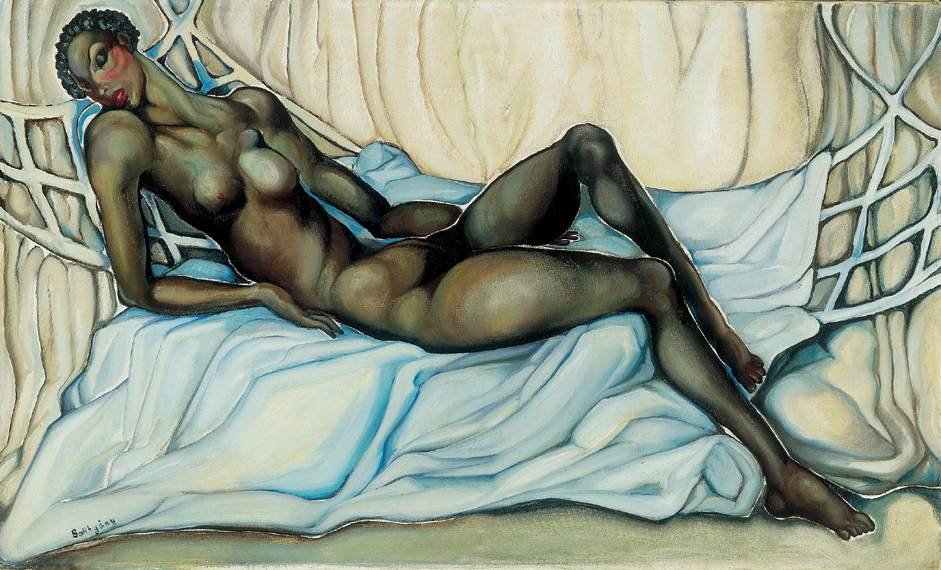
Bakst. This foray into theatricality would become a defining characteristic of his paintings—a sense of drama, pose, and carefully constructed artifice. His works often depicted scenes from aristocratic society, but these were not simple celebrations of wealth or privilege. Instead, Batthyány offered a subtly satirical commentary on the hollowness and decadence lurking beneath the surface of elegance. He uniquely portrayed luxurious pleasure girls, elegant gentlemen, gangsters—posing, theatrical characters inhabiting an aristocratic milieu brimming with sultry eroticism.
Influences and Artistic Development
Batthyány’s artistic style was a complex synthesis of various influences, blending elements of late
Art Nouveau with Expressionist tendencies and a touch of
Mannerism. The elongated figures in his paintings recall the work of
El Greco, while the overall decorativeness hints at the illustration styles of
Surrealism and
Art Deco. He drew inspiration from artists like Daumier, whose
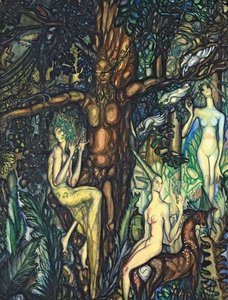
social realism resonated with Batthyány’s own critical perspective on society. However, he wasn't merely imitating these masters; he forged a distinctive visual language characterized by gracefully elongated forms, swirling
organic shapes, and a
dreamlike quality that set his work apart. His paintings are not static representations of reality but rather energetic compositions where form and color intertwine to create an atmosphere of tension and intrigue. The use of texture—often achieved through
mixed media—further enhances the emotional impact of his works, adding depth and complexity to their surfaces.
Major Achievements and Historical Significance
Throughout his career, Batthyány received numerous accolades for his artistic achievements, including silver medals in San Francisco (1916) and Barcelona (1930), as well as a gold medal in Paris (1934). He also earned a bronze medal at the 1937 World Exhibition in Paris. However, perhaps his most significant achievement lies not in awards but in the enduring power of his paintings to capture a specific moment in Hungarian history and society. His works offer a glimpse into the lives of the aristocracy—their pleasures, their anxieties, and their moral ambiguities. He was a known opponent of national socialists, which led to his unjust imprisonment for eight years in 1952. Despite spending five years incarcerated in Márianosztra and having his property confiscated, he continued to create art, albeit under difficult circumstances. After his release, he lived in relative seclusion until his death in Polgárdi in 1959. Today, Batthyány’s paintings are held in the collection of the
Hungarian National Gallery and other museums around the world, serving as a testament to his artistic vision and historical importance. His legacy endures as a powerful voice of
social commentary and a master of evocative
realism.