Portrét Giovanni Baronzio

20 nejslavnějších obrazů autora Giovanni Baronzio, každý naprosto unikátní

Aktualizováno listopad 2026 · seřazeno podle našeho skóre popularity (vyhledávání, návštěvy a objednávky u každého díla) · 20 děl umělce Giovanni Baronzio v našem katalogu

Stručně řečeno

Scenes from the Life of St Colomba: St Colomba Saved by a Bear (1340) je obraz autora Giovanni Baronzio, který přitahuje nejvíce pohledů; originál se nachází v Pinacoteca di Brera, Milán. Poté se zrak přesouvá k Madonna and Child with Five Angels (1335) a The Coronation of the Virgin (1330). Z 20 děl umělce Giovanni Baronzio v našem katalogu je těchto 20 těch nejznámějších; každé z nich je unikátním originálem s uvedením roku vzniku, muzea a důvodu jeho nesmrtelnosti.

Nejvíce děl: Gemäldegalerie

Top 10 obrazů autora Giovanni Baronzio podle výběru galerie

1
Scenes from the Life of St Colomba: St Colomba Saved by a Bear (1340) od Giovanni Baronzio

Scenes from the Life of St Colomba: St Colomba Saved by a Bear

1340 · Tempera On Panel · Pinacoteca di Brera, Milán

In the mid-fourteenth century, the air of the late Middle Ages held a heavy, spiritual tension. Giovanni Baronzio captured this friction in 1340, freezing a moment where the natural world and the divine collide. A lion lunges, its predatory intent sharp and lethal, yet the expected violence is interrupted. A bear enters the frame, not as a beast of chaos, but as an instrument of God’s will. The scene shifts…

2
Madonna and Child with Five Angels (1335) od Giovanni Baronzio

Madonna and Child with Five Angels

1335 · Tempera On Panel · National Gallery of Art, Washington

This highly stylized, sacred religious painting from the Trecento period features a formal, hierarchical composition. The Madonna is seated centrally, holding the Christ Child, and is surrounded by five angels. The artwork is characterized by a vertical, rectangular format and a shallow depth that creates an otherworldly, eternal atmosphere.

4
The Angel of the Annunciation (top), the Nativity and Annunciation to the Shepherds (centre), the Adoration of the Magi (bottom) (1337) od Giovanni Baronzio

The Angel of the Annunciation (top), the Nativity and Annunciation to the Shepherds (centre), the Adoration of the Magi (bottom)

1337 · Tempera On Panel · Barber Institute of Fine Arts, Birmingham

The sacred narrative unfolds across the vertical expanse of The Angel of the Annunciation (top), the Nativity and Annunciation to the Shepherds (centre), the Adoration of the Magi (bottom). This multi-tiered religious polyptych, painted by Giovanni Baronzio, captures the essential moments of the life of Christ through a series of stacked, devotional scenes. Each register holds a different chapter of the divine story, from the celestial messenger appearing in the…

5
Untitled (D2X2GU) (1340) od Giovanni Baronzio

Untitled (D2X2GU)

1340 · Painting · Metropolitan Museum of Art, New York

To gaze upon this painting is to step directly into the vibrant heart of the fourteenth century, where sacred narrative was not merely depicted but lived upon the panel. This exquisite work, titled Untitled (D2X2GU), presents a breathtaking panorama encompassing various pivotal moments from the life of Christ. It is an immersive experience, drawing the viewer into a bustling tableau populated by at least thirteen figures, each caught in a…

6
Scenes from the Life of St Colomba: Beheading of St Colomba (1340) od Giovanni Baronzio

Scenes from the Life of St Colomba: Beheading of St Colomba

1340 · Tempera On Panel · Pinacoteca di Brera, Milán

In the quiet intensity of this fourteenth-century masterpiece, Giovanni Baronzio invites us into a scene of profound spiritual drama and visceral human emotion. Scenes from the Life of St Colomba: Beheading of St Colomba is not merely a depiction of a historical execution; it is a carefully choreographed window into the late medieval soul. The composition centers on the harrowing moment of martyrdom, where the physical violence of the beheading…

7
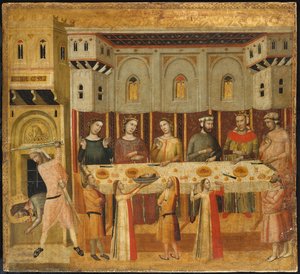
The Feast of Herod and the Beheading of the Baptist (1330) od Giovanni Baronzio

The Feast of Herod and the Beheading of the Baptist

1330 · Tempera On Panel · Metropolitan Museum of Art, New York

To stand before Giovanni Baronzio's "The Feast of Herod and the Beheading of the Baptist" is to step directly into the charged atmosphere of fourteenth-century Rimini. This tempera on panel, dating to 1330, is far more than a mere depiction of martyrdom; it is a masterful convergence of narrative drama, profound religious symbolism, and groundbreaking artistic technique. Baronzio, a key figure in the vibrant, yet often overlooked, school of Romagna,…

8
The Birth, Naming, and Circumcision of Saint John the Baptist (1335) od Giovanni Baronzio

The Birth, Naming, and Circumcision of Saint John the Baptist

1335 · Tempera On Panel · National Gallery of Art, Washington

The Birth, Naming, and Circumcision of Saint John the Baptist is a tempera on panel work by Giovanni Baronzio. Created about 1335, the piece belongs to the fourteenth-century Riminese school of painting. This period saw the development of a distinct visual language in the Romagna and Marche regions, heavily influenced by the stylistic innovations of Giotto di Bondone.

9
St Colomba Saved by a Bear (detail) (1340) od Giovanni Baronzio

St Colomba Saved by a Bear (detail)

1340 · Tempera On Panel · Pinacoteca di Brera, Milán

This work is titled St Colomba Saved by a Bear (detail) and was executed by the artist Giovanni Baronzio. The piece is dated to about 1340. It represents a specific section of a larger narrative composition centered on a religious scene involving St. Colomba and a bear.

Slavná díla umělce Giovanni Baronzio, čísla 11 až 20

Motivy, které zaujaly Giovanni Baronzio

Čtyři témata, která se v těchto originálech nejčastěji objevují, z nichž každé má svůj nejlepší příklad.

Muzea, v nichž jsou vystavena originálna umělce Giovanni Baronzio

7 muzea, v nichž je umístěno nejvíce obrazů z této stránky.

Muzeum Město Díla autora Giovanni Baronzio Obrazy z tohoto seznamu
Gemäldegalerie, BerlínGemäldegalerie Berlín 6 Five Panels with Scenes from the Life of Christ, Descent of the Holy Ghost, Ascension of Christ
Pinacoteca di Brera, MilánPinacoteca di Brera Milán 3 Scenes from the Life of St Colomba: St Colomba Saved by a Bear, Scenes from the Life of St Colomba: Beheading of St Colomba, St Colomba Saved by a Bear (detail)
National Gallery of Art, WashingtonNational Gallery of Art Washington 2 Madonna and Child with Five Angels, The Birth, Naming, and Circumcision of Saint John the Baptist
Metropolitan Museum of Art, New YorkMetropolitan Museum of Art New York 2 Untitled (D2X2GU), The Feast of Herod and the Beheading of the Baptist
Yale University Art Gallery, New HavenYale University Art Gallery New Haven 1 The Coronation of the Virgin
Barber Institute of Fine Arts, BirminghamBarber Institute of Fine Arts Birmingham 1 The Angel of the Annunciation (top), the Nativity and Annunciation to the Shepherds (centre), the Adoration of the Magi (bottom)
Liechtenstein Museum, VídeňLiechtenstein Museum Vídeň 1 Centrepiece of a Polyptych

Giovanni Baronzio v průběhu let: unikátní originály každého díla

Dlouhá kariéra trvající 16 let, od 1330 do 1345: nejznámější originály umělce Giovanni Baronzio představené rok po roce.

Díla podle roku

Vyberte rok a prohlédněte si originály.

Obrazy umělce Giovanni Baronzio: dotazy pro galerii

Kterým nejznámějším dílem je Giovanni Baronzio?Odhalit odpověď

Scenes from the Life of St Colomba: St Colomba Saved by a Bear (1340), Pinacoteca di Brera, Milán. Následují Madonna and Child with Five Angels (1335) a The Coronation of the Virgin (1330).

Kterých deset obrazů autora Giovanni Baronzio je nejznámějších?Odhalit odpověď

Scenes from the Life of St Colomba: St Colomba Saved by a Bear, Madonna and Child with Five Angels, The Coronation of the Virgin, The Angel of the Annunciation (top), the Nativity and Annunciation to the Shepherds (centre), the Adoration of the Magi (bottom), Untitled (D2X2GU), Scenes from the Life of St Colomba: Beheading of St Colomba, The Feast of Herod and the Beheading of the Baptist, The Birth, Naming, and Circumcision of Saint John the Baptist, St Colomba Saved by a Bear (detail) a Five Panels with Scenes from the Life of Christ. Hodnocení výše uvádí rok a muzeum pro každé z nich.

Kolik známých děl má autor Giovanni Baronzio?Odhalit odpověď

Náš katalog obsahuje 20 děl umělce Giovanni Baronzio z let 1330 až 1345.

Kde lze vidět nejznámější originály umělce Giovanni Baronzio?Odhalit odpověď

Většinou v Gemäldegalerie (Berlín), Pinacoteca di Brera (Milán) a National Gallery of Art (Washington). V tabulce muzeí výše jsou vypsány všechny.

V jakém období vytvořil(a) Giovanni Baronzio svá nejznámější obrazy?Odhalit odpověď

V období 1340: 4 z celkem 20 děl na této stránce vzniklo právě tehdy, z toho Scenes from the Life of St Colomba: St Colomba Saved by a Bear z nich.

Který slavný obraz od Giovanni Baronzio je nejstarší a který nejnovější?Odhalit odpověď

Na této stránce je nejstarší dílo z The Coronation of the Virgin (1330) a nejnovější z Centrepiece of a Polyptych (1345).

Jakým tématům se Giovanni Baronzio věnoval/a nejčastěji?Odhalit odpověď

Scenes (4), Medieval art (3) a Woman (3) napříč 20 díly na této stránce.

Jaké materiály používal(a) Giovanni Baronzio nejčastěji?Odhalit odpověď

Tempera On Panel, u 8 z 20 děl na této stránce.

Jaká originální díla Giovanni Baronzio mohu vidět v Gemäldegalerie?Odhalit odpověď

Five Panels with Scenes from the Life of Christ, Descent of the Holy Ghost a Ascension of Christ: muzeum Gemäldegalerie, Berlín má v obsluze 6 děl z této stránky.

Giovanni Baronzio: portrét umělce

Giovanni Baronzio: A Rimini Master of the Fourteenth Century

The name Giovanni Baronzio, often rendered as Giovanni da Rimini, represents a pivotal figure in the artistic landscape of late medieval Italy – specifically, the burgeoning school of painting centered around the city of Rimini. While shrouded in some historical ambiguity, and initially misidentified with other artists, modern scholarship has firmly established Baronzio as a distinct and remarkably talented painter active during the second quarter of the 14th century. His legacy lies not in grand, monumental works, but rather in a series of exquisitely detailed panels and frescoes that offer a compelling glimpse into the evolving artistic traditions of Romagna and Marche – regions deeply influenced by the innovations of Giotto di Bondone.

Born around 1320 (though his precise birthdate remains elusive), Baronzio’s early life is largely undocumented. What we know with certainty is that he emerged as a painter during a period of intense artistic ferment, inheriting and adapting the stylistic principles of Giotto while simultaneously forging his own unique visual language. The documentary evidence pointing to him as an artist comes primarily from a deed dated 1343, which identifies “Iohanne Baroncio pictore” – John Baronzio, painter – as a witness. This single record provides the foundation for understanding his career and artistic identity.

The Influence of Giotto and the Rimini School

Baronzio’s work is inextricably linked to the legacy of Giotto di Bondone, who had established a workshop in Rimini around 1300. Giotto's influence on the Riminese school was profound, shaping its approach to composition, color, and figural representation. Baronzio, like his contemporaries Giuliano, Pietro, and Giovanni da Rimini, absorbed these principles, yet he didn’t simply replicate them; instead, he skillfully integrated them into a distinctly local style. This involved a careful attention to detail, a refined use of color palettes – often employing muted earth tones and delicate blues and greens – and an emphasis on creating a sense of depth and realism within the confines of panel painting.

The “polyptych representing the Madonna and Child Enthroned with Saints” (now in the Galleria Nazionale delle Marche, Palazzo Ducale, Urbino) stands as the cornerstone of our understanding of Baronzio’s oeuvre. This monumental work, dating from around 1340-45, showcases his technical skill and artistic sensibility. It also provides a crucial starting point for reconstructing his broader body of work, which includes scenes from the life of Christ, devotional panels, and likely numerous altarpieces that have unfortunately vanished or remain unattributed.

Key Works and Artistic Techniques

Among Baronzio’s most celebrated works are the “Scenes from the Life of Christ” (circa 1345), now housed in the Metropolitan Museum of Art in New York. These panels, originally part of a diptych, demonstrate his ability to capture dramatic moments and convey profound emotion through carefully rendered figures and evocative compositions. The use of light and shadow is particularly noteworthy, creating a sense of volume and realism that was characteristic of Giotto’s style.

Baronzio's artistic approach can be characterized by several key features: meticulous attention to detail, a refined chromatic sensibility, and an adherence to established Riminese iconography. He skillfully employed decorative patterns and intricate details – a hallmark of the local school’s tradition – while simultaneously demonstrating a remarkable command of perspective and spatial relationships. His work is not overly stylized or manneristic; rather, it possesses a quiet dignity and understated elegance.

Legacy and Historical Significance

Giovanni Baronzio's contribution to the artistic heritage of Romagna and Marche is significant, though often overshadowed by the more prominent figures of Giotto and his immediate disciples. He represents a crucial link in the chain of artistic transmission, preserving and developing the stylistic innovations of the early 14th century. His work provides valuable insights into the evolving artistic practices of the period and demonstrates the enduring influence of Giotto’s legacy on the region's painting traditions.

Despite the scarcity of surviving works, Baronzio’s art continues to fascinate scholars and art enthusiasts alike. His meticulous attention to detail, his refined use of color, and his skillful integration of established iconography make him a compelling figure in the history of Italian Renaissance painting – a master whose quiet brilliance deserves renewed recognition.