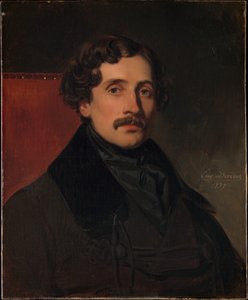
Portrét Eugène Devéria

33 nejslavnějších obrazů autora Eugène Devéria, každý naprosto unikátní

Aktualizováno listopad 2026 · seřazeno podle našeho skóre popularity (vyhledávání, návštěvy a objednávky u každého díla) · 33 děl umělce Eugène Devéria v našem katalogu

Stručně řečeno

Portrait of Monsieur Couche (1824) je obraz autora Eugène Devéria, který přitahuje nejvíce pohledů; originál se nachází v Detroit Institute of Arts, Detroit. Poté se zrak přesouvá k Young Women Sitting (1827) a The Assassination (1828). Z 33 děl umělce Eugène Devéria v našem katalogu je těchto 33 těch nejznámějších; každé z nich je unikátním originálem s uvedením roku vzniku, muzea a důvodu jeho nesmrtelnosti.

1805 – 1865, Paříž Nejvíce děl: Musée des Beaux-Arts de Pau

Top 10 obrazů autora Eugène Devéria podle výběru galerie

2
Young Women Sitting (1827) od Eugène Devéria

Young Women Sitting

1827 · Oil On Canvas

In the oil painting Young Women Sitting by Eugène Devéria, the composition is centered on a woman seated upon a large, gilded yellow chaise longue. To the left, a second woman reclines, her form partially obscured by heavy red drapery. The scene is set within an opulent interior where the color palette is dominated by deep reds, golds, and creams. This arrangement creates a shallow perspective that directs the viewer's…

3
The Assassination (1828) od Eugène Devéria

The Assassination

1828 · Oil On Canvas · Reading Public Museum, Reading

We find ourselves before The Assassination, a significant work by the French painter Eugène Devéria. This piece was executed about 1828, a period when the artist was beginning to establish his presence within the Parisian art scene. Devéria, who was born in Paris, France, in 1805, brought a specific sense of historical gravity to his compositions, a quality that is palpable in this particular canvas.

4
Portrait of General Joseph-Léopold Sigisbert Hugo (1835) od Eugène Devéria

Portrait of General Joseph-Léopold Sigisbert Hugo

1835 · Oil On Canvas · Musée Victor Hugo, Paříž

The subject is captured in a moment of quiet authority, positioned centrally against a somber, atmospheric landscape. He wears a dark blue military tunic, heavily detailed with gold braided aiguillettes, epaulettes, and medals that catch a sharp, directional light. This illumination, striking from the upper left, defines the contours of his face and the metallic textures of his uniform while casting the background into deep shadow. A sense of monumental…

5
Puget Presenting His Statue of Milon de Crotone to Louis XIV, in the Gardens of Versailles (1832) od Eugène Devéria

Puget Presenting His Statue of Milon de Crotone to Louis XIV, in the Gardens of Versailles

1832 · Oil On Canvas

In this 1832 oil on canvas, we find ourselves within the formal, structured elegance of the Gardens of Versailles. The scene captures a specific historical intersection: the presentation of a sculpture by Puget to the French monarchy. At the heart of the composition, a large, muscular statue of Milon de Crotone commands the viewer's attention. The figure is rendered with a sense of physical weight, its pale, marble-like surface contrasting…

6
Puget Presenting His Statue of Milo of Croton to Louis XIV, in the Gardens of Versailles (1832) od Eugène Devéria

Puget Presenting His Statue of Milo of Croton to Louis XIV, in the Gardens of Versailles

1832 · Oil On Canvas

The scene unfolds in the grand, manicured expanse of the Gardens of Versailles, where the air feels heavy with the weight of ceremony. Here, the artist Eugène Devéria captures a moment of profound historical significance. In this work, titled Puget Presenting His Statue of Milo of Croton to Louis XIV, in the Gardens of Versailles, the viewer finds themselves amidst a gathering of the French elite. The composition centers on…

7
Portrait of the Artist and His Brother Achille (1836) od Eugène Devéria

Portrait of the Artist and His Brother Achille

1836 · Terracotta · Opera House, Versailles

The gaze settles upon Portrait of the Artist and His Brother Achille, a work that brings together two figures bound by blood and art. This piece is the creation of Eugène Devéria, a man whose life began in Paris, France, in 1805. He carries the weight of a long creative life until his passing in 1865. Within this frame, the artist captures a personal connection, presenting himself alongside his brother,…

8
Breton Family Praying Before a Country Oratory (1838) od Eugène Devéria

Breton Family Praying Before a Country Oratory

1838 · Oil · Musée des Beaux-Arts de Quimper, Quimper

In Breton Family Praying Before a Country Oratory, Eugène Devéria arranges a quiet, intimate scene of religious devotion. The composition is centered on a group of five figures—two men, one woman, and two children—who are gathered in a moment of shared prayer. They are positioned in a triangular formation, a structural choice that provides a sense of stability and familial unity. This geometric arrangement naturally directs the viewer's eye toward…

9
Sketch for the church Notre-Dame-de-Lorette: Apotheosis of Saint Genevieve (1835) od Eugène Devéria

Sketch for the church Notre-Dame-de-Lorette: Apotheosis of Saint Genevieve

1835 · Oil On Canvas · Petit Palais, Paříž

The artwork titled Sketch for the church Notre-Dame-de-Lorette: Apotheosis of Saint Genevieve is a religious study by the French painter Eugène Devéria. Created about 1835, this oil on canvas work functions as a preliminary sketch for a larger painting intended for the church Notre-Dame-de-Lorette. The composition focuses on the subject matter of the Apotheosis of Saint Genevieve, depicting the saint's transition toward a celestial state.

10
Apotheosis of Saint Genevieve, sketch for the painting of the church Notre-Dame-de-Lorette (1835) od Eugène Devéria

Apotheosis of Saint Genevieve, sketch for the painting of the church Notre-Dame-de-Lorette

1835 · Drawing · Musée Carnavalet, Paříž

This vertical sketch, dated 1835, captures a moment of religious exaltation centered on the figure of Saint Genevieve. The composition is organized around a strong upward movement, drawing the eye from the lower grouping of figures toward a concentrated burst of white and yellow light at the top of the frame. Saint Genevieve is positioned in the midground, her arms reaching toward the celestial light, her white garments providing a…

Slavná díla umělce Eugène Devéria, čísla 11 až 33

Slavná díla Eugène Devéria podle jednotlivých období

Motivy, které zaujaly Eugène Devéria

Čtyři témata, která se v těchto originálech nejčastěji objevují, z nichž každé má svůj nejlepší příklad.

Muzea, v nichž jsou vystavena originálna umělce Eugène Devéria

8 muzea, v nichž je umístěno nejvíce obrazů z této stránky.

Muzeum Město Díla autora Eugène Devéria Obrazy z tohoto seznamu
Musée des Beaux-Arts de Pau, PauMusée des Beaux-Arts de Pau Pau 3 Portrait of Octavie Courcier, née Devéria (1804-1887), Portrait of Philippe-Adolphe Courcier, husband of Octavie Devéria, Christopher Columbus at the Court of Ferdinand and Isabella
Detroit Institute of Arts, DetroitDetroit Institute of Arts Detroit 1 Portrait of Monsieur Couche
Reading Public Museum, ReadingReading Public Museum Reading 1 The Assassination
Musée Victor Hugo, PařížMusée Victor Hugo Paříž 1 Portrait of General Joseph-Léopold Sigisbert Hugo
Opera House, VersaillesOpera House Versailles 1 Portrait of the Artist and His Brother Achille
Musée des Beaux-Arts de Quimper, QuimperMusée des Beaux-Arts de Quimper Quimper 1 Breton Family Praying Before a Country Oratory
Petit Palais, PařížPetit Palais Paříž 1 Sketch for the church Notre-Dame-de-Lorette: Apotheosis of Saint Genevieve
Musée Carnavalet, PařížMusée Carnavalet Paříž 1 Apotheosis of Saint Genevieve, sketch for the painting of the church Notre-Dame-de-Lorette

Eugène Devéria napříč desetiletími: jeden unikátní originál pro každou dekádu

Díla podle dekád

Vyberte si dekádu a prohlédněte si originál, který ji definuje.

Obrazy umělce Eugène Devéria: dotazy pro galerii

Kterým nejznámějším dílem je Eugène Devéria?Odhalit odpověď

Portrait of Monsieur Couche (1824), Detroit Institute of Arts, Detroit. Následují Young Women Sitting (1827) a The Assassination (1828).

V jakém věku vytvořil(a) Eugène Devéria dílo Portrait of Monsieur Couche?Odhalit odpověď

19 let: dílo Portrait of Monsieur Couche pochází z roku 1824 a Eugène Devéria se narodil/a v roce 1805.

Kterých deset obrazů autora Eugène Devéria je nejznámějších?Odhalit odpověď

Portrait of Monsieur Couche, Young Women Sitting, The Assassination, Portrait of General Joseph-Léopold Sigisbert Hugo, Puget Presenting His Statue of Milon de Crotone to Louis XIV, in the Gardens of Versailles, Puget Presenting His Statue of Milo of Croton to Louis XIV, in the Gardens of Versailles, Portrait of the Artist and His Brother Achille, Breton Family Praying Before a Country Oratory, Sketch for the church Notre-Dame-de-Lorette: Apotheosis of Saint Genevieve a Apotheosis of Saint Genevieve, sketch for the painting of the church Notre-Dame-de-Lorette. Hodnocení výše uvádí rok a muzeum pro každé z nich.

Kolik známých děl má autor Eugène Devéria?Odhalit odpověď

Náš katalog obsahuje 33 děl umělce Eugène Devéria z let 1824 až 1864.

Kde lze vidět nejznámější originály umělce Eugène Devéria?Odhalit odpověď

Většinou v Musée des Beaux-Arts de Pau (Pau), Detroit Institute of Arts (Detroit) a Reading Public Museum (Reading). V tabulce muzeí výše jsou vypsány všechny.

V jakém období vytvořil(a) Eugène Devéria svá nejznámější obrazy?Odhalit odpověď

V období 1830s: 10 z celkem 33 děl na této stránce vzniklo právě tehdy, z toho Portrait of General Joseph-Léopold Sigisbert Hugo z nich.

Který slavný obraz od Eugène Devéria je nejstarší a který nejnovější?Odhalit odpověď

Na této stránce je nejstarší dílo z Portrait of Monsieur Couche (1824) a nejnovější z Charles-Théodule Devéria (1831-1871) (1864).

Jakým tématům se Eugène Devéria věnoval/a nejčastěji?Odhalit odpověď

Man (11), Woman (9) a People (6) napříč 33 díly na této stránce.

Jaké materiály používal(a) Eugène Devéria nejčastěji?Odhalit odpověď

Oil On Canvas, u 10 z 33 děl na této stránce.

Jaká originální díla Eugène Devéria mohu vidět v Musée des Beaux-Arts de Pau?Odhalit odpověď

Portrait of Octavie Courcier, née Devéria (1804-1887), Portrait of Philippe-Adolphe Courcier, husband of Octavie Devéria a Christopher Columbus at the Court of Ferdinand and Isabella: muzeum Musée des Beaux-Arts de Pau, Pau má v obsluze 3 děl z této stránky.

Eugène Devéria: portrét umělce

Eugène Devéria: Most mezi historií a pozorováním

Eugène François Marie Joseph Devéria (1805 – 1865) byl francouzský malíř, jehož odlišný styl propojoval precizní realismus s expresivní prací s barvou, což z něj učinilo jednoho z nejvýznamnějších kronikářů jeho éry. Narodil se v Paříži v rodině hluboce zasazené v umělecké tradici – jeho otec byl sochařem – a jeho raný život předznamenal jeho budoucí povolání, když byl ponořen do živoucího kulturního prostředí Francie období Restaurace. Ačkoliv biografické detaily zůstávají v některých ohledech skromné, odborný výzkum naznačuje, že si své dovednosti zdokonalil pod vedením Jean-Baptiste Camille Corot a Alexandre Cabanel, přičemž vstřebával impresionistického ducha spolu s akademickou přísností École Supérieure des Beaux-Arts.

Devériaho formativní roky se shodovaly s obdobím uměleckého renesanční obnovy po Napoleonově vládě. Romantická vlna hluboce ovlivnila jeho citlivost a podnítila v něm obdiv k dramatickým krajinám a emocionálně nabitým narativům. Dokázal však tyto vlivy mistrsky vyvážit s precizním pozorováním, které prosazovali Corot a Cabanel – umělci, kteří kladli důraz na zachycení přirozeného světla a textury s neporovnatelnou přesností.

Jeho dílo je překvapivě rozmanité, zahrnuje jak monumentální historické obrazy, tak intimní portréty. Získal značnou slávu díky svým ztvárnicím skotských klanových bojovníků, precizně vykresleným v olejích, které vyjadřují nejen fyzickou podobnost, ale i psychologickou hloubku – což je důkazem jeho schopnosti přenést komplexní emoce na plátno.

Významná díla a umělecký styl

Umělecký styl Eugène Devéria je charakterizován neuvěřitelnou směsí realismu a tónální subtilnosti. Vyhýbal se výbušným tahům štětcem, kterým preferovali někteří jeho contemporary, a místo toho volil hladké, blendované povrchy, které dosahovaly ohromující míry luminocitní záře. Tato technika – szczególnie patrná na jeho slavných plátnech zobrazujících příchod Christophera Columba do Ameriky a obraz Holubinka – mu umožnila vykreslit atmosférické podmínky s dechberoucí přesností. Navíc Devériaho paleta byla střídmá, a přesto expresivní; využíval tlumené odstíny k vytvoření nálady a atmosféry, která v divácích vyvolávala hlubokou rezonanci.

Jeho monumentální plátna, jako například „Přijetí Christophera Columba“, jsou ukázkou jeho oddanosti vykreslování historických událostí s neústupnou detailností. Devériaho kompozice jsou pečlivě konstruovány, vedou oko přes rozlehlé krajiny a zachycují pomíjivé výrazy lidských emocí – což odráží humanistickou citlivost, která ho odlišovala od mnoha umělců jeho doby.

Jeho portréty byly stejně významné pro svůj psychologický vhled. S mistrovstvím zachytil podstatu osobností svých subjektů a vyjádřil nejen jejich fyzický vzhled, ale i vnitřní charakter prostřednictvím jemných gest a mimiky.

Odkaz a historický význam

Přínos Eugène Devéria pro francouzskou historii umění sahá daleko za jeho jednotlivá mistrovská díla. Pomohl upevnit pověst École Supérieure des Beaux-Arts jako instituce excelence a vychoval generaci umělců, kteří přijali jak akademickou tradici, tak impresionistickou inovaci. Jeho obrazy i nadále vyvolávají obdiv svou technickou virtuozitou a emocionální hloubkou – slouží jako trvalé připomínky klíčového okamžiku v evropské umělecké kultuře. Devériaho precizní pozorování a tónální mistrovství mu zajistily místo mezi nejvlivnějšími malíři poloviny 19. století a zaručily, že jeho dílo bude studováno a ceněno i v dalších desetiletích.