Portrét Eanger Irving Couse

Obrazy autora Eanger Irving Couse: 100 nejznámějších díel podle pohledu galerie

Aktualizováno listopad 2026 · seřazeno podle našeho skóre popularity (vyhledávání, návštěvy a objednávky u každého díla) · 152 děl umělce Eanger Irving Couse v našem katalogu

Stručně řečeno

Z pohledu galerie je nejslavnějším dílem Eanger Irving Couse obraz Taos Indian and Pottery (1920). The Harvest Song (1920) a Indian Brave Recording General MacKenzie's Fight with the Cheyenes (1902) doplňují trio, které každé oko okamžitě pozná. Z 152 děl umělce Eanger Irving Couse v našem katalogu představuje galerie níže 100 nejznámějších děl, z nichž každé je originálem s uvedením roku vzniku, muzea a toho, co jej činí jedinečným.

1866 – 1936, Saginaw Nejvíce děl: Reading Public Museum

Top 10 obrazů umělce Eanger Irving Couse v naší galerii

1
Taos Indian and Pottery (1920) od Eanger Irving Couse

Taos Indian and Pottery

1920 · Oil On Canvas

In 1920, E. Irving Couse captures a quiet moment of stillness in Taos Indian and Pottery. The scene unfolds within the intimate confines of an indoor space, perhaps a humble room or a traditional hut. A deep red wall provides a warm backdrop to the central figure, grounding the composition in a sense of place and purpose.

2
The Harvest Song (1920) od Eanger Irving Couse

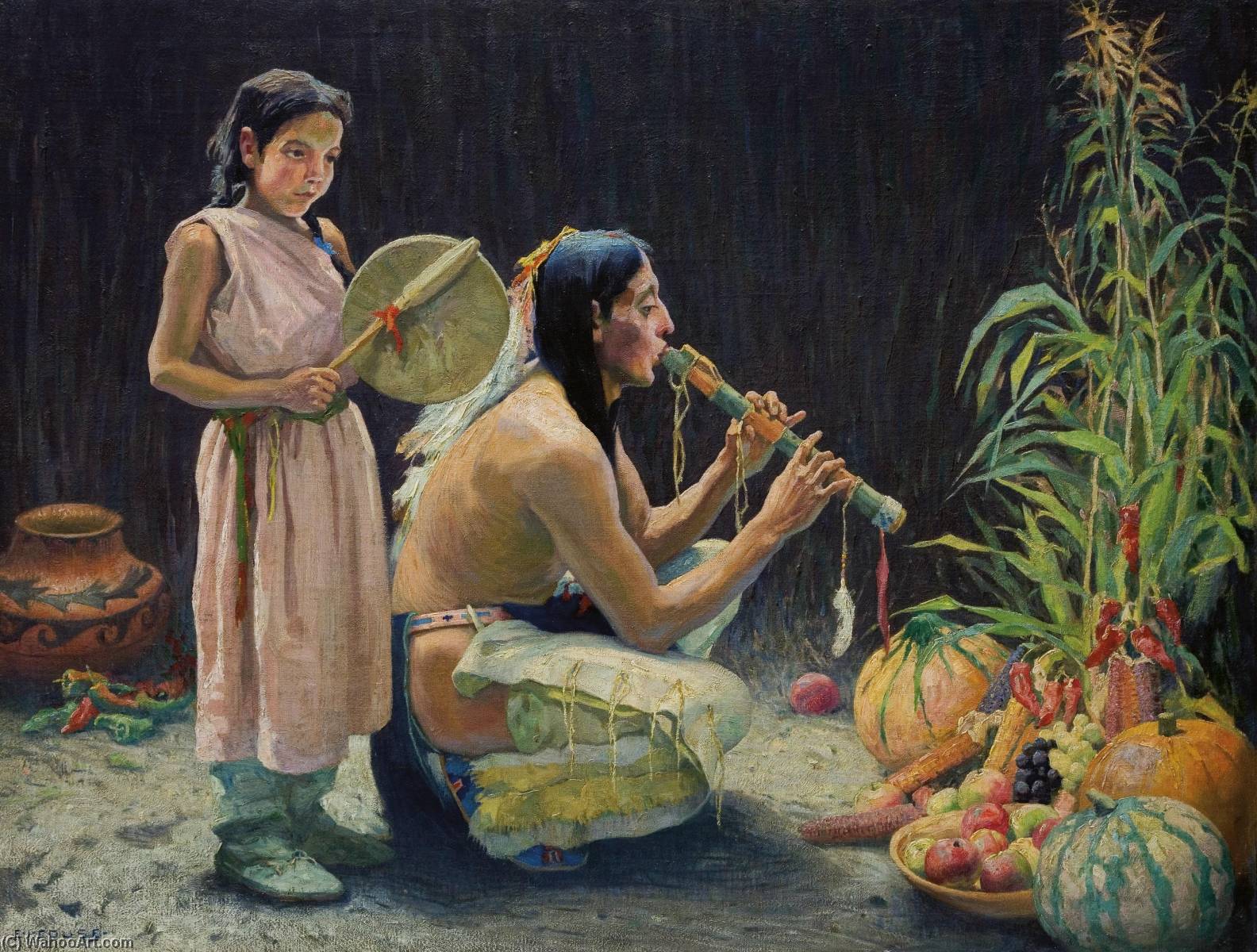
The Harvest Song

1920 · Oil On Canvas

The air feels heavy with the scent of ripening produce in The Harvest Song, a work painted by E. Irving Couse in 1920. Within this sun-drenched field, a man sits amidst an abundance of nature, his breath steady as he plays a flute. Beside him, a woman holds a drum, her presence completing a rhythmic duet that seems to echo through the surrounding crops. They exist in a moment of…

3
Indian Brave Recording General MacKenzie's Fight with the Cheyenes (1902) od Eanger Irving Couse

Indian Brave Recording General MacKenzie's Fight with the Cheyenes

1902 · Oil

In "Indian Brave Recording General MacKenzie's Fight with the Cheyenes" by E. Irving Couse, a quiet moment of creation unfolds. Two Native American men lean into their task, focused entirely on the act of painting a mural. They work upon a large, stretched animal hide, perhaps deer or buffalo, which serves as the canvas for their story. This central activity anchors the entire scene, drawing the eye directly to the…

4
The Water Course (1910) od Eanger Irving Couse

The Water Course

1910 · Oil · Reading Public Museum, Reading

In The Water Course, E. Irving Couse presents a quiet moment of interaction with the natural world. Painted around 1910, the work focuses on two Native American figures positioned within a rugged, sunlit landscape. They are situated near a flowing stream, their presence integrated into the terrain rather than imposed upon it. The scene captures a sense of tranquility, focusing on the subtle connection between the individuals and the land…

5
The Sculptor (1914) od Eanger Irving Couse

The Sculptor

1914 · Oil On Canvas

The Sculptor is an oil painting by E. Irving Couse, executed in 1914. The work focuses on a Native American man engaged in the act of creating petroglyphs or drawings upon a textured surface. The subject is positioned in a central-right profile, kneeling as he works against a shallow, textured background suggesting a rock face or cave wall.

6
The Cooling Stream (1912) od Eanger Irving Couse

The Cooling Stream

1912 · Oil On Canvas

The air feels heavy and still under a blanket of overcast clouds. Near the edge of a flowing river, a group of indigenous figures gathers, their presence deeply woven into the natural landscape. There is a quiet, somber energy in the way they move, a sense of ritual or perhaps a shared moment of mourning that settles over the scene. The water of the stream ripples softly, catching subtle highlights…

7
The Mountain Stream (1914) od Eanger Irving Couse

The Mountain Stream

1914 · Oil On Canvas

In The Mountain Stream, E. Irving Couse positions a solitary Indigenous man in the foreground, seated along a riverbank. The figure is the central focus, rendered with a posture and gaze that suggest deep introspection. This quietude is framed by a landscape of flowing water and dense foliage, creating a scene centered on contemplation and a profound connection with the natural world.

9
Indian Hunter (1925) od Eanger Irving Couse

Indian Hunter

1925 · Oil · Reading Public Museum, Reading

In this 1925 oil painting, a Native American hunter moves through a sun-dappled grove of birch or aspen trees. The composition is oriented vertically, drawing the eye to the profile of the figure on the left as he moves toward the right. There is a stillness here, a sense of quiet tension as the subject navigates the forest floor. Light filters through the canopy in patches of pale yellow, creating…

10
The Blanket Mender (1934) od Eanger Irving Couse

The Blanket Mender

1934 · Oil · The Owings Gallery, Santa Fe

The Blanket Mender is an oil painting by E. Irving Couse. Created about 1934, this work captures a quiet moment of focused labor. The subject is a Native American figure, depicted in a state of stillness as they attend to a textile. There is a profound sense of patience in the way the figure engages with the fabric, a task requiring steady hands and a calm mind.

Obrazy autora Eanger Irving Couse, seřazeny od 11 do 100

11Flute Player (1931) od Eanger Irving CouseFlute Player1931 · Private collection 12Untitled (AQU5U9) (1899) od Eanger Irving CouseUntitled (AQU5U9)1899 13Indian Weaver (1914) od Eanger Irving CouseIndian Weaver1914 · American Museum of Western Art 14Untitled (AQU5U3) (1927) od Eanger Irving CouseUntitled (AQU5U3)1927 · El Paso Museum of Art 15Ambush (1897) od Eanger Irving CouseAmbush1897 · Briscoe Western Art Museum 16The Pictographs (1919) od Eanger Irving CouseThe Pictographs1919 17The Captive (1891) od Eanger Irving CouseThe Captive1891 18The Card Player (1897) od Eanger Irving CouseThe Card Player1897 19Klikitat Indian with Pony (1898) od Eanger Irving CouseKlikitat Indian with Pony1898 20Indian Seated by a Campfire (1898) od Eanger Irving CouseIndian Seated by a Campfire1898 21An Indian Hunter (1897) od Eanger Irving CouseAn Indian Hunter1897 22The Peace Pipe (1901) od Eanger Irving CouseThe Peace Pipe1901 · Metropolitan Museum of Art 23Indian Drinking (1903) od Eanger Irving CouseIndian Drinking1903 24Moki Snake Sance (1904) od Eanger Irving CouseMoki Snake Sance1904 · American Museum of Western Art 25Walpi Pueblo (1903) od Eanger Irving CouseWalpi Pueblo1903 · Smithsonian American Art Museum 26The Forest Pool od Eanger Irving CouseThe Forest PoolThe Owings Gallery 27Quail Hunters od Eanger Irving CouseQuail Hunters 28Sacred Waters od Eanger Irving CouseSacred WatersIndianapolis Museum of Art 29Woman in a White Dress od Eanger Irving CouseWoman in a White Dress 30The Speaker od Eanger Irving CouseThe Speaker 31Indian Portrait od Eanger Irving CouseIndian Portrait 32Evening Solitude od Eanger Irving CouseEvening Solitude 33Western Sunlight od Eanger Irving CouseWestern Sunlight 34Medicine Man od Eanger Irving CouseMedicine Man 35Hunting Cranes od Eanger Irving CouseHunting Cranes 36Klickitat Brave od Eanger Irving CouseKlickitat Brave 37The Sculptor od Eanger Irving CouseThe Sculptor 38Ute Waterbottle od Eanger Irving CouseUte Waterbottle 39Young Kibbey Whitman Couse od Eanger Irving CouseYoung Kibbey Whitman Couse 40The Thinker od Eanger Irving CouseThe Thinker 41The Setting Sun od Eanger Irving CouseThe Setting Sun 42John Concha, Taos Pueblo od Eanger Irving CouseJohn Concha, Taos Pueblo 43Resting od Eanger Irving CouseResting 44Moonlight Meditation od Eanger Irving CouseMoonlight Meditation 45The Master Workman od Eanger Irving CouseThe Master Workman 46The Evening Meal od Eanger Irving CouseThe Evening Meal 47Indian By A Stream od Eanger Irving CouseIndian By A Stream 48The Lovers od Eanger Irving CouseThe LoversBrigham Young University Museum of Art 49Lamb od Eanger Irving CouseLamb 50Young Hunter by a Stream od Eanger Irving CouseYoung Hunter by a Stream 51Portrait Of Kibbey Whitman Couse od Eanger Irving CousePortrait Of Kibbey Whitman Couse 52Flute Player, Rio Lucero, Taos, NM od Eanger Irving CouseFlute Player, Rio Lucero, Taos, NM 53The Arrow Maker od Eanger Irving CouseThe Arrow Maker 54Indians in Moonlight od Eanger Irving CouseIndians in Moonlight 55The Tom Tom Lesson od Eanger Irving CouseThe Tom Tom Lesson 56The Lesson od Eanger Irving CouseThe Lesson 57Lovers (Indian Love Song) od Eanger Irving CouseLovers (Indian Love Song) 58The Peace Pipe od Eanger Irving CouseThe Peace Pipe 59Putting on the War Shoes od Eanger Irving CousePutting on the War Shoes 60Indian Painter od Eanger Irving CouseIndian Painter 61The Drink od Eanger Irving CouseThe Drink 62Serenade od Eanger Irving CouseSerenade 63The Pottery Maker od Eanger Irving CouseThe Pottery Maker 64Indian by the Fire od Eanger Irving CouseIndian by the Fire 65Return of the War Party (1910) od Eanger Irving CouseReturn of the War Party1910 66The Beaded Tobacco Bag od Eanger Irving CouseThe Beaded Tobacco Bag 67By the Fire od Eanger Irving CouseBy the Fire 68Beaded Bag od Eanger Irving CouseBeaded Bag 69Evening Reverie (1911) od Eanger Irving CouseEvening Reverie1911 70The Love Call (1908) od Eanger Irving CouseThe Love Call1908 71The Pottery Decorator od Eanger Irving CouseThe Pottery Decorator 72New Rug (1917) od Eanger Irving CouseNew Rug1917 73Making Pottery (1912) od Eanger Irving CouseMaking Pottery1912 74Lone Hunter (1915) od Eanger Irving CouseLone Hunter1915 75The Sentinel (1912) od Eanger Irving CouseThe Sentinel1912 76The Successful Hunter (1913) od Eanger Irving CouseThe Successful Hunter1913 77Indian Girl in a Blanket (1921) od Eanger Irving CouseIndian Girl in a Blanket1921 78Crow Tent (1918) od Eanger Irving CouseCrow Tent1918 79The Evening Meal (1918) od Eanger Irving CouseThe Evening Meal1918 80The Magic Flute (also known as Flute Player at the Spring) (1918) od Eanger Irving CouseThe Magic Flute (also known as Flute Player at the Spring)1918 81The Flute Ceremony (1922) od Eanger Irving CouseThe Flute Ceremony1922 82Untitled (AQU5UF) (1921) od Eanger Irving CouseUntitled (AQU5UF)1921 · El Paso Museum of Art 83Indian Summer (1924) od Eanger Irving CouseIndian Summer1924 84Moonlight on the Hondo (1928) od Eanger Irving CouseMoonlight on the Hondo1928 85Hunting the Turkey in the Aspens (1926) od Eanger Irving CouseHunting the Turkey in the Aspens1926 86Flute Song, Moonlight (1927) od Eanger Irving CouseFlute Song, Moonlight1927 87Sheep At Sundown od Eanger Irving CouseSheep At Sundown 88Pottery Vendor (1916) od Eanger Irving CousePottery Vendor1916 · Philbrook Museum of Art 89The Chief od Eanger Irving CouseThe Chief 90Chief David Shoppenegons (1911) od Eanger Irving CouseChief David Shoppenegons1911 · Detroit Institute of Arts 91The Lesson (1902) od Eanger Irving CouseThe Lesson1902 92Indian Painter od Eanger Irving CouseIndian PainterMinneapolis Institute of Art 93Hidden House od Eanger Irving CouseHidden House 94Moving In Clouds od Eanger Irving CouseMoving In Clouds 95Purple Shore od Eanger Irving CousePurple Shore 96Boat Alone od Eanger Irving CouseBoat Alone 97Trees In Snow od Eanger Irving CouseTrees In Snow 98Lillies od Eanger Irving CouseLillies 99At The Spring (Sheep In Field) od Eanger Irving CouseAt The Spring (Sheep In Field) 100Taos Canyon Creek od Eanger Irving CouseTaos Canyon Creek

Motivy, které zaujaly Eanger Irving Couse

Čtyři témata, která se v těchto originálech nejčastěji objevují, z nichž každé má svůj nejlepší příklad.

Muzea, v nichž jsou vystavena originálna umělce Eanger Irving Couse

8 muzea, v nichž je umístěno nejvíce obrazů z této stránky.

Muzeum Město Díla autora Eanger Irving Couse Obrazy z tohoto seznamu
Reading Public Museum, ReadingReading Public Museum Reading 2 The Water Course, Indian Hunter
The Owings Gallery Santa Fe 2 The Blanket Mender, The Forest Pool
American Museum of Western Art, ColoradoAmerican Museum of Western Art Colorado 2 Indian Weaver, Moki Snake Sance
El Paso Museum of Art, El PasoEl Paso Museum of Art El Paso 2 Untitled (AQU5U3), Untitled (AQU5UF)
Smithsonian American Art Museum, Washington, D.C.Smithsonian American Art Museum Washington, D.C. 2 Walpi Pueblo
Cincinnati Art Museum, CincinnatiCincinnati Art Museum Cincinnati 1 Indian Drinking from a Lake
Private collection, AkronPrivate collection Akron 1 Flute Player
Briscoe Western Art Museum, San AntonioBriscoe Western Art Museum San Antonio 1 Ambush

Eanger Irving Couse, jeden ikonický obraz na každé desetiletí

Díla podle dekád

Vyberte si dekádu a prohlédněte si originál, který ji definuje.

Obrazy umělce Eanger Irving Couse: odpovědi galerie

Který obraz autora Eanger Irving Couse je nejslavnější ze všech?Odhalit odpověď

Taos Indian and Pottery (1920). Následují The Harvest Song (1920) a Indian Brave Recording General MacKenzie's Fight with the Cheyenes (1902).

Kolik let bylo Eanger Irving Couse, když dokončil/a Taos Indian and Pottery?Odhalit odpověď

54 let: dílo Taos Indian and Pottery pochází z roku 1920 a Eanger Irving Couse se narodil/a v roce 1866.

Kterých 10 nejlepších obrazů má Eanger Irving Couse?Odhalit odpověď

Taos Indian and Pottery, The Harvest Song, Indian Brave Recording General MacKenzie's Fight with the Cheyenes, The Water Course, The Sculptor, The Cooling Stream, The Mountain Stream, Indian Drinking from a Lake, Indian Hunter a The Blanket Mender. Hodnocení výše uvádí rok a muzeum pro každé z nich.

Kolik děl vytvořil/a Eanger Irving Couse?Odhalit odpověď

Náš katalog obsahuje 152 děl umělce Eanger Irving Couse z let 1891 až 1934.

Kde jsou vystavena nejznámější originály umělce Eanger Irving Couse?Odhalit odpověď

Většinou v Reading Public Museum (Reading), The Owings Gallery (Santa Fe) a American Museum of Western Art (Colorado). V tabulce muzeí výše jsou vypsány všechny.

Kdy Eanger Irving Couse vytvořil své nejslavnější obrazy?Odhalit odpověď

V období 1910s: 18 z celkem 100 děl na této stránce vzniklo právě tehdy, z toho The Water Course z nich.

Která jsou nejstarší a nejnovější slavná díla umělce Eanger Irving Couse?Odhalit odpověď

Na této stránce je nejstarší dílo z The Captive (1891) a nejnovější z The Blanket Mender (1934).

Kterým tématům se Eanger Irving Couse věnoval(a) nejčastěji?Odhalit odpověď

Native american (14), Native american culture (13) a Southwestern landscape (10) napříč 100 díly na této stránce.

V jaké technice tvořil(a) Eanger Irving Couse nejčastěji?Odhalit odpověď

Oil On Canvas, u 10 z 100 děl na této stránce.

Jaká originální díla Eanger Irving Couse má v obsluze Reading Public Museum?Odhalit odpověď

The Water Course a Indian Hunter: muzeum Reading Public Museum, Reading má v obsluze 2 děl z této stránky.

Eanger Irving Couse: umělec

Eanger Irving Couse: Mostecký most mezi světy

Eanger Irving Couse, narozený v roce 1866 v prosperujícího hornického města Saginaw ve státě Michigan, byl umělec, jehož život a dílo představují fascinující most mezi evropskou akademickou malířskou tradicí a hlubokým respektem k kultuře a krajinám Jižního západu Ameriky. Jeho příběh není jen o vývoji umělce; je to poutavá kronika kulturního porozumění, které překonává přísné akademické techniky malby s hlubokou úctou k životu a tradicím původních obyvatel Ameriky a úchvatným scenériím Jižního západu. Už od svých raných let projevoval Couse vrozené zvědavost vůči Chippewa indiánům, kteří žili v blízkosti jeho dětství – touha, která se rozvíjela v celoživotní oddanost zobrazení jejich existence s citlivostí a důstojností. Toto nebyla pouhá pozorování; byla to semínko hluboké empatie, které zásadně ovlivnilo jeho uměleckou cestu. V šestnácti let opustil tradiční školení, poháněn neochvějným závazkem k umění, začal nejprve studovat na Art Institute of Chicago a poté na National Academy of Design v New York City, než se vydal na desetileté putování do Paříže.

Od pařížských salonů k kouzlu Taosu

Pařířská zkušenost byla transformativní. Studium pod William-Adolphe Bouguereau na École des Beaux-Arts a Académie Julian vložilo Couse do hlubokého porozumění klasickým technikám – preciznímu kreslení, nuancovanému modelování a vypracované kompozici. Zdokonaloval své dovednosti zachycováním světla a atmosféry normandského pobřeží, přestože i v těchto evropských vlivů sílila touha po americkém západě. Návštěva ranče jeho snachoviště v Oregonu vyvolala zájem o indiánské předměty, který culminoval v *The Captive*, vystavený na Pařížském salónu v roce 1892. Tato významná raná práce, zobrazující scénu z masakru Whitmana a modelovanou jeho manželkou Virginie a místním Klikitat indianem, demonstrovala jak jeho technickou zdatnost, tak i rozvíjející se tematické zájmy. Po návratu do USA, Couse vyvažoval studii v New Yorku s rostoucím počtem cest na západ, nakonec se usadil v Taosu, Nové Mexiku, v roce 1902. Toto znamenalo obrat; byl okouzlán jedinečným světlem, krajinou a kulturou regionu a založil si letní sídlo, které se vyvinulo v jeho trvalý domov. Neznamenalo to jen návštěvu; ponořil se do něj, snažil se porozumět a zobrazení způsobu života, který byl daleko od rušných měst východního pobřeží.

Duše Taosu: Definující umělecké vize

Taos se pro Couse stal něčím víc než jen lokalitou – stal se ponořením do kultury. Věnoval se studiu a malování života Taosu, ne jako exotické postavy, ale jako jednotlivci s inherentní důstojností a grácií. Na rozdíl od některých současníků, kteří se zaměřovali na dramatické příběhy nebo romantizované zobrazení, Couse usiloval o zachycení klidných okamžiků každodenního života – scén z úvah, řemeslné činnosti a rodinného spojení. Jeho styl se vyvinul do jedinečné kombinace akademické preciznosti a sugestivního používání světla a barvy, vytvářející obrazy, které byly jak technicky zdatné, tak i emocionálně rezonující. Preferoval teplé, zemité tóny, často zobrazoval své předměty v měkkém záření ohně nebo zlatých tónech zapadajícího slunce. Často používal dva hlavní modely, Ben Lujana a Jerryho Mirabele, aby zachytil pocit kontinuity a intimity ve svých dílech. Tato oddanost vedla k tomu, že se stal prvním prezidentem Taos Society of Artists v roce 1915, čímž posílil reputaci Taosu jako důležité uměleckého centra. Jeho obrazy nebyly pouhými reprezentacemi; byly interpretacemi nabitými respektem a porozuměním – svědectvím o jeho závazku k autentickému zobrazení indiánského života.

Rozpoznání, dědictví a trvalý vliv

Couseova talentu nezůstalo lhostejné. Dostal řadu ocenění během své kariéry, včetně Altman Prize od National Academy of Design, Isidor Prize od Salmagundi Club a Lippincott Prize od Pennsylvania Academy of Fine Arts. Významně si také zajistil zakázky od Santa Fe Railway mezi lety 1914 a 1936 k vytvoření obrazů používaných ve svých reklamních kampaních, které měly přilákat turisty ze východu. *Elk-foot of the Taos Tribe* je široce považován za jeho mistrovské dílo, nakonec zakoupené pro národní uměleckou sbírku USA, čímž se upevnil v canonu amerického umění. Kromě těchto ocenění má Couseho trvalé dědictví v přispění k utváření vnímání indiánského života a etablovaní jedinečné umělecké identity pro Taos Society of Artists. Nabídl perspektivu, která se lišila od stereotypních reprezentací, které byly běžné v té době, zdůrazňoval mírovou koexistenci a inherentní krásu Pueblo kultury. *Jeho dílo stojí jako silný důkaz důležitosti kulturní citlivosti a respektujícího zobrazení v umění. Jeho domov a studio – nyní Eanger Irving Couse House and Studio–Joseph Henry Sharp Studios, jsou uvedeny na seznam Národního registru historických památek, což zajišťuje, že budoucí generace se mohou spojit s jeho uměleckou vizí a ocenit jeho hluboký dopad na historii amerického umění.*

Klíčové charakteristiky jeho díla

  • Akademická preciznost: Couseova základna v evropské akademické malířské tradici je patrná v pečlivém detailu a realistickém zobrazení jeho postav a krajin.
  • Sugestivní použití světla: Mistrovsky využíval světlo a stín k vytvoření atmosféry a emocionální hloubky, často zobrazoval scény v měkkých zlatých tónech.
  • Respektující zobrazení: Couseovy zobrazení indiánů byly charakterizovány důstojností a citlivostí, vyhýbaly se stereotypním nebo romantizovaným reprezentacím.
  • Zaměření na každodenní život: Preferoval zachycení klidných okamžiků každodenního života spíše než dramatických příběhů, nabízející pohled do zvyků a tradic Pueblo kultury.
  • Omezená paleta: Couse preferoval teplou, zemité paletu, která odráží barvy jihozápadní krajiny a vytváří pocit harmonie a klidu.