Portrét Chuck Close

Obrazy autora Chuck Close: 13 nejznámějších díel podle pohledu galerie

Aktualizováno říjen 2026 · seřazeno podle našeho skóre popularity (vyhledávání, návštěvy a objednávky u každého díla) · 17 děl umělce Chuck Close v našem katalogu

Stručně řečeno

Z pohledu galerie je nejslavnějším dílem Chuck Close obrazem Big Self-Portrait (1968), jehož originál je vystaven v Walker Art Center v obci Minneapolis. Barack Obama by Chuck Close (2013) a Alex (1994) doplňují trio, které každé oko okamžitě pozná. Z 17 děl umělce Chuck Close v našem katalogu představuje galerie níže 13 nejznámějších děl, z nichž každé je originálem s uvedením roku vzniku, muzea a toho, co jej činí jedinečným.

1940 – 2021, Monroe Contemporary realism Nejvíce děl: Walker Art Center

Top 10 obrazů umělce Chuck Close v naší galerii

1
Big Self-Portrait (1968) od Chuck Close

Big Self-Portrait

1968 · Black and White Photography · Walker Art Center, Minneapolis

To stand before a work like Big Self-Portrait is not merely to observe a likeness; it is to confront an intensely rendered meditation on identity itself. Created in 1968, this piece by Chuck Close captures the artist at a pivotal moment, presenting a self that feels both intimately known and profoundly alien. The composition is a masterful study in compression, tightly framing the head and shoulders until the viewer has…

2
Barack Obama by Chuck Close (2013) od Chuck Close

Barack Obama by Chuck Close

2013 · Acrylic On Canvas · National Portrait Gallery, Londýn

Barack Obama by Chuck Close: A Portrait of Resilience and Reflection Chuck Close’s “Barack Obama” is more than just a photograph; it's a testament to the artist’s groundbreaking approach to portraiture and a poignant exploration of identity. Created in 2013, this diptych—featuring two black and white prints—captures Obama’s gaze with remarkable detail and immediacy, embodying Close’s signature style: monumental hyperrealism achieved through a meticulous grid system. The artwork speaks volumes…

4
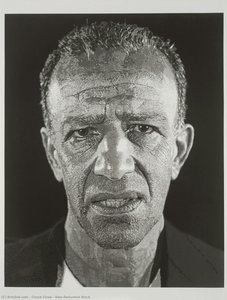
Alex/Redukce blok (1993) od Chuck Close

Alex/Redukce blok

1993 · Akryl na plátně · Parrish Art Museum, Water Mill

Český Art Magazine Esej: Alex/Reduction Block – Výstava Chuck Closeho v Parrish Art Museum Alex/Reduction Block je fascinující dílo amerického umělce Chuck Closeho, které vypráví příběh nejen o jeho osobě, ale i o metodách tvorby a filozofii umění. Tento monumentalní obraz vytvořený roku 1993 představuje redukované linoleové rytiny kombinované s technikou sítotisků – přístup, který Close následně vyvíjel a který dnes považujeme za základní stavební kámen jeho unikátního stylu. Výstavu…

6
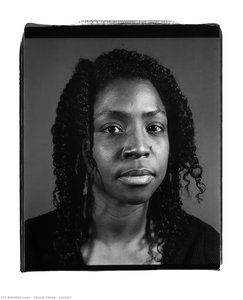
Lorna I (1997) od Chuck Close

Lorna I

1997 · Photography · Kemper Museum of Contemporary Art, Kansas City

Lorna I is a photograph created by the artist Chuck Close. The original image was produced in 1996, and the specific version of this work was printed in 1997. This piece is an inkjet print on kozo paper. The composition focuses on a close-up view of a woman, capturing her face and upper torso against a dark gray backdrop. The subject features tightly coiled hair and a direct gaze toward…

Obrazy autora Chuck Close, seřazeny od 11 do 13

Motivy, které zaujaly Chuck Close

Čtyři témata, která se v těchto originálech nejčastěji objevují, z nichž každé má svůj nejlepší příklad.

Muzea, v nichž jsou vystavena originálna umělce Chuck Close

5 muzea, v nichž je umístěno nejvíce obrazů z této stránky.

Muzea Město Díla autora Chuck Close Obrazy z tohoto seznamu
Walker Art Center, MinneapolisWalker Art Center Minneapolis 1 Big Self-Portrait
National Portrait Gallery, LondýnNational Portrait Gallery Londýn 1 Barack Obama by Chuck Close
Parrish Art Museum, Water MillParrish Art Museum Water Mill 1 Alex/Redukce blok
Kemper Museum of Contemporary Art, Kansas CityKemper Museum of Contemporary Art Kansas City 1 Lorna I
Muzeum umění v Bostonu, BostonMuzeum umění v Bostonu Boston 1 Paul IV

Chuck Close, jeden ikonický obraz na každé desetiletí

Díla podle dekád

Vyberte si dekádu a prohlédněte si originál, který ji definuje.

Obrazy umělce Chuck Close: odpovědi galerie

Který obraz autora Chuck Close je nejslavnější ze všech?Odhalit odpověď

Big Self-Portrait (1968), Walker Art Center, Minneapolis. Následují Barack Obama by Chuck Close (2013) a Alex (1994).

Kolik let bylo Chuck Close, když dokončil/a Big Self-Portrait?Odhalit odpověď

28 let: dílo Big Self-Portrait pochází z roku 1968 a Chuck Close se narodil/a v roce 1940.

Kterých 10 nejlepších obrazů má Chuck Close?Odhalit odpověď

Big Self-Portrait, Barack Obama by Chuck Close, Alex, Alex/Redukce blok, Self-Portrait, Lorna I, Nat, Mark, Robert - (104,072) a Self-Portrait Spitbite White on Black. Hodnocení výše uvádí rok a muzeum pro každé z nich.

Kolik děl vytvořil/a Chuck Close?Odhalit odpověď

Náš katalog obsahuje 17 děl umělce Chuck Close z let 1968 až 2013.

Kde jsou vystavena nejznámější originály umělce Chuck Close?Odhalit odpověď

Většinou v Walker Art Center (Minneapolis), National Portrait Gallery (Londýn) a Parrish Art Museum (Water Mill). V tabulce muzeí výše jsou vypsány všechny.

Kdy Chuck Close vytvořil své nejslavnější obrazy?Odhalit odpověď

V období 1990s: 3 z celkem 13 děl na této stránce vzniklo právě tehdy, z toho Alex z nich.

Která jsou nejstarší a nejnovější slavná díla umělce Chuck Close?Odhalit odpověď

Na této stránce je nejstarší dílo z Big Self-Portrait (1968) a nejnovější z Barack Obama by Chuck Close (2013).

Kterým tématům se Chuck Close věnoval(a) nejčastěji?Odhalit odpověď

Detail (2), American art (2) a Portrait (2) napříč 13 díly na této stránce.

S jakým směrem je spojen(a) Chuck Close?Odhalit odpověď

Contemporary realism, podle originálů na této stránce.

Chuck Close: umělec

Chuck Close: A Titan of Photorealism

Chuck Close (1940–2021) stands as one of the most influential figures in contemporary art, redefining portraiture and establishing a singular visual language that continues to inspire artists today. Born July 5, 1940, in Monroe, Washington—a town steeped in agricultural heritage—Close’s early life was marked by significant physical challenges stemming from neuromuscular disorder and dyslexia, obstacles which profoundly shaped his artistic perspective. These difficulties fostered an acute observational skill, a characteristic that would become central to his groundbreaking approach to depicting the human form. Early Influences & Artistic Genesis Like many artists of his generation, Close was captivated by Jackson Pollock’s drip paintings at the Seattle Art Museum in 1962. This encounter ignited within him an unwavering desire to push artistic boundaries—a yearning that propelled him toward abstraction before he decisively embraced photorealism. The influence of De Kooning and Mason also played a crucial role in shaping his formative style. The Grid System & Methodical Detail Close’s revolutionary technique involved meticulously transferring photographic images onto enormous canvases using a grid system. This process wasn't merely about replicating an image; it was about dissecting it into manageable squares and reconstructing it with painstaking accuracy, utilizing acrylic paints and airbrush techniques. As Close himself eloquently described, “I wanted to find out if I could make something that looked like a photograph but didn’t feel like one.” This method demanded immense patience and precision—a testament to his dedication.
  • He painstakingly transferred photographic images onto massive canvases using a grid system
  • Airbrushing was used to achieve remarkable detail and tonal accuracy
  • The resulting paintings were characterized by an almost obsessive attention to texture and surface

Photorealism: Challenging Perception

Close’s commitment to photorealism wasn't simply a stylistic choice; it represented a fundamental interrogation of how we perceive the world. Rejecting traditional artistic conventions, he sought to capture not just what was seen but also the underlying structure of visual experience.
  • He deliberately incorporated imperfections—such as wrinkles and blemishes—into his portraits
  • This approach challenged viewers to confront their own biases about beauty standards
  • Close’s work questioned the very nature of representation, demonstrating that photography could be transformed into a powerful artistic medium

Notable Achievements & Legacy

Throughout his career, Close produced an astonishing body of work—spanning monumental portraits, intricate prints, and innovative explorations of texture and color.His series featuring Barack Obama garnered widespread acclaim for its masterful execution and symbolic resonance. He continued to adapt his artistic practice even after suffering a spinal artery occlusion in 1988, demonstrating unwavering resilience. Close’s influence extends far beyond the realm of painting; his techniques have resonated with artists across various disciplines. A Continuing Dialogue Chuck Close's legacy resides not only in his technical prowess but also in his profound engagement with artistic inquiry—a legacy that compels us to reconsider our understanding of perception and representation. His art remains a beacon for aspiring artists, reminding them that creativity can flourish even amidst adversity.
  • His meticulous grid system technique continues to inspire artists today
  • Close’s exploration of texture and surface elevated photorealism to new heights
  • He championed the inclusion of imperfections into portraiture, fostering a more honest and nuanced depiction of human experience

Concluding Thoughts

Chuck Close's unwavering dedication to his craft—coupled with his groundbreaking artistic vision—solidified his place as one of the most important artists of the 20th century. His monumental portraits stand as enduring testaments to his artistic spirit and resilience, inviting us to contemplate the complexities of human identity and perception.His work continues to provoke discussion and inspire creativity, ensuring that Chuck Close’s legacy will endure for generations to come.