Early Life and Artistic Training
Christian Ludwig Attersee was born on 28 August 1940 in Bratislava. His formative years were spent moving through the landscapes of Upper Austria, including Aschach and Linz. It was near the Attersee lake that he spent much of his youth, a connection that would eventually provide the pseudonym for his professional identity.
His formal education began in 1957 when he entered the Vienna Akademie für angewandte Kunst. He remained at the academy for several years, continuing his studies until 1963. During this period of academic development, he expanded his technical training to include peinture, earning his diploma in 1959.
Artistic Style and Themes
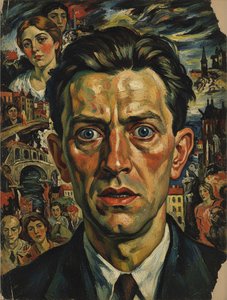
Attersee’s visual language is defined by a fluid transition from figural representation toward a more symbolic abstraction. His compositions often move through a surrealistic and gestural landscape, where the boundaries between recognizable forms and playful abstraction blur. This approach is driven by an energetic ductus and a preference for bright, saturated colors that demand immediate attention. There is a certain lightness to his work, a sense of a free spirit that avoids the heavy gravity of traditional portraiture in favor of something more whimsical and dreamlike.
Thematic concerns in his oeuvre frequently orbit the intersections of the physical and the elemental. He draws heavily from the natural world, exploring subjects such as the weather, water, and navigation—interests deeply tied to his experience as a yachtsman. These elemental forces often coexist with more intimate, provocative explorations of sexuality and the human body. His work frequently integrates textual elements and specific contexts, embedding language directly into the visual field to create a layered, often ambiguous, dialogue between the image and the word.
- Marvelous Monkey (1970)
- Kinderzimmertriptychon (1971)
Diverse Artistic Mediums and Projects
Attersee’s creative output is defined by a refusal to remain within the boundaries of a single discipline. His practice is a restless intersection of many forms, encompassing painting, drawing, and photography alongside more tactile pursuits like product design and tapisserie. From 1966, his involvement with the Viennese Actionism movement informed a drive toward the experimental. He sought to achieve a Gesamtkunstwerk, or total artwork, by weaving together disparate elements such as music, speech, photo, and video art. This multidisciplinary approach allowed him to move fluidly between the roles of painter, scenographer, musician, and writer.
His investigations into the physical world often manifested as object art and inventive structures. He moved beyond the flat surface of the canvas to explore the dimensions of the three-dimensional, creating works that functioned as both sculpture and social commentary. These efforts included the development of specific object inventions, such as the "Speisekugel" and the "Prothesenalphabet." His work in printmaking and silkscreen further expanded his reach, allowing his visual language to inhabit various textures and materials.
- "Marvelous Monkey" (1970)
- "Kinderzimmertriptychon" (1971)
Major Exhibitions and Recognition
Attersee’s presence in the international arena was solidified through participation in significant mid-century exhibitions. He was included in Documenta 1977, a moment that placed his energetic visual language within a broader European context. This momentum continued into 1984, when he was chosen to represent Austria at the Venice Biennial, an appointment that underscored his standing within the contemporary art landscape.
His contributions to the arts have been met with several high-level honors from Austrian institutions. In 1989, he was awarded the City of Vienna Prize for Visual Arts. This was followed by the Grand Austrian State Prize for Fine Arts in May 1998. His influence on the cultural fabric of his home country was further recognized in September 2005, when he received the Austrian Cross of Honour for Science and Art, 1st class.
Where to See His Works Today
The physical presence of Christian Ludwig Attersee’s output is scattered across several significant European institutions, reflecting a career that has moved through various cultural centers. In his home country, his work is preserved within the Belvedere Museum Vienna and the Museum des 20. Jahrhunderts in Wien. These collections hold pieces that reflect his long-standing connection to the Austrian art scene.
Beyond the borders of Austria, his visual language is represented in major Dutch and German collections. The Stedelijk Museum in Amsterdam maintains his works, while the Stedelijk Van Abbemuseum in Eindhoven also holds pieces from his production. In Germany, the Kunstsammlung Nordrhein Westfalen in Düsseldorf serves as another repository for his creative output.