Portrét Carl Blechen

94 nejslavnějších obrazů autora Carl Blechen, každý naprosto unikátní

Aktualizováno listopad 2026 · seřazeno podle našeho skóre popularity (vyhledávání, návštěvy a objednávky u každého díla) · 97 děl umělce Carl Blechen v našem katalogu

Stručně řečeno

Sanssouci Palace (1830) je obraz autora Carl Blechen, který přitahuje nejvíce pohledů; originál se nachází v Národní galerie v Berlíně, Berlín. Poté se zrak přesouvá k The Interior of the Palm House on the Pfaueninsel Near Potsdam (1834) a Afternoon on Capri (1829). Z 97 děl umělce Carl Blechen v našem katalogu je těchto 94 těch nejznámějších; každé z nich je unikátním originálem s uvedením roku vzniku, muzea a důvodu jeho nesmrtelnosti.

1798 – 1840, Chotěbuz Romantic industrialization Nejvíce děl: Alte Nationalgalerie

Top 10 obrazů autora Carl Blechen podle výběru galerie

1
Sanssouci Palace (1830) od Carl Blechen

Sanssouci Palace

1830 · Oil On Canvas · Národní galerie v Berlíně, Berlín

Subject Carl Blechen’s 1830 canvas invites the viewer into a dramatic yet serene tableau of Sanssouci Palace, its stately gardens framed by a storm‑laden sky that breathes both tension and awe. The central fountain glistens beneath swirling clouds, while a lone horse stands poised in the midst of the park, an emblem of grace amid turmoil. Figures—families, couples, solitary wanderers—are scattered across the scene, their silhouettes hinting at stories untold.…

2
The Interior of the Palm House on the Pfaueninsel Near Potsdam (1834) od Carl Blechen

The Interior of the Palm House on the Pfaueninsel Near Potsdam

1834 · Oil On Canvas · Art Institute of Chicago, Chicago

The work before us is titled The Interior of the Palm House on the Pfaueninsel Near Potsdam, a significant oil on canvas by the German artist Carl Blechen. Created in 1834, this painting captures a specific moment of architectural and botanical splendor within the Prussian royal grounds. It offers a view into a space where the structured lines of design meet the untamed growth of tropical flora.

3
Afternoon on Capri (1829) od Carl Blechen

Afternoon on Capri

1829 · Oil On Canvas

The oil painting depicts a coastal scene on the island of Capri, captured from an elevated perspective. In the upper right, massive cliffs of ochre and sienna rise toward the center-left, their jagged surfaces textured by light and shadow. These geological formations descend toward a calm, blue sea that occupies the middle ground. A solitary figure sits upon a rocky outcrop in the lower left, positioned against the scale of…

4
Napoleon on Horseback, Surrounded by Generals and Troops (1823) od Carl Blechen

Napoleon on Horseback, Surrounded by Generals and Troops

1823 · Watercolor

In Napoleon on Horseback, Surrounded by Generals and Troops, Carl Blechen organizes a scene of profound historical and heroic weight. The composition is centered upon a prominent figure on horseback, presumably Napoleon, who commands the viewer's immediate attention. This central figure is encircled by a dense gathering of military personnel and troops, creating a sense of crowded, purposeful movement. Whether the scene depicts a moment of intense military engagement or…

5
Tarantella (1830) od Carl Blechen

Tarantella

1830 · Oil On Canvas · Städel Museum, Frankfurt nad Mohanem

In this 1830 oil on canvas, we find ourselves drawn into a lively scene of folk celebration. A group of people has gathered for a traditional dance, the Tarantella, set against a picturesque coastal landscape. The composition is built around a central dancing figure, whose movement acts as a focal point for the seated observers and the figures drifting in the background. There is a sense of rhythm here, captured…

6
Two monks in the park of Terni (1830) od Carl Blechen

Two monks in the park of Terni

1830 · Oil On Canvas · Alte Nationalgalerie, Berlín

The painting, titled Two monks in the park of Terni, was executed by the German artist Carl Blechen in 1830. It is also known by the alternative title Parthie aus dem Park des Grafen Graziani bei Terni. This work captures a quiet moment within the Park of Count Graziani, situated in the Nera river valley at Terni. The scene focuses on two monks engaged in conversation, positioned beneath a leafy…

7
Two Ladies in the Park (1830) od Carl Blechen

Two Ladies in the Park

1830 · Oil · Bavarské státní sbírky malby, Mnichov

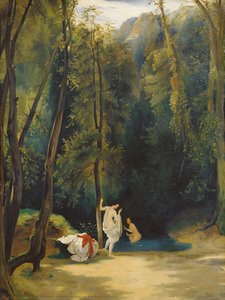
This romanticized landscape painting, dating from 1830, captures a tranquil scene of two women enjoying a moment of quiet companionship within an elegant park. The composition is carefully balanced, featuring the two figures positioned slightly off-center. They are framed by lush greenery on the right, while the left side of the work offers a receding view of trees and water. The women are dressed in soft white and cream garments,…

8
"Tarantella" Merry-society at Italian shore (1823) od Carl Blechen

"Tarantella" Merry-society at Italian shore

1823 · Oil

"Tarantella" Merry-society at Italian shore is an oil painting by the German artist Carl Blechen. Executed about 1823, the work captures a lively social gathering set against a coastal landscape. The scene focuses on human interaction within a picturesque environment, featuring figures engaged in various activities, including dance and seated observation.

10
Fishermen on Capri (1834) od Carl Blechen

Fishermen on Capri

1834 · Oil On Canvas · Alte Nationalgalerie, Berlín

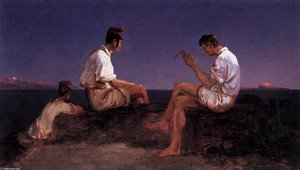
In Fishermen on Capri, Carl Blechen captures a quiet moment on a pebbled shore. The scene is a serene and atmospheric coastal landscape set against the dramatic natural backdrop of the Italian coast. A woman in a flowing white dress sits upon the rocks, leaning toward a man kneeling before her. Nearby, a second man stands with his back to the viewer, his red cap a sharp point of color…

Slavná díla umělce Carl Blechen, čísla 11 až 94

11Shepherd boy (1832) od Carl BlechenShepherd boy1832 12Forest path near Spandau (1835) od Carl BlechenForest path near Spandau1835 · Alte Nationalgalerie 13Weathered Tree Trunks in a Park (recto), c. 1834 (1834) od Carl BlechenWeathered Tree Trunks in a Park (recto), c. 18341834 · Albertina 14Stormy Weather over the Roman Campagna (1829) od Carl BlechenStormy Weather over the Roman Campagna1829 · Národní galerie v Berlíně 15Galgenberg (1833) od Carl BlechenGalgenberg1833 · Galerie Neue Meister 16Italian Monastery Building on the Water's Edge (1832) od Carl BlechenItalian Monastery Building on the Water's Edge1832 · Alte Nationalgalerie 17Memorial Column in the Forest (1837) od Carl BlechenMemorial Column in the Forest1837 · Alte Nationalgalerie 18Sleeping Faun in the Reeds (1827) od Carl BlechenSleeping Faun in the Reeds1827 · Alte Nationalgalerie 19Gothic Church Ruins (1826) od Carl BlechenGothic Church Ruins1826 · Staatliche Kunstsammlungen Dresden 20Rocky Landscape with Monk (1825) od Carl BlechenRocky Landscape with Monk1825 · Alte Nationalgalerie 21View of Rooftops and Gardens (1835) od Carl BlechenView of Rooftops and Gardens1835 · Národní galerie v Berlíně 22The Woods near Spandau (1834) od Carl BlechenThe Woods near Spandau1834 · Národní galerie v Berlíně 23Grotto in the Gulf of Naples (1829) od Carl BlechenGrotto in the Gulf of Naples1829 · Wallraf-Richartz-Museum 24Woman Bathing in the Park of Terni (1829) od Carl BlechenWoman Bathing in the Park of Terni1829 · Städel Museum 25Italian Landscape (1829) od Carl BlechenItalian Landscape1829 · Alte Nationalgalerie 26Sleeping Faun (1820) od Carl BlechenSleeping Faun1820 27Romantic Painting with Ruins (1820) od Carl BlechenRomantic Painting with Ruins1820 · Westfälisches Landesmuseum 28Landscape with Hermit (1822) od Carl BlechenLandscape with Hermit1822 29Friedrich Wilhelm III's Palm Court (1832) od Carl BlechenFriedrich Wilhelm III's Palm Court1832 · Národní galerie v Berlíně 30In the Berliner Tiergarten / Forest Path with Water (1825) od Carl BlechenIn the Berliner Tiergarten / Forest Path with Water1825 31The Roman Forum (1829) od Carl BlechenThe Roman Forum1829 32Forest Gorge with Red Deer (1828) od Carl BlechenForest Gorge with Red Deer1828 · Niedersächsisches Landesmuseum 33View of Monte Castiglione in Capri (1829) od Carl BlechenView of Monte Castiglione in Capri1829 · Staatliche Kunsthalle Karlsruhe 34Young Oak Tree (1828) od Carl BlechenYoung Oak Tree1828 · Národní galerie Kanady 35Fantasy Mountain Scene (1823) od Carl BlechenFantasy Mountain Scene1823 · Alte Nationalgalerie 36Ruins of Oybin Monastery (1823) od Carl BlechenRuins of Oybin Monastery1823 · Alte Nationalgalerie 37Track to Castle Gandolfo (1830) od Carl BlechenTrack to Castle Gandolfo1830 · Alte Nationalgalerie 38The Shattered Tower of Heidelberg Castle (1829) od Carl BlechenThe Shattered Tower of Heidelberg Castle1829 · Alte Nationalgalerie 39Trees at Sunrise in Autumn (1823) od Carl BlechenTrees at Sunrise in Autumn1823 · Alte Nationalgalerie 40Knight's castle at the fir pond (1823) od Carl BlechenKnight's castle at the fir pond1823 · Alte Nationalgalerie 41Campagna landscape (1830) od Carl BlechenCampagna landscape1830 · Berlinische Galerie 42Stormy sea with Lighthouse (1826) od Carl BlechenStormy sea with Lighthouse1826 · Hamburger Kunsthalle 43The Capuchin Convent at Amalfi (1829) od Carl BlechenThe Capuchin Convent at Amalfi1829 · National Gallery 44The Valley of Mills near Amalfi (1830) od Carl BlechenThe Valley of Mills near Amalfi1830 45boat at the coast (1823) od Carl Blechenboat at the coast1823 46Winterlandscape + wanderer (1823) od Carl BlechenWinterlandscape + wanderer1823 47landscape with figures (1823) od Carl Blechenlandscape with figures1823 48Winter- Landscape (1823) od Carl BlechenWinter- Landscape1823 49Mill Valley at Amalfi with Capuchin monk and farmer (1823) od Carl BlechenMill Valley at Amalfi with Capuchin monk and farmer1823 50Landscape with ruin, with motives of Webers "Freischütz" (1823) od Carl BlechenLandscape with ruin, with motives of Webers "Freischütz"1823 51Sleeping satyr in landscape (1823) od Carl BlechenSleeping satyr in landscape1823 52forest with pond + deers (1826) od Carl Blechenforest with pond + deers1826 53Gravestone (1823) od Carl BlechenGravestone1823 · Alte Nationalgalerie 54Mountain Gorge in Winter (1825) od Carl BlechenMountain Gorge in Winter1825 · Alte Nationalgalerie 55Mill in the valley near Amalfi (1829) od Carl BlechenMill in the valley near Amalfi1829 · Hamburger Kunsthalle 56Monastery of Saint Scholastica (1830) od Carl BlechenMonastery of Saint Scholastica1830 · Von der Heydt Museum 57Landscape (1823) od Carl BlechenLandscape1823 · Schloss Weimar 58Studium náhrobního monumentu (1824) od Carl BlechenStudium náhrobního monumentu1824 · Národní galerie v Berlíně 59Gorge at Amalfi (1831) od Carl BlechenGorge at Amalfi1831 · Alte Nationalgalerie 60Forest Path in the Harz (1833) od Carl BlechenForest Path in the Harz1833 61Waterfalls near Tivoli (1832) od Carl BlechenWaterfalls near Tivoli1832 · Alte Nationalgalerie 62In the park of Villa Borghese (1837) od Carl BlechenIn the park of Villa Borghese1837 · Alte Nationalgalerie 63Schloss Sanssouci (1833) od Carl BlechenSchloss Sanssouci1833 · Alte Nationalgalerie 64Forest Landscape at Dawn (1835) od Carl BlechenForest Landscape at Dawn1835 · Bavarské státní sbírky malby 65Spinning women in Cervara (1835) od Carl BlechenSpinning women in Cervara1835 · Alte Nationalgalerie 66Monk on Terrace (1835) od Carl BlechenMonk on Terrace1835 · Alte Nationalgalerie 67Mill in a valley (1833) od Carl BlechenMill in a valley1833 68Landscape in Winter at Moonlight (1836) od Carl BlechenLandscape in Winter at Moonlight1836 · Museum Behnhaus Drägerhaus 69In the Palm House in Potsdam (1832) od Carl BlechenIn the Palm House in Potsdam1832 · Hamburger Kunsthalle 70Girls on a Hill at the Beach (1840) od Carl BlechenGirls on a Hill at the Beach1840 71Fisherman (1839) od Carl BlechenFisherman1839 · Staatliche Kunsthalle Karlsruhe 72View of the Santa Scolastica Monastery near Subiaco (1832) od Carl BlechenView of the Santa Scolastica Monastery near Subiaco1832 · Staatliche Kunsthalle Karlsruhe 73In the Park at Terni od Carl BlechenIn the Park at TerniStaatsgalerie Stuttgart 74Alpské přechody v zimě s mnachy (1833) od Carl BlechenAlpské přechody v zimě s mnachy1833 · Staatliche Graphische Sammlung 75Bathers in Terni Park (1836) od Carl BlechenBathers in Terni Park1836 · Národní galerie v Berlíně 76Tivoli Gardens at the Villa d'Este (1831) od Carl BlechenTivoli Gardens at the Villa d'Este1831 · Národní galerie v Berlíně 77View of Assisi (1832) od Carl BlechenView of Assisi1832 · Neue Pinakothek 78Self-Portrait (1823) od Carl BlechenSelf-Portrait1823 · Národní galerie v Berlíně 79Scaffold in Storm (1833) od Carl BlechenScaffold in Storm1833 · Gemäldegalerie Alte Meister 80Forest landscape with flowing water and two hunters od Carl BlechenForest landscape with flowing water and two huntersKupferstichkabinett 81Hermit in a rocky landscape od Carl BlechenHermit in a rocky landscape 82The studio of the sculptor Rudolf Schadow od Carl BlechenThe studio of the sculptor Rudolf SchadowKunsthalle Bremen 83Resting Pilgrim in a Church's ruin od Carl BlechenResting Pilgrim in a Church's ruin 84Wooded landscape with castle od Carl BlechenWooded landscape with castle 85Tiberius rocks at Capri od Carl BlechenTiberius rocks at CapriNiedersächsisches Landesmuseum 86Rest in the Forest od Carl BlechenRest in the Forest 87Heidelberg Ruins od Carl BlechenHeidelberg RuinsKunsthalle Bremen 88The Waterfall od Carl BlechenThe WaterfallDetroit Institute of Arts 89Fishermen at the Gulf of Naples (1829) od Carl BlechenFishermen at the Gulf of Naples1829 · Národní galerie v Berlíně 90The Bay of Rapallo (1829) od Carl BlechenThe Bay of Rapallo1829 · Národní galerie v Berlíně 91Grotte im Park der Villa d’Este (1828) od Carl BlechenGrotte im Park der Villa d’Este1828 92Tower Ruins with Dragon (1827) od Carl BlechenTower Ruins with Dragon1827 · Alte Nationalgalerie 93Building the Devil's Bridge (1833) od Carl BlechenBuilding the Devil's Bridge1833 · Neue Pinakothek 94Rolling Mill (1834) od Carl BlechenRolling Mill1834 · Národní galerie v Berlíně

Slavná díla Carl Blechen podle jednotlivých období

Motivy, které zaujaly Carl Blechen

Čtyři témata, která se v těchto originálech nejčastěji objevují, z nichž každé má svůj nejlepší příklad.

Muzea, v nichž jsou vystavena originálna umělce Carl Blechen

8 muzea, v nichž je umístěno nejvíce obrazů z této stránky.

Muzeum Město Díla autora Carl Blechen Obrazy z tohoto seznamu
Alte Nationalgalerie, BerlínAlte Nationalgalerie Berlín 24 Two monks in the park of Terni, Pifferaro and Girls in Rome, Fishermen on Capri
Národní galerie v Berlíně, BerlínNárodní galerie v Berlíně Berlín 12 Sanssouci Palace, Stormy Weather over the Roman Campagna, View of Rooftops and Gardens
Staatliche Kunsthalle Karlsruhe, KarlsruheStaatliche Kunsthalle Karlsruhe Karlsruhe 3 View of Monte Castiglione in Capri, Fisherman, View of the Santa Scolastica Monastery near Subiaco
Hamburger Kunsthalle, HamburgHamburger Kunsthalle Hamburg 3 Stormy sea with Lighthouse, Mill in the valley near Amalfi, In the Palm House in Potsdam
Städel Museum, Frankfurt nad MohanemStädel Museum Frankfurt nad Mohanem 2 Tarantella, Woman Bathing in the Park of Terni
Bavarské státní sbírky malby, MnichovBavarské státní sbírky malby Mnichov 2 Two Ladies in the Park, Forest Landscape at Dawn
Niedersächsisches Landesmuseum, HannoverNiedersächsisches Landesmuseum Hannover 2 Forest Gorge with Red Deer, Tiberius rocks at Capri
Neue Pinakothek, MnichovNeue Pinakothek Mnichov 2 View of Assisi, Building the Devil's Bridge

Carl Blechen napříč desetiletími: jeden unikátní originál pro každou dekádu

Díla podle dekád

Vyberte si dekádu a prohlédněte si originál, který ji definuje.

Obrazy umělce Carl Blechen: dotazy pro galerii

Kterým nejznámějším dílem je Carl Blechen?Odhalit odpověď

Sanssouci Palace (1830), Národní galerie v Berlíně, Berlín. Následují The Interior of the Palm House on the Pfaueninsel Near Potsdam (1834) a Afternoon on Capri (1829).

V jakém věku vytvořil(a) Carl Blechen dílo Sanssouci Palace?Odhalit odpověď

32 let: dílo Sanssouci Palace pochází z roku 1830 a Carl Blechen se narodil/a v roce 1798.

Kterých deset obrazů autora Carl Blechen je nejznámějších?Odhalit odpověď

Sanssouci Palace, The Interior of the Palm House on the Pfaueninsel Near Potsdam, Afternoon on Capri, Napoleon on Horseback, Surrounded by Generals and Troops, Tarantella, Two monks in the park of Terni, Two Ladies in the Park, "Tarantella" Merry-society at Italian shore, Pifferaro and Girls in Rome a Fishermen on Capri. Hodnocení výše uvádí rok a muzeum pro každé z nich.

Kolik známých děl má autor Carl Blechen?Odhalit odpověď

Náš katalog obsahuje 97 děl umělce Carl Blechen z let 1820 až 1840.

Kde lze vidět nejznámější originály umělce Carl Blechen?Odhalit odpověď

Většinou v Alte Nationalgalerie (Berlín), Národní galerie v Berlíně (Berlín) a Staatliche Kunsthalle Karlsruhe (Karlsruhe). V tabulce muzeí výše jsou vypsány všechny.

V jakém období vytvořil(a) Carl Blechen svá nejznámější obrazy?Odhalit odpověď

V období 1820s: 43 z celkem 94 děl na této stránce vzniklo právě tehdy, z toho Afternoon on Capri z nich.

Který slavný obraz od Carl Blechen je nejstarší a který nejnovější?Odhalit odpověď

Na této stránce je nejstarší dílo z Sleeping Faun (1820) a nejnovější z Girls on a Hill at the Beach (1840).

Jakým tématům se Carl Blechen věnoval/a nejčastěji?Odhalit odpověď

Landscape (31), Sky (30) a Trees (26) napříč 94 díly na této stránce.

Jaké materiály používal(a) Carl Blechen nejčastěji?Odhalit odpověď

Oil On Canvas, u 46 z 94 děl na této stránce.

K kterému směru patří dílo umělce Carl Blechen?Odhalit odpověď

Romantic industrialization a Romanticism, podle originálů na této stránce.

Jaká originální díla Carl Blechen mohu vidět v Alte Nationalgalerie?Odhalit odpověď

Two monks in the park of Terni, Pifferaro and Girls in Rome a Fishermen on Capri: muzeum Alte Nationalgalerie, Berlín má v obsluze 24 děl z této stránky.

Carl Blechen: portrét umělce

Průkopník romantické industrializace: Život a dílo Carla Blechena

Carl Eduard Ferdinand Blechen, narozený v Cottbusu v roce 1798, zaujímá jedinečné a často přehlížené místo v tradici krajinomalby. Jeho život byl poznamenán jak uměleckou brilancí, tak osobními trápeními – dualitou, která hluboce ovlivnila jeho sugestivní a průlomové dílo. Původně předurčen k pragmatické kariéře v bankovnictví kvůli rodinným finančním omezením, Blechenovy vrozené umělecké sklony nakonec zvítězily. V roce 1822 zahájil studia na Berlínské akademii výtvarných umění a vydal se cestou, která z něj učinila jednoho z prvních umělců, kteří se potýkali s estetickými výzvami – a možnostmi – spojenými s ranou industrializací.

Blechenovy formující roky byly ponořeny do romantických ideálů šířících se Evropou. Nicméně, na rozdíl od mnoha svých současníků, kteří se zaměřovali výhradně na idealizovanou přírodní krásu nebo historickou velkolepost, Blechenův pohled byl upřen k měnícímu se světu. Zlomový pobyt v Itálii v letech 1828–1829 se ukázal jako transformační. Pohlcen světlem a atmosférou italské krajiny zdokonalil své dovednosti v plenérovém skicování, zachycoval prchavé okamžiky a dramatické efekty s pozoruhodnou citlivostí. Tyto skici nebyly pouhými přípravnými studiemi; byly prostoupeny živou energií, která charakterizovala jeho zralý styl. Do Berlína se vrátil nejen jako technicky zdatný malíř, ale jako umělec s odlišnou vizí – vizí, která usilovala o smíření vznešené krásy přírody s narůstajícími realitami modernity.

Navigace tradice a transformace

Blechenova tvorba se vyznačuje přesvědčivým napětím mezi romantickou citlivostí a nastávajícím realismem. Nevyhýbal se zobrazování rozvíjejícího se průmyslového prostředí, ale ani ho nekriticky neslavil. Díla jako Bau der Teufelsbrücke (Stavba ďáblova mostu), malovaná mezi lety 1830 a 1832, jsou příkladem tohoto přístupu. Obraz neglorifikuje inženýrský počin; místo toho prezentuje scénu namáhavé práce na dramatickém pozadí, naznačující lidské ambice i potenciál narušení přirozeného řádu. Tato ochota konfrontovat složitost své doby ho odlišuje od mnoha jeho současníků.

Jeho krajiny jsou často prostoupeny melancholickou atmosférou, která odráží nejen měnící se fyzické prostředí, ale i jeho vlastní vnitřní boje. Waldweg bei Spandau (Lesní stezka u Spandau) například vyvolává pocit samoty a introspekce, a zároveň demonstruje Blechenovu mistrovskou znalost světla a stínu. Zručně využíval atmosférickou perspektivu k vytvoření hloubky a nálady, vtáhl diváka do scény a vybízel ho k zamyšlení. Nesnažil se pouze zaznamenávat to, co viděl; vyjadřoval emocionální reakci na to.

Tragický génius a trvalý odkaz

Navzdory svým uměleckým úspěchům byl Blechenův život tragicky přerušen duševní nemocí. Jmenován profesorem krajinomalby na Berlínské akademii v roce 1831 – svědectví jeho rostoucí pověsti – jeho stav se začal rychle zhoršovat po roce 1835. Nucen si vzít dovolenou a nakonec hospitalizován, pokračoval ve tvorbě umění i uprostřed svého utrpení, vytvářel dojemné kresby, které nabízejí pohled do jeho sužovaného vnitřního světa. Zemřel v Berlíně v roce 1840 ve věku 41 let.

Přestože byla jeho kariéra relativně krátká, Blechenův vliv na následující generace umělců je nepopiratelný. Jeho průkopnické zobrazení průmyslových krajin připravilo cestu pozdějším realistickým a impresionistickým malířům, kteří se snažili zachytit měnící se tvář moderního života. Prokázal, že je možné nalézt krásu – i smysl – i uprostřed transformace, což je lekce, která dodnes inspiruje umělce. Jeho dílo zůstává silnou připomínkou složitého vztahu mezi lidmi, přírodou a pokrokem.

Klíčová díla & sbírky

  • Im Berliner Tiergarten (Berlínská zoologická zahrada), 1825: Raný příklad jeho schopnosti zachytit atmosférické efekty a každodenní scény s romantickou citlivostí.
  • Waldweg bei Spandau (Lesní stezka u Spandau): Hrozivá krajina, která je příkladem jeho mistrovství světla, stínu a nálady.
  • Bau der Teufelsbrücke (Stavba ďáblova mostu), 1830–32: Průlomové zobrazení rané industrializace, ukazující lidské ambice i její dopad na přírodní svět.

Dnes lze Blechenovy práce nalézt v významných muzeálních sbírkách po celém světě, včetně Kunsthalle Bielefeld v Německu, The Fitzwilliam Museum v Cambridge a National Gallery v Londýně. Tyto instituce uchovávají jeho odkaz pro budoucí generace a zajišťují, že jeho inovativní vize bude i nadále inspirovat a vyzývat diváky.