Portrét Caesar Van Everdingen

41 nejslavnějších obrazů autora Caesar Van Everdingen, každý naprosto unikátní

Aktualizováno listopad 2026 · seřazeno podle našeho skóre popularity (vyhledávání, návštěvy a objednávky u každého díla) · 41 děl umělce Caesar Van Everdingen v našem katalogu

Stručně řečeno

Woman praying (1650) je obraz autora Caesar Van Everdingen, který přitahuje nejvíce pohledů; originál se nachází v Rijksmuseum, Amsterdam. Poté se zrak přesouvá k Jupiter and Callisto (1655) a Winter (1646). Z 41 děl umělce Caesar Van Everdingen v našem katalogu je těchto 41 těch nejznámějších; každé z nich je unikátním originálem s uvedením roku vzniku, muzea a důvodu jeho nesmrtelnosti.

1616 – 1678, Alkmaar Baroque Nejvíce děl: Stedelijk Museum

Top 10 obrazů autora Caesar Van Everdingen podle výběru galerie

1
Woman praying (1650) od Caesar Van Everdingen

Woman praying

1650 · Oil On Panel · Rijksmuseum, Amsterdam

The quiet intensity of Woman praying draws the viewer into a private moment of devotion. Attributed to the hand of Caesar van Everdingen, this intimate portrait captures a figure lost in contemplation. The work is also known by the title Mary Praying, as the subject is identified as the Virgin Mary. She exists in a space of profound stillness, her presence felt through the weight of her silent plea.

2
Jupiter and Callisto (1655) od Caesar Van Everdingen

Jupiter and Callisto

1655 · Oil On Canvas · Nationalmuseum, Stockholm

A single mask lies discarded in the upper corner, a silent witness to a deception. Beneath it, the nymph Callisto reclines upon heavy folds of fabric, her skin catching a pale, directional light that carves her form from the surrounding gloom. She looks upward, her gaze meeting the eyes of a man she believes to be a friend, yet the viewer sees the truth of his divinity. Jupiter stands near…

3
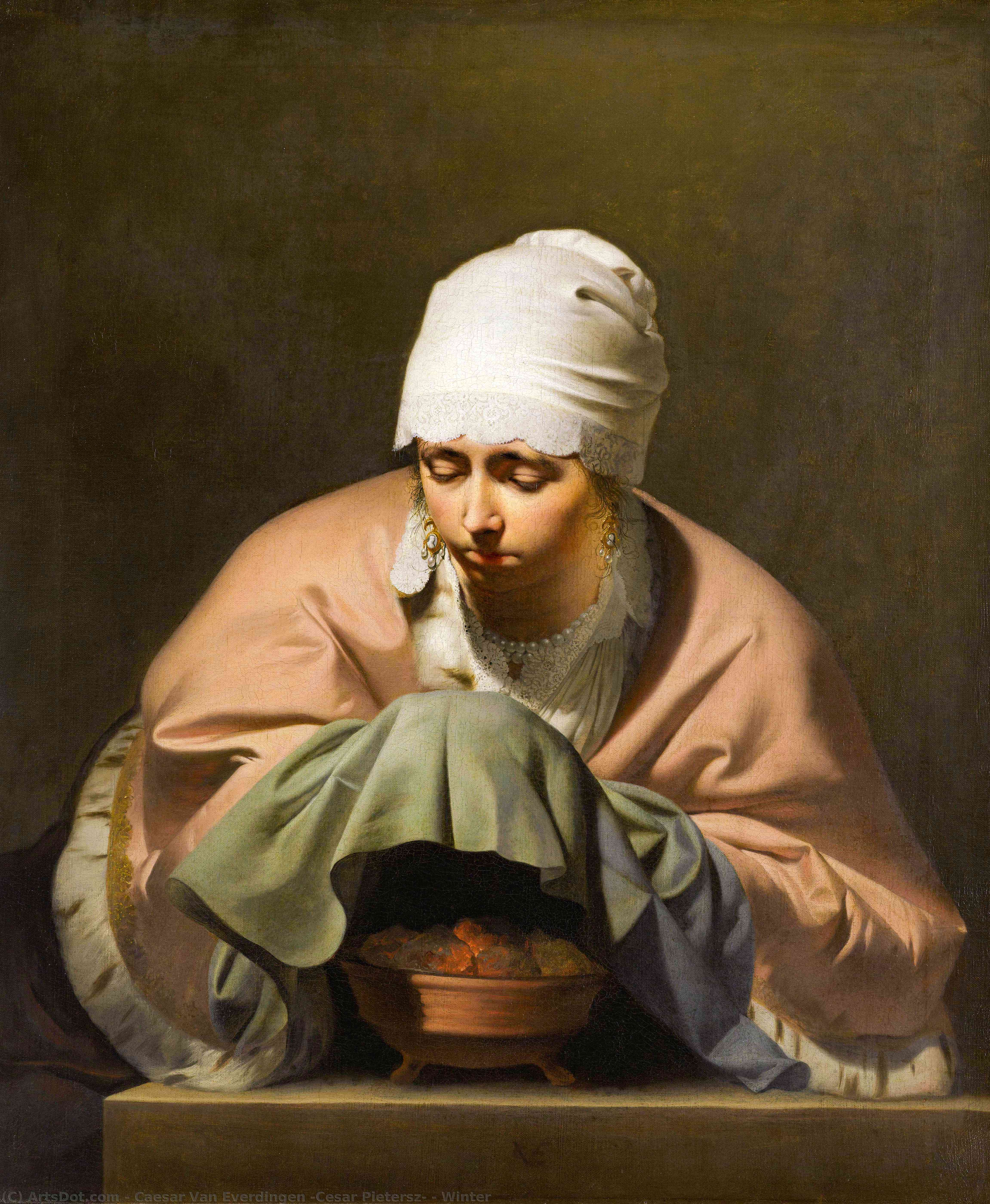
Winter (1646) od Caesar Van Everdingen

Winter

1646 · Oil On Canvas · Rijksmuseum, Amsterdam

To gaze upon Caesar Van Everdingen’s Winter is to step directly into the hushed, contemplative atmosphere of the Dutch Golden Age. This painting, executed in 1646, transcends a mere depiction of a season; it captures an ephemeral moment—a pause in the rhythm of daily life under the soft dominion of winter's breath. The composition immediately draws the eye to the central figure: a young woman whose presence is both delicate…

4
Vertumnus and Pomona (1631) od Caesar Van Everdingen

Vertumnus and Pomona

1631 · Oil

In this 1631 oil painting, the tension of a mythological pursuit unfolds within a dense, shadowed landscape. Vertumnus, the god of seasons, is depicted as an older man seated upon the earth, his gaze directed upward toward Pomona. She is positioned to the right, her back turned to the viewer, her sculptural physique partially draped in white cloth. The composition relies on a heavy use of chiaroscuro, where dramatic light…

5
Vertumnus and Pomona (1638) od Caesar Van Everdingen

Vertumnus and Pomona

1638 · Oil On Canvas · Thyssen-Bornemisza Museum, Madrid

This work, titled Vertumnus and Pomona, is a significant example of the mythological painting produced by Caesar van Everdingen. The piece is dated about 1637–1640, a period during which the artist was establishing his presence within the Dutch Golden Age. It is a work that captures a specific moment of classical narrative, rendered with the precision characteristic of his training in Utrecht.

6
Officers of the Orange Compagny of the Old Civic Guard (1641) od Caesar Van Everdingen

Officers of the Orange Compagny of the Old Civic Guard

1641 · Oil On Canvas · Stedelijk Museum, Alkmaar

In this 1641 portrait, we find ourselves standing before a dense assembly of men, the officers of the Orange Company of the Old Civic Guard. There is a certain weight to the composition, a horizontal arrangement that feels both crowded and deeply organized. These men are not merely subjects; they are a collective force, their postures providing a structural rhythm to the canvas. The lighting, descending from the upper left,…

7
Portret van Aechje Claesdr. Moer (1585-1640) (1636) od Caesar Van Everdingen

Portret van Aechje Claesdr. Moer (1585-1640)

1636 · Oil · Stedelijk Museum, Alkmaar

This 1636 oil portrait presents a three-quarter length view of an elderly woman, Aechje Claesdr. Moer, set against a somber, atmospheric backdrop. The composition relies on a sharp tonal contrast between her dark, light-absorbing gown and a large, bright white ruff collar. This millstone ruff, with its rhythmic pleats, directs the eye toward the subject's face, which is rendered with naturalistic precision. A soft, directional light enters from the upper…

8
Portrait of Pieter Cornelisz. van Everdingen (1575-1662) (1636) od Caesar Van Everdingen

Portrait of Pieter Cornelisz. van Everdingen (1575-1662)

1636 · Photography · Stedelijk Museum, Alkmaar

A woman occupies the foreground, her gaze directed toward the viewer from a waist-up perspective. She is positioned within a rural, village setting characterized by traditional thatched-roof huts and sparse vegetation. The composition utilizes linear perspective to draw the eye toward these structures, creating a sense of depth behind the central figure. Natural, bright daylight illuminates the scene, casting soft shadows that define the textures of her skin and the…

9
Vertumnus and Pomona (1650) od Caesar Van Everdingen

Vertumnus and Pomona

1650 · Oil · J. Paul Getty Museum, Los Angeles

This Baroque-style oil painting presents an intimate mythological scene featuring two figures, Vertumnus and Pomona, set against a dark and atmospheric landscape. The composition centers on a tactile exchange of fruit between a seated figure on the left and a woman on the right. The scene is characterized by a dramatic use of chiaroscuro, where light highlights the faces and hands of the subjects while casting much of the background…

10
Portrait of an unknown girl (1651) od Caesar Van Everdingen

Portrait of an unknown girl

1651 · Oil On Canvas · Herzog Anton Ulrich Museum, Brunšvik

The work before us is the Portrait of an unknown girl, a quiet study by the Dutch Golden Age painter Caesar van Everdingen. This portrait, which is also known by the titles Girl in a Large Hat or Meisje met brede hoed, offers a glimpse into the meticulous portraiture practiced during the mid-17th century. It captures a sense of individual presence through a restrained and dignified approach to the subject.

Slavná díla umělce Caesar Van Everdingen, čísla 11 až 41

11Officers and standard-bearers of New Civic Guard in Alkmaar (1657) od Caesar Van EverdingenOfficers and standard-bearers of New Civic Guard in Alkmaar1657 · Stedelijk Museum 12Portrait of Cornelis Jacobsz. Groot (?-1661) (1656) od Caesar Van EverdingenPortrait of Cornelis Jacobsz. Groot (?-1661)1656 · Kunsthandel P. de Boer 13Four Muses and Pegasus on Parnassus (1650) od Caesar Van EverdingenFour Muses and Pegasus on Parnassus1650 · Huis ten Bosch 14Lycurgus Demonstrates the Benefits of Education (1660) od Caesar Van EverdingenLycurgus Demonstrates the Benefits of Education1660 · Stedelijk Museum 15Self-portrait of Caesar van Everdingen (?-1678) (1670) od Caesar Van EverdingenSelf-portrait of Caesar van Everdingen (?-1678)1670 · Stedelijk Museum 16Portrait of a woman, possibly a sister of Cornelis Jacobsz. Groot (1664) od Caesar Van EverdingenPortrait of a woman, possibly a sister of Cornelis Jacobsz. Groot1664 · Kunsthandel P. de Boer 17Portrait of Wollebrand Geleynsz de Jongh (1594-1674), with a servant and a child (1674) od Caesar Van EverdingenPortrait of Wollebrand Geleynsz de Jongh (1594-1674), with a servant and a child1674 · Stedelijk Museum 18Four Evangelists: John (1676) od Caesar Van EverdingenFour Evangelists: John1676 · Stedelijk Museum 19Four Evangelists: Luke (1676) od Caesar Van EverdingenFour Evangelists: Luke1676 · Stedelijk Museum 20Four Evangelists: Mark (1676) od Caesar Van EverdingenFour Evangelists: Mark1676 · Stedelijk Museum 21Joueuse de Cistre (1678) od Caesar Van EverdingenJoueuse de Cistre1678 · Musée des Beaux-Arts de Rouen 22Allegory of the Birth of Frederik Hendrik (1650) od Caesar Van EverdingenAllegory of the Birth of Frederik Hendrik1650 · Huis ten Bosch 23Female Figure, possibly Lucretia (1793) od Caesar Van EverdingenFemale Figure, possibly Lucretia1793 · Nationalmuseum 24Diogenes Seeks a True Man (1652) od Caesar Van EverdingenDiogenes Seeks a True Man1652 · Mauritshuis 25Still-Life with a Bust of Venus (1665) od Caesar Van EverdingenStill-Life with a Bust of Venus1665 · Mauritshuis 26View of the Oranjezaal (1650) od Caesar Van EverdingenView of the Oranjezaal1650 · Huis ten Bosch 27Amor Holding a Glass Orb (1660) od Caesar Van EverdingenAmor Holding a Glass Orb1660 28Count Willem II of Holland Granting Privileges (1655) od Caesar Van EverdingenCount Willem II of Holland Granting Privileges1655 · Gemeenlandshuis 29Officers and Standard-Bearers of the Old Civic Guard (1657) od Caesar Van EverdingenOfficers and Standard-Bearers of the Old Civic Guard1657 · Stedelijk Museum 30Nymphs Offering the Young Bacchus Wine, Fruit and Flowers (1670) od Caesar Van EverdingenNymphs Offering the Young Bacchus Wine, Fruit and Flowers1670 · Museum Kunstpalast 31Holy Family (1660) od Caesar Van EverdingenHoly Family1660 · Museum Catharijneconvent 32Portrait of a Girl as a Huntress (1665) od Caesar Van EverdingenPortrait of a Girl as a Huntress1665 · Koninklijk Museum voor Schone Kunsten 33Portrait of a Two-Year-Old Boy (1664) od Caesar Van EverdingenPortrait of a Two-Year-Old Boy1664 · Cannon Hall Museum 34Elisabeth van Kessel (1640-1717), Wife of Willem Jacobsz Baert, Caesar Boëtius van Everdingen, 1671 (1671) od Caesar Van EverdingenElisabeth van Kessel (1640-1717), Wife of Willem Jacobsz Baert, Caesar Boëtius van Everdingen, 16711671 · Rijksmuseum 35Willem Jacobsz Baert (1636-84), Burgomaster of Alkmaar and Amsterdam, Caesar Boëtius van Everdingen, 1671 (1671) od Caesar Van EverdingenWillem Jacobsz Baert (1636-84), Burgomaster of Alkmaar and Amsterdam, Caesar Boëtius van Everdingen, 16711671 · Rijksmuseum 36The four muses with pegasus od Caesar Van EverdingenThe four muses with pegasusHuis ten Bosch 37Portrait of a Dutch Commander od Caesar Van EverdingenPortrait of a Dutch CommanderNational Gallery 38Bacchus with Two Nymphs And Cupid od Caesar Van EverdingenBacchus with Two Nymphs And Cupid 39Pan and Syrinx, Caesar Boëtius van Everdingen, c. 1637 - c. 1640 (1640) od Caesar Van EverdingenPan and Syrinx, Caesar Boëtius van Everdingen, c. 1637 - c. 16401640 · Rijksmuseum 40Girl in a Large Hat (1647) od Caesar Van EverdingenGirl in a Large Hat1647 · Rijksmuseum 41Bacchus with Nymphs and Cupid (1660) od Caesar Van EverdingenBacchus with Nymphs and Cupid1660 · Gemäldegalerie Alte Meister

Slavná díla Caesar Van Everdingen podle jednotlivých období

Motivy, které zaujaly Caesar Van Everdingen

Čtyři témata, která se v těchto originálech nejčastěji objevují, z nichž každé má svůj nejlepší příklad.

Muzea, v nichž jsou vystavena originálna umělce Caesar Van Everdingen

8 muzea, v nichž je umístěno nejvíce obrazů z této stránky.

Muzeum Město Díla autora Caesar Van Everdingen Obrazy z tohoto seznamu
Stedelijk Museum, AlkmaarStedelijk Museum Alkmaar 11 Officers of the Orange Compagny of the Old Civic Guard, Portret van Aechje Claesdr. Moer (1585-1640), Portrait of Pieter Cornelisz. van Everdingen (1575-1662)
Rijksmuseum, AmsterdamRijksmuseum Amsterdam 6 Woman praying, Winter, Elisabeth van Kessel (1640-1717), Wife of Willem Jacobsz Baert, Caesar Boëtius van Everdingen, 1671
Huis ten Bosch, The HagueHuis ten Bosch The Hague 4 Four Muses and Pegasus on Parnassus, Allegory of the Birth of Frederik Hendrik, View of the Oranjezaal
Nationalmuseum, StockholmNationalmuseum Stockholm 2 Jupiter and Callisto, Female Figure, possibly Lucretia
Kunsthandel P. de BoerKunsthandel P. de Boer 2 Portrait of Cornelis Jacobsz. Groot (?-1661), Portrait of a woman, possibly a sister of Cornelis Jacobsz. Groot
Mauritshuis, HaagMauritshuis Haag 2 Diogenes Seeks a True Man, Still-Life with a Bust of Venus
Thyssen-Bornemisza Museum, MadridThyssen-Bornemisza Museum Madrid 1 Vertumnus and Pomona
J. Paul Getty Museum, Los AngelesJ. Paul Getty Museum Los Angeles 1 Vertumnus and Pomona

Caesar Van Everdingen napříč desetiletími: jeden unikátní originál pro každou dekádu

Díla podle dekád

Vyberte si dekádu a prohlédněte si originál, který ji definuje.

Obrazy umělce Caesar Van Everdingen: dotazy pro galerii

Kterým nejznámějším dílem je Caesar Van Everdingen?Odhalit odpověď

Woman praying (1650), Rijksmuseum, Amsterdam. Následují Jupiter and Callisto (1655) a Winter (1646).

V jakém věku vytvořil(a) Caesar Van Everdingen dílo Woman praying?Odhalit odpověď

34 let: dílo Woman praying pochází z roku 1650 a Caesar Van Everdingen se narodil/a v roce 1616.

Kterých deset obrazů autora Caesar Van Everdingen je nejznámějších?Odhalit odpověď

Woman praying, Jupiter and Callisto, Winter, Vertumnus and Pomona, Vertumnus and Pomona, Officers of the Orange Compagny of the Old Civic Guard, Portret van Aechje Claesdr. Moer (1585-1640), Portrait of Pieter Cornelisz. van Everdingen (1575-1662), Vertumnus and Pomona a Portrait of an unknown girl. Hodnocení výše uvádí rok a muzeum pro každé z nich.

Kolik známých děl má autor Caesar Van Everdingen?Odhalit odpověď

Náš katalog obsahuje 41 děl umělce Caesar Van Everdingen z let 1631 až 1678.

Kde lze vidět nejznámější originály umělce Caesar Van Everdingen?Odhalit odpověď

Většinou v Stedelijk Museum (Alkmaar), Rijksmuseum (Amsterdam) a Huis ten Bosch (The Hague). V tabulce muzeí výše jsou vypsány všechny.

V jakém období vytvořil(a) Caesar Van Everdingen svá nejznámější obrazy?Odhalit odpověď

V období 1650s: 12 z celkem 41 děl na této stránce vzniklo právě tehdy, z toho Woman praying z nich.

Který slavný obraz od Caesar Van Everdingen je nejstarší a který nejnovější?Odhalit odpověď

Na této stránce je nejstarší dílo z Vertumnus and Pomona (1631) a nejnovější z Joueuse de Cistre (1678).

Jakým tématům se Caesar Van Everdingen věnoval/a nejčastěji?Odhalit odpověď

Woman (13), Man (11) a Drapery (5) napříč 41 díly na této stránce.

Jaké materiály používal(a) Caesar Van Everdingen nejčastěji?Odhalit odpověď

Oil On Canvas, u 15 z 41 děl na této stránce.

K kterému směru patří dílo umělce Caesar Van Everdingen?Odhalit odpověď

Baroque a Dutch golden age, podle originálů na této stránce.

Jaká originální díla Caesar Van Everdingen mohu vidět v Stedelijk Museum?Odhalit odpověď

Officers of the Orange Compagny of the Old Civic Guard, Portret van Aechje Claesdr. Moer (1585-1640) a Portrait of Pieter Cornelisz. van Everdingen (1575-1662): muzeum Stedelijk Museum, Alkmaar má v obsluze 11 děl z této stránky.

Caesar Van Everdingen: portrét umělce

Odkaz světla a linie: Život Caesara van Everdingena

V zlaté éře nizozemského malířství, kdy hra světla a stínu definovala vizuální identitu celé národnosti, se Caesar van Everdingen vyvinul jako mistr jemných emocí a atmosférické hloubky. Narodil se kolem roku 1616 ve historickém městě Alkmaar v Nizozemsku a jeho umělecká cesta byla hluboce protkána prestižní rodinnou linií. Ačkoliv je často zmiňován vedle svých slavných bratrů, Allarta a Jana, Caesar si uvnitř nizozemského zlatého věku vybudoval zcela vlastní místo. Jeho rané vzdělání pod zářím uznávaného Jana Gerritsze van Bronckhorsta v Utrechtu mu poskytlo přísné základy klasické estetiky, což v něm vštípilo preciznost, která mu později umožnila překonat pouhé technické dovednosti a dosáhnout skutečné umělecké vize.

Jeho profesní vzestup začal vážně v roce 1632, kdy oficiálně vstoupil do cechu v Alkmaaru. Během těchto formativních let byl jeho repertoár charakterizován pečlivými portréty a evokativními žánrovými scénami, díly, která vyžadovaly intenzivní pozorování lidské existence. Jak však jeho talent dozrával, rostla i jeho ambice. Přešel za hranice doslovné reprezentace a rozvinul jedinečnou schopnost manipulovat s tahy štětcem tak, aby zachytil prchavé nuance světla a tíhu atmosféry. Tato evoluce znamenala jeho přechod od zručnéno řemeslníka k vizionářskému malíři, schopnému vdechnout plátnu život.

Haarlemská léta a velkolepé ambice

Zásadní kapitola Van Everdingenova života se rozvinula v roce 1648, kdy se přestěhoval do živého a kulturně bohatého města Haarlem. Tento přesun byl víc než jen změnou krajiny; byla to imerze do samotného srdce nizozemského uměleckého světa. Připojením k prestižnímu haarlemskému cechu svatého Lukáše a aktivitou v rámci schutterij (městské stráže) se Caesar stal pevnou součástí sociální a politické elity města. Tato spojení se ukázala jako klíčová pro získávání zakázek, které by později definovaly jeho historický význam.

Možná nejúchvatnějším úspěchem jeho kariéry byla jeho účast na dekoraci Oranje Zaal (Oranžový sál) v paláci Huis ten Bosch. Tento monumentální podnik vyžadoval mistrovství v historickém malování velkého formátu, žánru, který vyžadoval jak narativní komplexnost, tak grandiózní měřítko. V tomto prostředí Caesar předvedl svou zdatnost při skládání epických scén, kde propojil historickou vážnost s jemným dotekem. Jeho práce v tomto období ukázala rostoucí schopnost pracovat se složitými kompozicí a zajistila, že jeho jméno zůstane vytesáno do architektonické historie Nizozemska.

Umělecká zralost a trvalý vliv

Ve svých pozdějších letech se Caesar vrátil ke svým kořenům v Alkmaaru, kde založil dílnu, která se stala útočištěm pro uměleckou výuku. Toto období jeho života bylo poznamenáno hlubokým oddaním zdokonalování svého řemesla a mentorstvím nové generace malířů. Jeho pozdní díla odrážejí život plný nahromaděné moudrosti, charakterizované opakovanou fascinací nebeskými a éterickými tématy. Stal se obzvláště známým svými zobrazeními křídlatých postav – andělů a božských bytostí – vykreslených s takovou měkkostí, která naznačovala přítomnost toho, co je vznešené.

Význam Caesara van Everdingena nespočívá pouze v jeho individuálních mistrovských dílech, ale i v jeho roli spojovaného mostu mezi přísnými tradicemi počátku 17. století a následnými emotivnějšími, atmosférickými styly. Jeho schopnost spojit preciznost nizozemského portrétництва s velkolepostí historického narativu zůstává důkazem jeho všestrannosti. Dnes jeho díla slouží jako životně důležitá okna do duše nizozemského zlatého věku a připomínají nám dobu, kdy každý tah štětcem byl pokusem zachytit věčnost v tom, co je pomíjivé.