Portrét Bernard Blommers

46 nejslavnějších obrazů autora Bernard Blommers, každý naprosto unikátní

Aktualizováno listopad 2026 · seřazeno podle našeho skóre popularity (vyhledávání, návštěvy a objednávky u každého díla) · 48 děl umělce Bernard Blommers v našem katalogu

Stručně řečeno

Fishwives by the Sea (1888) je obraz autora Bernard Blommers, který přitahuje nejvíce pohledů. Poté se zrak přesouvá k Little Girl's Head (1868) a The Romance Novel (1860). Z 48 děl umělce Bernard Blommers v našem katalogu je těchto 46 těch nejznámějších; každé z nich je unikátním originálem s uvedením roku vzniku, muzea a důvodu jeho nesmrtelnosti.

1845 – 1914, Haag Hague school Nejvíce děl: The Mesdag Collection

Top 10 obrazů autora Bernard Blommers podle výběru galerie

1
Fishwives by the Sea (1888) od Bernard Blommers

Fishwives by the Sea

1888 · Oil On Canvas

The North Sea air carries a weight of salt and damp sand. In this 1888 oil on canvas, a group of women gathers at the water's edge, their figures anchored against the shifting tides. They move with the practiced rhythm of those who live by the sea, some tending to baskets, others simply existing within the coastal light. A lone boat rests in the background, a silent witness to the…

2
Little Girl's Head (1868) od Bernard Blommers

Little Girl's Head

1868 · Oil On Canvas · Kunstmuseum Den Haag, Haag

The oil on canvas portrait presents a close-up bust of a young girl, positioned slightly off-center against a dark, undifferentiated background. The subject looks toward the viewer with a direct, calm gaze. A single light source illuminates one side of her face, casting gentle shadows that define the contours of her features and create a sense of three-dimensionality. The color palette is dominated by warm, earthy tones, specifically deep browns…

3
The Romance Novel (1860) od Bernard Blommers

The Romance Novel

1860 · Oil On Board · Bavarské státní sbírky malby, Mnichov

The Romance Novel is an oil painting by Bernard Blommers, created about 1860. The scene captures a quiet, domestic interior where light enters from a large window on the left. A standing woman, seen in profile, faces away from the viewer toward a second woman who reclines in a bed. The figures exist within a soft, painterly space defined by visible brushstrokes and the textures of fabric and bedding.

4
Interior (1872) od Bernard Blommers

Interior

1872 · Oil On Canvas · Kunstmuseum Den Haag, Haag

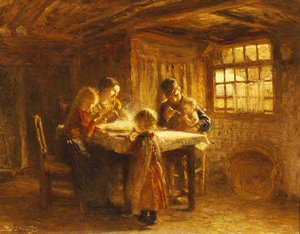
A single window on the right side of the room breathes light into the gloom. This soft glow catches the curve of a wooden table and the heavy folds of fabric worn by the figures gathered there. Three souls occupy this dim space: a woman seated opposite another, and a third figure cradling a child. The air in the room feels thick, weighted by the deep browns and ochre tones…

5
Where are the pigeons? (1875) od Bernard Blommers

Where are the pigeons?

1875 · Oil On Canvas · The Mesdag Collection, Haag

In this 1875 oil on canvas, we find ourselves drawn into a private, hushed moment of domestic life. The composition is oriented vertically, guiding the eye upward from the heavy, dark tones of the floor toward a tender interaction between a woman and a small child. There is a palpable sense of weight in the room, anchored by the deep browns and ochre of the wooden furniture and the stone…

6
The little rabbit (1873) od Bernard Blommers

The little rabbit

1873 · Oil On Canvas · The Mesdag Collection, Haag

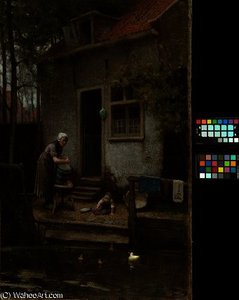
The little rabbit is a genre painting that captures a tender and intimate domestic moment. The composition centers on two figures positioned before a dark doorway, which serves to create a focal point through the use of light and subject. A woman, dressed in traditional peasant attire, leans toward a small child wearing a white gown. Both figures are looking down at a small rabbit situated on the ground.

7
Fallen (1875) od Bernard Blommers

Fallen

1875 · Oil On Canvas · The Mesdag Collection, Haag

A small child leans over the edge of a dark, weathered wooden structure, perhaps a toy cart or a high chair, caught in a moment of profound stillness. The scene feels intimate, as if we have stumbled upon a private, domestic secret. A white cap sits atop the child's head, catching a sharp, directional light that spills from the upper left, casting the rest of the room into deep, heavy…

8
Fisherwomen on the Beach (1882) od Bernard Blommers

Fisherwomen on the Beach

1882 · Oil On Canvas

The shoreline is a place of salt and heavy fabric. In this 1882 oil on canvas, the sand holds the damp imprint of labor. A group of women, dressed in long skirts and aprons, gather near the water's edge. They move with a practiced rhythm, their hands busy with baskets and the sorting of fish. To the right, a wooden boat rests in the shallow surf, its tall masts cutting…

9
Little Boat Sailing (1882) od Bernard Blommers

Little Boat Sailing

1882 · Oil · Dordrechts Museum, Dordrecht

Little Boat Sailing, painted by Bernard Blommers in 1882, presents a genre scene of everyday life. The work captures three young children playing in the shallow water along a beach or shoreline. This candid moment of childhood play is rendered with the characteristic focus of Impressionism, prioritizing the immediate sensation of the scene over rigid detail.

10
Playing School (1882) od Bernard Blommers

Playing School

1882 · Oil On Canvas · Dordrechts Museum, Dordrecht

Playing School is an oil painting by Bernard Blommers, executed in 1882. The work captures a group of children engaged in a game of school in an outdoor setting. The composition centers on five children arranged in a semi-circle, creating an intimate, enclosed scene.

Slavná díla umělce Bernard Blommers, čísla 11 až 46

Slavná díla Bernard Blommers podle jednotlivých období

Motivy, které zaujaly Bernard Blommers

Čtyři témata, která se v těchto originálech nejčastěji objevují, z nichž každé má svůj nejlepší příklad.

Muzea, v nichž jsou vystavena originálna umělce Bernard Blommers

8 muzea, v nichž je umístěno nejvíce obrazů z této stránky.

Muzeum Město Díla autora Bernard Blommers Obrazy z tohoto seznamu
The Mesdag Collection, HaagThe Mesdag Collection Haag 6 Where are the pigeons?, The little rabbit, Fallen
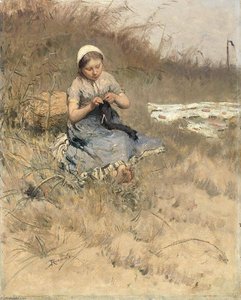
Rijksmuseum, AmsterdamRijksmuseum Amsterdam 5 Neighborly Gossip, Vyšívající dívka na duně, The Fishermen's Children
Dordrechts Museum, DordrechtDordrechts Museum Dordrecht 4 Little Boat Sailing, Playing School, Little Boat Sailing
Kunstmuseum Den Haag, HaagKunstmuseum Den Haag Haag 3 Little Girl's Head, Interior, Jaantje the fish seller
Bavarské státní sbírky malby, MnichovBavarské státní sbírky malby Mnichov 2 The Romance Novel, Fresh Sea Fish
Museum Boijmans Van Beuningen, RotterdamMuseum Boijmans Van Beuningen Rotterdam 1 painting
Groninger Museum, GroningenGroninger Museum Groningen 1 Feeding
Královské muzeum výtvarného umění Antverpy, AntverpyKrálovské muzeum výtvarného umění Antverpy Antverpy 1 Interior

Bernard Blommers napříč desetiletími: jeden unikátní originál pro každou dekádu

Díla podle dekád

Vyberte si dekádu a prohlédněte si originál, který ji definuje.

Obrazy umělce Bernard Blommers: dotazy pro galerii

Kterým nejznámějším dílem je Bernard Blommers?Odhalit odpověď

Fishwives by the Sea (1888). Následují Little Girl's Head (1868) a The Romance Novel (1860).

V jakém věku vytvořil(a) Bernard Blommers dílo Fishwives by the Sea?Odhalit odpověď

43 let: dílo Fishwives by the Sea pochází z roku 1888 a Bernard Blommers se narodil/a v roce 1845.

Kterých deset obrazů autora Bernard Blommers je nejznámějších?Odhalit odpověď

Fishwives by the Sea, Little Girl's Head, The Romance Novel, Interior, Where are the pigeons?, The little rabbit, Fallen, Fisherwomen on the Beach, Little Boat Sailing a Playing School. Hodnocení výše uvádí rok a muzeum pro každé z nich.

Kolik známých děl má autor Bernard Blommers?Odhalit odpověď

Náš katalog obsahuje 48 děl umělce Bernard Blommers z let 1860 až 1914.

Kde lze vidět nejznámější originály umělce Bernard Blommers?Odhalit odpověď

Většinou v The Mesdag Collection (Haag), Rijksmuseum (Amsterdam) a Dordrechts Museum (Dordrecht). V tabulce muzeí výše jsou vypsány všechny.

V jakém období vytvořil(a) Bernard Blommers svá nejznámější obrazy?Odhalit odpověď

V období 1880s: 12 z celkem 46 děl na této stránce vzniklo právě tehdy, z toho Fishwives by the Sea z nich.

Který slavný obraz od Bernard Blommers je nejstarší a který nejnovější?Odhalit odpověď

Na této stránce je nejstarší dílo z The Romance Novel (1860) a nejnovější z The Milkmaid (1914).

Jakým tématům se Bernard Blommers věnoval/a nejčastěji?Odhalit odpověď

Woman (8), Child (7) a Beach (6) napříč 46 díly na této stránce.

Jaké materiály používal(a) Bernard Blommers nejčastěji?Odhalit odpověď

Oil On Canvas, u 11 z 46 děl na této stránce.

K kterému směru patří dílo umělce Bernard Blommers?Odhalit odpověď

Hague school, podle originálů na této stránce.

Jaká originální díla Bernard Blommers mohu vidět v The Mesdag Collection?Odhalit odpověď

Where are the pigeons?, The little rabbit a Fallen: muzeum The Mesdag Collection, Haag má v obsluze 6 děl z této stránky.

Bernard Blommers: portrét umělce

Bernardus Blommers: Holandský mistr světla a života

Bernardus Johannes, neboli Bernard, jak je známější, byl klíčovou postavou holandské umělecké scény na přelomu 19. a 20. století. Narodil se v Haagu v roce 1845 a jeho život i dílo jsou neoddělitelně spjaty s rozkvétající haagskou školou – hnutím, které se snažilo zachytit podstatu každodenního holandského života s neuvěřitelným realismem a citlivostí. Blommers byl však víc než jen umělec; byl to bystrý pozorovatel lidskosti, který s precizností vykresloval život rybářů, farmářů a jejich rodin na dramatickém pozadí pobřeží Severního moře a jeho rozlehlých dun.

Blommersova umělecká cesta nezačala v klasické ateliéru, ale v tiskárně svého otce. Tato raná zkušenost s vizuální reprodukcí v něm vrostla hluboká vá 존ění detailu a řemeslné preciznosti – vlastností, které později ovlivní jeho pečlivé tahy štětcem. Původně se věnoval lithografii jako řemeslu, avšak právě díky večerním kurzům na Haagské akademii umění objevil svou pravou vášeň: malířství. Pod hlubokým vlivem Josefa Israëla, zejména jeho zobrazení života pracující třídy, si Blommers rychle vybudoval pověst mistra zachycování intimních scén a vyjadřování pocitu tiché důstojnosti.

Jeho raná díla jsou charakteristická silným důrazem na žánrové malba – scény rybářů opravujících sítě, žen pečujících o své domácnosti a dětí hrajících si podél břehu. Tato témata nebyla pouze dekorativní; byla prosycena hlubokým respektem k životu obyčejných lidí. Vliv Israëla je patrný v Blommersově práci se světlem a stínem, v jeho pečlivé pozornosti věnované kostýmům i prostředí a v jeho schopnosti vyvolat pocit atmosféry. Blommers si však brzy vyvinul svůj vlastní, nezaměnitelný styl, který překročil pouhou imitaci a vytvořil díla s jedinečnou emocionální rezonancí.

Evoluce krajináře

S postupujícími 80. lety se Blommerův zájem přesunul k malbě krajiny, zejména k pohledům na pobřeží Severního moře. Trávil značnou část času v Scheveningen a později v Katwijk, kde pečlivě dokumentoval neustále se měnící světlo a meteorologické podmínky, které tyto dramatické prostředí utvářející. Nešlo jen o malebných pohledů; byla v nich cítit melancholie a osamělost, zrcadlící životy lidí, jejichž existence závisela na moři.

Klíčovým zlomem v Blommersově uměleckém vývoji byla jeho manželství s Annou van der Toorn, prodejky ryb ze Scheveningen. Anna se stala nejen jeho milovanou manželkou, ale také častou modelkou a muzą, která se objevuje v mnoha jeho obrazech. Toto intimní spojení s tématem – zejména s životy žen a dětí – prohloubilo jeho porozumění lidským emocím a obohatilo jeho uměleckou vizi. Jeho pozdější díla, často zobrazující matky a děti hrající si na pláži, jsou naplněna vřelostí, něhou a tichým pocitem spokojenosti.

Blommersova technika se v čase vyvíjela od více uhlazeného, akademického stylu k jednoduššímu, charakterizovanému volnějšími tahy štětcem a větším důrazem na zachycení prchavých okamžiků. Přijal techniku impasto, nanose aby silné vrstvy barvy vytvářely texturu a hloubku, zejména v jeho zobrazeních dun a bouřlivého moře. Tato hmatatelnost přidává do jeho malby další úroveň smyslového zážitku a vybízí diváka, aby cítil vítr, vnímal vůni slané mořské bry a prožíval drama přírodního světa.

⦖