Portrét Auguste Toulmouche

Obrazy autora Auguste Toulmouche: 21 nejznámějších díel podle pohledu galerie

Aktualizováno listopad 2026 · seřazeno podle našeho skóre popularity (vyhledávání, návštěvy a objednávky u každého díla) · 21 děl umělce Auguste Toulmouche v našem katalogu

Stručně řečeno

Z pohledu galerie je nejslavnějším dílem Auguste Toulmouche obraz Vanity - Auguste Toulmouche (2026). Reading Lesson (1865) a The Kiss (1870) doplňují trio, které každé oko okamžitě pozná. Z 21 děl umělce Auguste Toulmouche v našem katalogu představuje galerie níže 21 nejznámějších děl, z nichž každé je originálem s uvedením roku vzniku, muzea a toho, co jej činí jedinečným.

1829 – 1890, Nantes Academic realism Nejvíce děl: Muzeum umění v Bostonu

Top 10 obrazů umělce Auguste Toulmouche v naší galerii

1
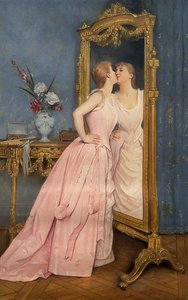
Vanity - Auguste Toulmouche (2026) od Auguste Toulmouche

Vanity - Auguste Toulmouche

2026 · Akryl

Auguste Toulmouche’s captivating work transports us to the heart of 19th-century Parisian society, a world steeped in luxury and delicate sensibilities. This hand-painted acrylic reproduction captures the essence of his signature style – an exquisite blend of academic realism and genre painting that celebrated the lives of upper-bourgeois women. Toulmouche wasn’t merely documenting a scene; he was crafting an idealized vision of domestic elegance, a realm where beauty and refinement…

2
Reading Lesson (1865) od Auguste Toulmouche

Reading Lesson

1865 · Oil · Muzeum umění v Bostonu, Boston

In Auguste Toulmouche's Reading Lesson, a quiet moment of instruction unfolds within a serene domestic setting. Created about 1865, the scene captures a young woman and a child sharing a book. They sit together in a stillness that suggests the world outside has momentarily paused. The focus remains entirely on this intimate exchange, where the act of reading becomes a shared experience between the two figures.

3
The Kiss (1870) od Auguste Toulmouche

The Kiss

1870 · Oil On Canvas

A man leans over a table to meet a woman in a sudden, quiet collision of movement. She is draped in a pink dress, the fabric spilling in heavy, luminous ruffles that catch the light from an unseen source to the left. He wears a dark suit and a crisp, delicate lace collar. They are caught in the threshold of a kiss, a private intersection of breath and silk. The…

4
Woman and Roses (1879) od Auguste Toulmouche

Woman and Roses

1879 · Oil

In this 1879 composition, we find ourselves drawn into a quiet, shaded corner of a lush garden. A woman is captured in profile, her presence defined by a sense of stillness as she stands amidst a profusion of rose bushes. The scene is bathed in the soft, diffused light of an overcast day, which avoids harsh shadows and instead wraps the subject in a gentle, natural glow. There is a…

5
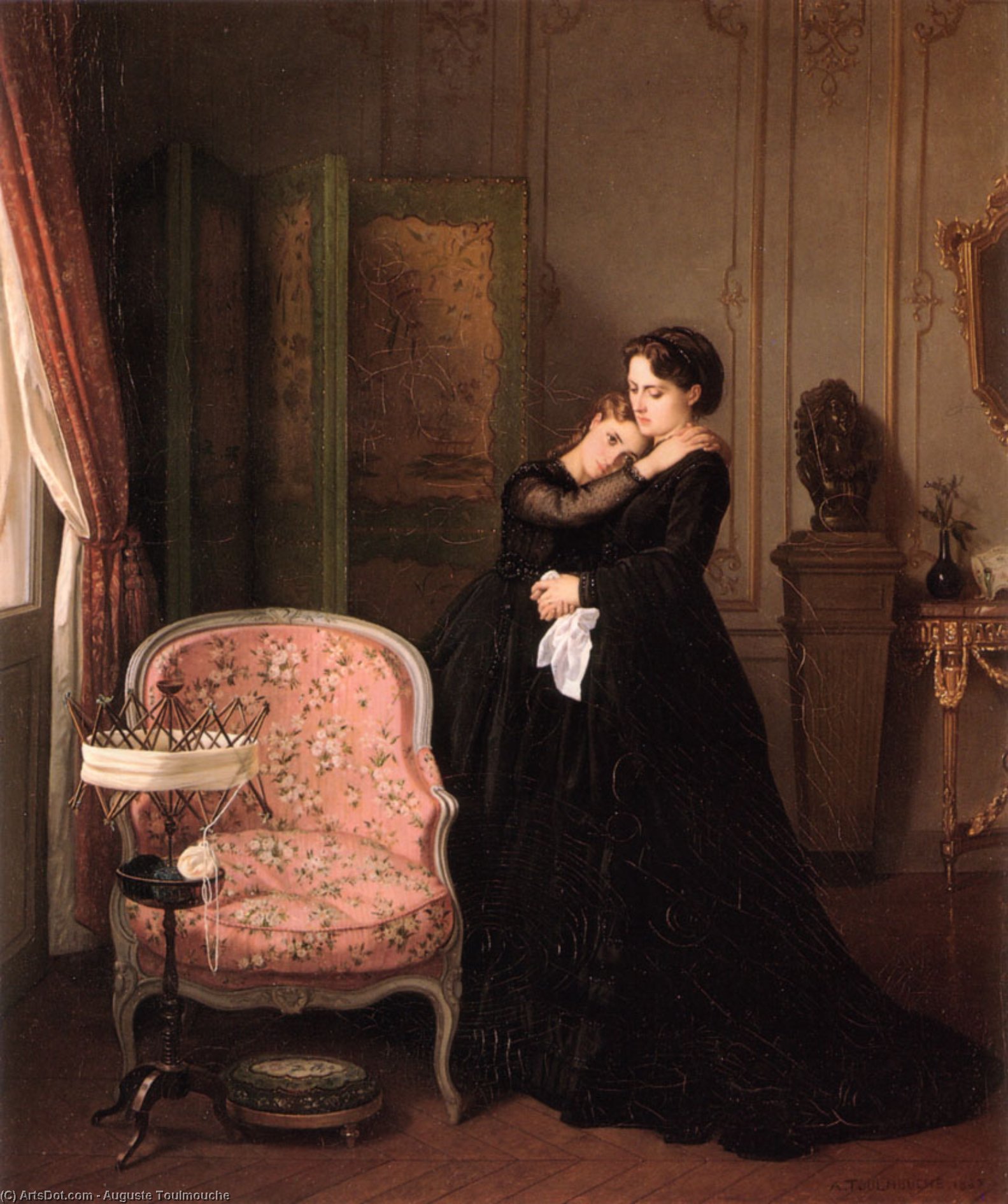
Consolation od Auguste Toulmouche

Consolation

Oil

Two women occupy a room defined by stillness. One woman reaches out, her hands framing the face of the other, offering a silent anchor against a tide of grief. The woman being held is caught in a moment of weeping, her features softened by the weight of her emotion. They are draped in black clothing, the dark fabric absorbing the light of the room. A chair sits to the left,…

Obrazy autora Auguste Toulmouche, seřazeny od 11 do 21

Motivy, které zaujaly Auguste Toulmouche

Čtyři témata, která se v těchto originálech nejčastěji objevují, z nichž každé má svůj nejlepší příklad.

Muzea, v nichž jsou vystavena originálna umělce Auguste Toulmouche

2 muzea, v nichž je umístěno nejvíce obrazů z této stránky.

Muzeum Město Díla autora Auguste Toulmouche Obrazy z tohoto seznamu
Muzeum umění v Bostonu, BostonMuzeum umění v Bostonu Boston 1 Reading Lesson
Musée Carnavalet, PařížMusée Carnavalet Paříž 1 Portrait of Rose Caron

Auguste Toulmouche, ikonická díla každého roku

Kariéra umělce Auguste Toulmouche na této stránce trvá 15 let, od 1865 do 1879: každý rok je zde zastoupen svými nejznámějšími originály.

Díla podle roku

Vyberte rok a prohlédněte si originály.

Obrazy umělce Auguste Toulmouche: odpovědi galerie

Který obraz autora Auguste Toulmouche je nejslavnější ze všech?Odhalit odpověď

Vanity - Auguste Toulmouche (2026). Následují Reading Lesson (1865) a The Kiss (1870).

Kterých 10 nejlepších obrazů má Auguste Toulmouche?Odhalit odpověď

Vanity - Auguste Toulmouche, Reading Lesson, The Kiss, Woman and Roses, Consolation, La fiancee hesitante, La Toilette, Portrait of Rose Caron, The lost love a The reluctant bride. Hodnocení výše uvádí rok a muzeum pro každé z nich.

Kolik děl vytvořil/a Auguste Toulmouche?Odhalit odpověď

Náš katalog obsahuje 21 děl umělce Auguste Toulmouche z let 1865 až 1879.

Kde jsou vystavena nejznámější originály umělce Auguste Toulmouche?Odhalit odpověď

Většinou v Muzeum umění v Bostonu (Boston) a Musée Carnavalet (Paříž). V tabulce muzeí výše jsou vypsány všechny.

Která jsou nejstarší a nejnovější slavná díla umělce Auguste Toulmouche?Odhalit odpověď

Na této stránce je nejstarší dílo z Reading Lesson (1865) a nejnovější z Woman and Roses (1879).

Kterým tématům se Auguste Toulmouche věnoval(a) nejčastěji?Odhalit odpověď

Woman (6), Interior (6) a Portrait (3) napříč 21 díly na této stránce.

V jaké technice tvořil(a) Auguste Toulmouche nejčastěji?Odhalit odpověď

Oil, u 3 z 21 děl na této stránce.

S jakým směrem je spojen(a) Auguste Toulmouche?Odhalit odpověď

Academic realism, podle originálů na této stránce.

Auguste Toulmouche: umělec

The Painter of Parisian Elegance

Auguste Toulmouche (1829-1890) stands as a luminous figure in the tapestry of 19th-century French art, a master whose brush captured the very essence of the Belle Époque. Born in Nantes to Emile Toulmouche, a prosperous broker, his early life was bathed in an atmosphere of artistic appreciation, nurtured by the steady encouragement of his father. This foundational support allowed him to pursue a rigorous classical education, beginning with the study of drawing and sculpture under Amédée Ménard. His journey eventually led him to the heart of Paris, where he sought the guidance of the esteemed Charles Gleyre. Under Gleyre’s tutelage, Toulmouche refined his command over academic realism, developing a sophisticated ability to translate the textures of high society onto canvas with unparalleled precision.

The brilliance of Toulmouche’s talent was recognized almost immediately by the art establishment. At the tender age of nineteen, he made his debut at the prestigious Paris Salon in 1848, an entrance that signaled the arrival of a formidable new voice in French genre painting. His subsequent triumphs at the Salons of 1852 and 1861, where he was honored with medals, solidified his standing among the artistic vanguard. This period of rising acclaim was further elevated by the highest form of recognition: imperial patronage. When Napoleon III commissioned ‘La Fille,’ a portrait of Eugénie de Bourbon, it served as a profound testament to the Emperor's trust in Toulmouche’s vision and cemented the artist's status as one of the era’s most fashionable and sought-after painters.

A Vision of Opulence and Introspection

Toulmouche’s oeuvre is characterized by a breathtaking devotion to the aesthetics of the upper-bourgeoisie. He did not merely document the lives of Parisian women; he crafted an idealized, almost dreamlike vision of domestic refinement. His canvases are celebrated for their meticulous rendering of opulent fabrics—the shimmering sheen of silk, the heavy weight of velvet, and the delicate intricacy of lace. Through his eyes, we witness a world of lavish furnishings and gilded interiors that epitomize the luxury of 19th-century France. Yet, beneath this surface of material splendor, there exists a profound psychological depth.

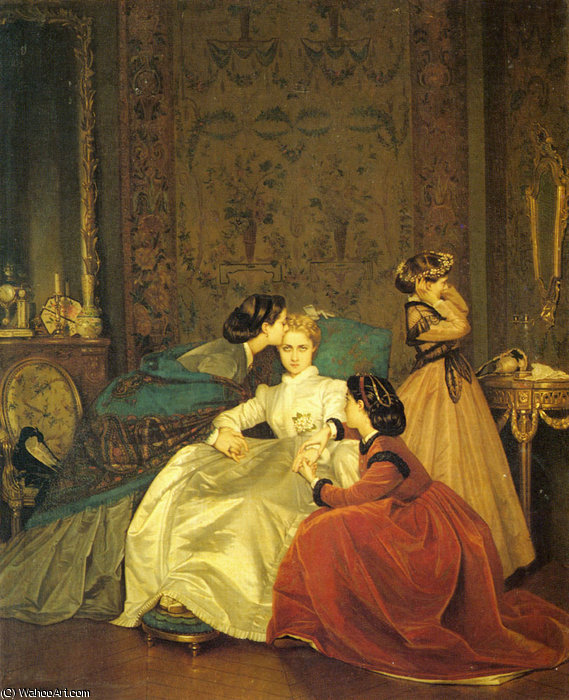
In works such as ‘La Fiancée Hesitante’ and ‘The Reluctant Bride,’ Toulmouche explores the nuanced emotions of his subjects. He possessed a singular talent for capturing moments of quiet introspection, where a gaze into an ornate mirror or a subtle tilt of the head suggests a complex inner life. His paintings often invite the viewer to contemplate themes of identity, beauty, and the fleeting nature of youth. This mastery of light and shadow—the interplay of soft pinks against deep blues and warm golds—creates an atmosphere that is simultaneously intimate and grand, pulling the observer into the private, elegant sanctuaries of his subjects.

Legacy of Academic Realism

The historical significance of Auguste Toulmouche lies in his ability to bridge the gap between strict academic tradition and the evocative storytelling of genre painting. While his technique remained rooted in the disciplined realism taught by Gleyre, his subject matter embraced the contemporary social shifts of his time. He became a chronicler of a specific social stratum, preserving the sartorial elegance and domestic rituals of a bygone era for posterity. His work remains a vital window into the cultural heartbeat of Paris during a period of immense transformation.

Today, Toulmouche’s influence persists through the enduring allure of his compositions. Collectors and art enthusiasts continue to be drawn to his ability to evoke nostalgia and wonder. His legacy is defined by:

  • Technical Mastery: An unparalleled skill in rendering textures, light, and the tactile qualities of luxury goods.
  • Cultural Documentation: Providing a detailed visual record of the social hierarchies and aesthetic values of the Belle Époque.
  • Emotional Resonance: The ability to imbue highly stylized portraits with genuine human sentiment and psychological complexity.