Attavante degli Attavanti (1452–1525): A Florentine Illuminator
Attavante degli Attavanti, often referred to as Vante, stands as a pivotal figure in the artistic landscape of Renaissance Florence—a painter whose legacy resides primarily within the realm of illuminated manuscripts. Born around 1452 in Castel Fiorentino, Italy, he emerged from a milieu steeped in humanist scholarship and artistic innovation, inheriting the stylistic sensibilities of masters like Bartolomeo della Gatta.
His early training likely occurred under Domenico Ghirlandaio’s tutelage, fostering an understanding of perspective and naturalism that would permeate his subsequent oeuvre. Attavante quickly established himself as a sought-after illuminator, securing commissions from influential patrons—most notably Matthias Corvinus, King of Hungary—who recognized his exceptional talent for transforming parchment into breathtaking visual narratives.
- Notable Commissions: Among his most celebrated undertakings were the Missal and Codex Heroica commissioned by Corvinus, masterpieces that exemplify the grandeur and sophistication of Hungarian Renaissance art.
- Architectural Designs: Beyond manuscript illumination, Attavante demonstrated versatility as an architect, contributing to significant projects in Florence, showcasing his mastery of classical principles and decorative embellishment.
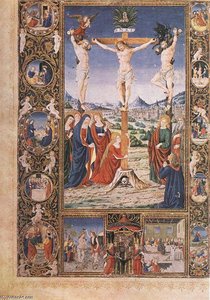
Attavante’s artistic style is characterized by a meticulous attention to detail—a hallmark of Florentine Mannerism—combined with a profound engagement with Antiquity. He drew inspiration from sculptural reliefs and architectural precedents, incorporating motifs of garlands, medallions, and classical columns into his compositions. His palette favored rich hues—deep reds, blues, and golds—creating luminous surfaces that conveyed both solemn piety and artistic splendor.
His workshop produced the Jerome’s Bible – one of the finest bibles ever to be produced in the Italian renaissance, now in the Portuguese national archives, Torre do Tombo.
A remarkable achievement was the Codex Heroica by Philostratus, which is currently housed in the National Library at Paris.
Technique and Style
Attavante’s technique involved layering thin glazes of pigment onto gesso panels—a method that allowed for unparalleled luminosity and textural richness. He skillfully employed hatching and stippling to achieve subtle gradations of tone, capturing the nuances of light and shadow with remarkable precision.
Furthermore, Attavante's meticulous rendering of drapery—particularly in depictions of saints and biblical figures—demonstrated an exceptional command of anatomical accuracy and artistic virtuosity. His compositions were carefully balanced, reflecting a humanist preoccupation with harmonious proportions and idealized beauty.
Influence and Legacy
Attavante degli Attavanti’s influence extended far beyond his immediate contemporaries, shaping the aesthetic sensibilities of subsequent generations of Florentine artists. He served as an exemplar for Mannerist painters striving to emulate the grandeur and expressive power of Michelangelo—a testament to his enduring artistic vision.
His workshop also produced the Jerome's Bible - one of the finest bibles ever to be produced in the Italian renaissance, now in the Portuguese national archives, Torre do Tombo.
Rediscovery and Recognition
Despite facing obscurity for centuries, Attavante’s work has experienced a resurgence of scholarly interest in recent decades—fueled by advancements in art historical research and conservation techniques. The attribution of several previously unidentified paintings to his workshop has dramatically expanded our understanding of his artistic output.
The theft of the Missal from London in January 2017 underscored the importance of safeguarding cultural heritage and reaffirmed Attavante’s place as one of Florence's most celebrated artists.
Otázky a odpovědi
Kde mohu vidět barevný profil děl umělce Attavante Degli Attavanti (Vante)?
Barevný profil děl umělce Attavante Degli Attavanti (Vante) naleznete na jeho stránce Genom palety.
Kde si mohu prohlédnout díla umělce Attavante Degli Attavanti (Vante) uspořádaná podle atmosféry?
Stránka umělce Galerie nálad nabízí díla Attavante Degli Attavanti (Vante) uspořádaná podle jejich atmosféry.
Kde mohu si prohlédnout všechná umělecká díla autora Attavante Degli Attavanti (Vante)?
Veškerá díla umělce Attavante Degli Attavanti (Vante) na tato webová stránka si můžete prohlédnout na jeho stránce Všechná umělecká díla.