Portrét Antonio Zucchi

87 nejslavnějších obrazů autora Antonio Zucchi, výběr z galerie

Aktualizováno listopad 2026 · seřazeno podle našeho skóre popularity (vyhledávání, návštěvy a objednávky u každého díla) · 101 děl umělce Antonio Zucchi v našem katalogu

Stručně řečeno

Z všech originálů, které Antonio Zucchi zanechal, je nejslavnější A Putto Being Woken from Sleep by Tickling of His Nose (1770), který se nachází ve sbírce Nostell Priory, Wakefield. Hned za ním následují James Adam, 1732 - 1794. Architect and designer (1763) a Landscape with a Bridge and Ruins with Peasants Fishing (a set of six decorative wall panels) (1781). Náš katalog obsahuje 101 děl umělce Antonio Zucchi; galerie si zachovala 87 děl, která obdivuje celý svět, přičemž každé je znázorněno s datem vzniku, názevem muzea a jeho příběhem.

1726 – 1795, Benátky Neoclassical style Nejvíce děl: Nostell Priory

10 nejlepších obrazů umělce Antonio Zucchi: výběr galerie

1
A Putto Being Woken from Sleep by Tickling of His Nose (1770) od Antonio Zucchi

A Putto Being Woken from Sleep by Tickling of His Nose

1770 · Oil · Nostell Priory, Wakefield

We find ourselves before A Putto Being Woken from Sleep by Tickling of His Nose, a work by the Venetian painter Antonio Zucchi. This piece dates to about 1770, a period when Zucchi was establishing his presence within the English artistic landscape. The painting is currently held within the Nostell Priory collection, where it has been preserved as part of their significant holdings.

2
James Adam, 1732 - 1794. Architect and designer (1763) od Antonio Zucchi

James Adam, 1732 - 1794. Architect and designer

1763 · Oil On Canvas · Scottish National Portrait Gallery, Edinburgh

In this portrait, James Adam, 1732 - 1794. Architect and designer, meets the viewer through the brush of Antonio Zucchi. The scene unfolds in Rome, captured during the subject's Grand Tour of Italy in 1763. Here, the youngest member of a prominent dynasty of Scottish architects appears not merely as a man, but as a central figure in the unfolding Neoclassical movement. He carries the weight of his profession with…

3
Landscape with a Bridge and Ruins with Peasants Fishing (a set of six decorative wall panels) (1781) od Antonio Zucchi

Landscape with a Bridge and Ruins with Peasants Fishing (a set of six decorative wall panels)

1781 · Oil On Canvas · National Trust, Plymouth

Antonio Zucchi’s “Landscape with a Bridge and Ruins with Peasants Fishing,” painted in 1781, is more than just a picturesque scene; it’s a poignant meditation on time, memory, and the enduring relationship between humanity and nature. This captivating work, originally conceived as one of a set of decorative wall panels, transports us to an idealized Italian countryside where classical grandeur meets rustic simplicity. The eye is immediately drawn to the…

4
Nymphs garlanding Cupid (1774) od Antonio Zucchi

Nymphs garlanding Cupid

1774 · Oil · Nostell Priory, Wakefield

This work, titled Nymphs garlanding Cupid, is an oil painting by the Italian painter and printmaker Antonio Zucchi. Created about 1774, the piece presents a mythological scene set within a sun-drenched woodland. The composition focuses on a central group of figures, including several nymphs and a small, nude Cupid, captured in a moment of celebration.

6
Hector and Andromache (1773) od Antonio Zucchi

Hector and Andromache

1773 · Oil On Canvas · Nostell Priory, Wakefield

In Hector and Andromache, Antonio Zucchi captures a heavy moment of farewell and reunion. A muscular warrior, clad in a helmet, pulls a woman into a tight embrace. She holds a small baby against her, a fragile weight amidst the tension of the scene. They are framed by the skeletal remains of Roman architecture, where weathered stone walls and broken arches rise into the shadows. In the distance, other figures…

7
Three dancing nymphs and a reclining cupid in a landscape (1772) od Antonio Zucchi

Three dancing nymphs and a reclining cupid in a landscape

1772 · Metropolitan Museum of Art, New York

The forest breathes with a quiet, rhythmic energy as three women move through the dappled light. They are caught in a moment of pure, unburdened motion, their bodies swaying in a synchronized grace that defies the stillness of the trees. One woman leads on the left, her pose a delicate curve against the greenery, while the central figure anchors the movement, her form a focal point of light and motion.…

8
Jurisprudence (1769) od Antonio Zucchi

Jurisprudence

1769 · Oil · English Heritage, Londýn

In the quiet, commanding presence of Antonio Zucchi’s Jurisprudence, we encounter more than a mere portrait; we enter a realm where personified virtue meets classical grandeur. Painted in 1769, this exquisite work serves as a profound meditation on the nature of law, wisdom, and authority. The composition centers upon a regal woman, seated with a poised grace that suggests both accessibility and an impenetrable intellect. As she sits with her…

9
The Four Continents America (1777) od Antonio Zucchi

The Four Continents America

1777 · Painting · National Trust, Derby

To gaze upon this magnificent piece is to step directly into the vibrant heart of Enlightenment-era global ambition. The Four Continents America, executed in 1777 by Antonio Zucchi, is far more than a mere depiction of people; it is a sweeping, allegorical testament to human connection, exploration, and the perceived organization of the known world at the close of the eighteenth century. The composition immediately draws the eye to the…

10
Mathematics (1769) od Antonio Zucchi

Mathematics

1769 · Oil On Canvas · English Heritage, Londýn

In "Mathematics," Antonio Zucchi presents a scene where intellect and grace meet in a quiet, suspended moment. Completed in 1769, the painting centers on a woman seated upon an easel-like structure. She exists in a state of profound contemplation, her gaze directed upwards toward an unseen height, as if she is tracing the very logic of the heavens. This upward look suggests a mind reaching beyond the physical realm to…

Výběr umělce Antonio Zucchi pokračuje, od 11 do 87

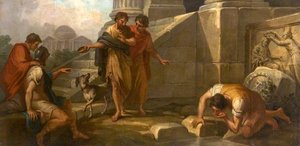
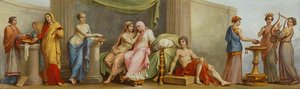
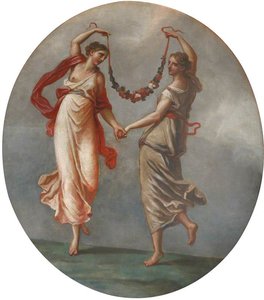
11The Four Continents Europe (1777) od Antonio ZucchiThe Four Continents Europe1777 · National Trust 12Winter (1769) od Antonio ZucchiWinter1769 · English Heritage 13Chloe Playing the Lyre to Daphnis (or Sappho and Anacreon) (1776) od Antonio ZucchiChloe Playing the Lyre to Daphnis (or Sappho and Anacreon)1776 · Nostell Priory 14The Four Continents Asia (1777) od Antonio ZucchiThe Four Continents Asia1777 · National Trust 15The Four Continents Africa (1777) od Antonio ZucchiThe Four Continents Africa1777 · National Trust 16Diogenes Casting Away His Wooden Bowl as a Superfluity, on Seeing a Youth Drinking from His Hand (a set of three decorative wall panels) (1768) od Antonio ZucchiDiogenes Casting Away His Wooden Bowl as a Superfluity, on Seeing a Youth Drinking from His Hand (a set of three decorative wall panels)1768 · National Trust 17Theology (1769) od Antonio ZucchiTheology1769 · English Heritage 18Ruins of Classical Baths with Nymphs Bathing (a set of six decorative wall panels) (1781) od Antonio ZucchiRuins of Classical Baths with Nymphs Bathing (a set of six decorative wall panels)1781 · National Trust 19A Bacchanal (1769) od Antonio ZucchiA Bacchanal1769 · English Heritage 20Minerva among the Arts (1769) od Antonio ZucchiMinerva among the Arts1769 · English Heritage 21Sappho Giving Anacreon a Feather from Cupid's Wing (1770) od Antonio ZucchiSappho Giving Anacreon a Feather from Cupid's Wing1770 · Nostell Priory 22Capriccio of Figures Dancing amongst Classical Ruins, with a Statue of the Rape of Proserpine (1775) od Antonio ZucchiCapriccio of Figures Dancing amongst Classical Ruins, with a Statue of the Rape of Proserpine1775 · Nostell Priory 23Commerce (1769) od Antonio ZucchiCommerce1769 · English Heritage 24The Rape of Europa (1769) od Antonio ZucchiThe Rape of Europa1769 · English Heritage 25Apollo and the Muses (1767) od Antonio ZucchiApollo and the Muses1767 · Nostell Priory 26Capriccio of Figures Dancing amongst Classical Ruins, with a Ruined Arch (1775) od Antonio ZucchiCapriccio of Figures Dancing amongst Classical Ruins, with a Ruined Arch1775 · Nostell Priory 27The Aldobrandini Marriage (1769) od Antonio ZucchiThe Aldobrandini Marriage1769 · English Heritage 28Navigation (1769) od Antonio ZucchiNavigation1769 · English Heritage 29Justice Embracing Peace (1769) od Antonio ZucchiJustice Embracing Peace1769 · English Heritage 30Bacchantes (5 of 6 ovals) (1773) od Antonio ZucchiBacchantes (5 of 6 ovals)1773 · English Heritage 31Homer Crowned as Poet Laureate (1767) od Antonio ZucchiHomer Crowned as Poet Laureate1767 · Nostell Priory 32Agriculture (1769) od Antonio ZucchiAgriculture1769 · English Heritage 33Bacchantes (2 of 6 ovals) (1773) od Antonio ZucchiBacchantes (2 of 6 ovals)1773 · English Heritage 34Dido and Aeneas ( ) (1773) od Antonio ZucchiDido and Aeneas ( )1773 · Nostell Priory 35An Unidentified Classical Subject A Fight (1767) od Antonio ZucchiAn Unidentified Classical Subject A Fight1767 · Nostell Priory 36Putti Making Music (1770) od Antonio ZucchiPutti Making Music1770 · Nostell Priory 37The Infant Hercules (1769) od Antonio ZucchiThe Infant Hercules1769 · English Heritage 38Anacreon Sacrificing to the Three Graces (1770) od Antonio ZucchiAnacreon Sacrificing to the Three Graces1770 · Nostell Priory 39Bacchantes (4 of 6 ovals) (1773) od Antonio ZucchiBacchantes (4 of 6 ovals)1773 · English Heritage 40Bacchantes (3 of 6 ovals) (1773) od Antonio ZucchiBacchantes (3 of 6 ovals)1773 · English Heritage 41Bacchantes (1 of 6 ovals) (1773) od Antonio ZucchiBacchantes (1 of 6 ovals)1773 · English Heritage 42Putti Fishing (1770) od Antonio ZucchiPutti Fishing1770 · Nostell Priory 43An Epithalium (1769) od Antonio ZucchiAn Epithalium1769 · English Heritage 44An Unidentified Classical Subject A Quarrel over a Dead Ass (1767) od Antonio ZucchiAn Unidentified Classical Subject A Quarrel over a Dead Ass1767 · Nostell Priory 45Putti with a Bird (1770) od Antonio ZucchiPutti with a Bird1770 · Nostell Priory 46Putti with a Dog (1770) od Antonio ZucchiPutti with a Dog1770 · Nostell Priory 47Socrates Drinking the Hemlock (1767) od Antonio ZucchiSocrates Drinking the Hemlock1767 48Wisdom (Prudence) and Temperance (1767) od Antonio ZucchiWisdom (Prudence) and Temperance1767 · Nostell Priory 49Rinaldo and Armida (1773) od Antonio ZucchiRinaldo and Armida1773 · Nostell Priory 50A Greek Philosopher and His Disciples (1767) od Antonio ZucchiA Greek Philosopher and His Disciples1767 · Nostell Priory 51Justice and Strength (Fortitude) (1767) od Antonio ZucchiJustice and Strength (Fortitude)1767 · Nostell Priory 52Minerva Presenting the Personifications of the Arts of Painting, Gardening, Sculpture and Architecture to Britannia (1767) od Antonio ZucchiMinerva Presenting the Personifications of the Arts of Painting, Gardening, Sculpture and Architecture to Britannia1767 · Nostell Priory 53Putti with a Garland of Flowers (1770) od Antonio ZucchiPutti with a Garland of Flowers1770 · Nostell Priory 54The Return of Telemachus (1773) od Antonio ZucchiThe Return of Telemachus1773 · Nostell Priory 55Virgil Reading the Aeneid to the Emperor Augustus, His Wife Livia and His Fainting Sister, Octavia (1767) od Antonio ZucchiVirgil Reading the Aeneid to the Emperor Augustus, His Wife Livia and His Fainting Sister, Octavia1767 · Nostell Priory 56Hercules between Glory and the Passions (1769) od Antonio ZucchiHercules between Glory and the Passions1769 · English Heritage 57Cupid Preparing Venus for an Amorous Encounter with Mars (1773) od Antonio ZucchiCupid Preparing Venus for an Amorous Encounter with Mars1773 · Nostell Priory 58Mythological Subject with a Couple in an Embrace (1773) od Antonio ZucchiMythological Subject with a Couple in an Embrace1773 · Nostell Priory 59Bacchus and Ceres (1773) od Antonio ZucchiBacchus and Ceres1773 · English Heritage 60Aristippus and His Companions after Being Shipwrecked, Seeing Mathematical Diagrams, Realise the Land Was Inhabited (a set of three decorative wall panels) (1768) od Antonio ZucchiAristippus and His Companions after Being Shipwrecked, Seeing Mathematical Diagrams, Realise the Land Was Inhabited (a set of three decorative wall panels)1768 · National Trust 61Mitellus Ordering a Marble Crow to Be Put on the Tomb of His Former Master, Diodorus Siculus (a set of three decorative wall panels) (1768) od Antonio ZucchiMitellus Ordering a Marble Crow to Be Put on the Tomb of His Former Master, Diodorus Siculus (a set of three decorative wall panels)1768 · National Trust 62Catullus Comforting Lesbia over the Death of Her Pet Sparrow and Writing an Ode (1773) od Antonio ZucchiCatullus Comforting Lesbia over the Death of Her Pet Sparrow and Writing an Ode1773 · Nostell Priory 63Angelica and Medoro Medoro Carving the Name of Angelica into the Trunk of a Tree (1773) od Antonio ZucchiAngelica and Medoro Medoro Carving the Name of Angelica into the Trunk of a Tree1773 · Nostell Priory 64Capriccio with a Pagan Temple and a Sacrifice (1776) od Antonio ZucchiCapriccio with a Pagan Temple and a Sacrifice1776 · Nostell Priory 65Capriccio with the Ruins of a Triumphal Arch and a Bridge (1776) od Antonio ZucchiCapriccio with the Ruins of a Triumphal Arch and a Bridge1776 · Nostell Priory 66A Ruined Temple and Fountain with Musicians (a set of six decorative wall panels) (1781) od Antonio ZucchiA Ruined Temple and Fountain with Musicians (a set of six decorative wall panels)1781 · National Trust 67Fountain with Women Washing Clothes (a set of six decorative wall panels) (1781) od Antonio ZucchiFountain with Women Washing Clothes (a set of six decorative wall panels)1781 · National Trust 68Daphnis Giving an Apple to Chloe (1776) od Antonio ZucchiDaphnis Giving an Apple to Chloe1776 · Nostell Priory 69Daphnis Bestowing a Garland of Flowers on Chloe (1776) od Antonio ZucchiDaphnis Bestowing a Garland of Flowers on Chloe1776 · Nostell Priory 70Philetus Explaining Love to Daphnis and Chloe (1776) od Antonio ZucchiPhiletus Explaining Love to Daphnis and Chloe1776 · Nostell Priory 71A Procession of Classical Figures with a Donkey and a Tambourine (a set of six decorative wall panels) (1781) od Antonio ZucchiA Procession of Classical Figures with a Donkey and a Tambourine (a set of six decorative wall panels)1781 · National Trust 72Girls Dancing amid Classical Ruins (a set of six decorative wall panels) (1781) od Antonio ZucchiGirls Dancing amid Classical Ruins (a set of six decorative wall panels)1781 · National Trust 73Philosophy (1769) od Antonio ZucchiPhilosophy1769 · English Heritage 74Spring (1769) od Antonio ZucchiSpring1769 · English Heritage 75Venus and Cupid od Antonio ZucchiVenus and CupidNostell Priory 76Putto with a Personification of Chemistry od Antonio ZucchiPutto with a Personification of ChemistryNostell Priory 77Putto with a Personification of Sculpture od Antonio ZucchiPutto with a Personification of SculptureNostell Priory 78Putto with a Personification of Drawing od Antonio ZucchiPutto with a Personification of DrawingNostell Priory 79Putto with a Personification of Architecture od Antonio ZucchiPutto with a Personification of ArchitectureNostell Priory 80Putto with a Personification of Mathematics od Antonio ZucchiPutto with a Personification of MathematicsNostell Priory 81Putto with a Personification of Painting od Antonio ZucchiPutto with a Personification of PaintingNostell Priory 82Putto with a Personification of Poetry od Antonio ZucchiPutto with a Personification of PoetryNostell Priory 83Autumn (1769) od Antonio ZucchiAutumn1769 · English Heritage 84Summer (1769) od Antonio ZucchiSummer1769 · English Heritage 85Bacchantes (6 z 6 oválů) (1773) od Antonio ZucchiBacchantes (6 z 6 oválů)1773 · English Heritage 86A Pair of Dancing Women od Antonio ZucchiA Pair of Dancing WomenNational Trust 87Disarming of Cupid od Antonio ZucchiDisarming of CupidThe National Trust For Scotland

Slavná díla Antonio Zucchi podle jednotlivých období

Motivy, které zaujaly Antonio Zucchi

Čtyři témata, která se v těchto originálech nejčastěji objevují, z nichž každé má svůj nejlepší příklad.

Muzea, v nichž jsou vystavena originálna umělce Antonio Zucchi

8 muzea, v nichž je umístěno nejvíce obrazů z této stránky.

Muzeum Město Díla autora Antonio Zucchi Obrazy z tohoto seznamu
Nostell Priory, WakefieldNostell Priory Wakefield 43 A Putto Being Woken from Sleep by Tickling of His Nose, Nymphs garlanding Cupid, Putto with Personification of Music
English Heritage, LondýnEnglish Heritage Londýn 26 Jurisprudence, Mathematics, Winter
National Trust, PlymouthNational Trust Plymouth 9 Landscape with a Bridge and Ruins with Peasants Fishing (a set of six decorative wall panels), Diogenes Casting Away His Wooden Bowl as a Superfluity, on Seeing a Youth Drinking from His Hand (a set of three decorative wall panels), Ruins of Classical Baths with Nymphs Bathing (a set of six decorative wall panels)
National Trust, DerbyNational Trust Derby 4 The Four Continents America, The Four Continents Europe, The Four Continents Asia
Scottish National Portrait Gallery, EdinburghScottish National Portrait Gallery Edinburgh 1 James Adam, 1732 - 1794. Architect and designer
Metropolitan Museum of Art, New YorkMetropolitan Museum of Art New York 1 Three dancing nymphs and a reclining cupid in a landscape
National Trust, AylesburyNational Trust Aylesbury 1 A Pair of Dancing Women
The National Trust For Scotland, MayboleThe National Trust For Scotland Maybole 1 Disarming of Cupid

Antonio Zucchi dekáda po dekádě: originální díla, která definují každou z nich

Díla podle dekád

Vyberte si dekádu a prohlédněte si originál, který ji definuje.

Otázky sběratelů o obrazech umělce Antonio Zucchi

Kterým dílem je Antonio Zucchi nejznámější?Odhalit odpověď

A Putto Being Woken from Sleep by Tickling of His Nose (1770), Nostell Priory, Wakefield. Následují James Adam, 1732 - 1794. Architect and designer (1763) a Landscape with a Bridge and Ruins with Peasants Fishing (a set of six decorative wall panels) (1781).

Kolik let bylo Antonio Zucchi, když bylo vytvořeno dílo A Putto Being Woken from Sleep by Tickling of His Nose?Odhalit odpověď

44 let: dílo A Putto Being Woken from Sleep by Tickling of His Nose pochází z roku 1770 a Antonio Zucchi se narodil/a v roce 1726.

Kterých deset nejslavnějších obrazů má Antonio Zucchi?Odhalit odpověď

A Putto Being Woken from Sleep by Tickling of His Nose, James Adam, 1732 - 1794. Architect and designer, Landscape with a Bridge and Ruins with Peasants Fishing (a set of six decorative wall panels), Nymphs garlanding Cupid, Putto with Personification of Music, Hector and Andromache, Three dancing nymphs and a reclining cupid in a landscape, Jurisprudence, The Four Continents America a Mathematics. Hodnocení výše uvádí rok a muzeum pro každé z nich.

Kolik obrazů zanechal(a) Antonio Zucchi?Odhalit odpověď

Náš katalog obsahuje 101 děl umělce Antonio Zucchi z let 1763 až 1781.

Ve kterých muzeích jsou vystavena díla mistrovská umělce Antonio Zucchi?Odhalit odpověď

Většinou v Nostell Priory (Wakefield), English Heritage (Londýn) a National Trust (Plymouth). V tabulce muzeí výše jsou vypsány všechny.

V jakých letech namaloval Antonio Zucchi svá nejznámější díla?Odhalit odpověď

V období 1770s: 38 z celkem 87 děl na této stránce vzniklo právě tehdy, z toho A Putto Being Woken from Sleep by Tickling of His Nose z nich.

Jaká jsou první a poslední slavná originální díla umělce Antonio Zucchi?Odhalit odpověď

Na této stránce je nejstarší dílo z James Adam, 1732 - 1794. Architect and designer (1763) a nejnovější z Landscape with a Bridge and Ruins with Peasants Fishing (a set of six decorative wall panels) (1781).

Jaká témata si Antonio Zucchi vybíral nejčastěji?Odhalit odpověď

Woman (28), People (20) a Man (13) napříč 87 díly na této stránce.

Kterou techniku používal(a) Antonio Zucchi nejčastěji?Odhalit odpověď

Oil On Canvas, u 33 z 87 děl na této stránce.

K kterému uměleckému směru patří Antonio Zucchi?Odhalit odpověď

Neoclassical style, podle originálů na této stránce.

Která díla umělce Antonio Zucchi jsou vystavena v Nostell Priory?Odhalit odpověď

A Putto Being Woken from Sleep by Tickling of His Nose, Nymphs garlanding Cupid a Putto with Personification of Music: muzeum Nostell Priory, Wakefield má v obsluze 43 děl z této stránky.

Antonio Zucchi: život a dílo

Francis Cotes: Pionýr anglického pastelu

Francis Cotes (1726–1770) představuje klíčovou postavu v rozkvétajícím světě anglického portrétního malířství, přičemž je zejména uznáván pro své inovativní využití pastelu a schopnost zachytit pomíjivé okamžiky charakteru. Narodil se v Londýně a prošel loutnictvím u Williama Faithorneho, malíře známého svými teatrálními skupinovými portréty, což byla zkušenost, která bezpochyby formovala jeho rané umělecké smysly. Cotes však svého mistra rychle předčil a vytvořil si zcela vlastní styl, charakteristický neuvěřitelnou citlivostí k světlu, textuře a psychologickým nuancím svých subjektů. Na rozdíl od často strohé formality rané anglické portrétní tvorby však díla Cotesova vyzařují živou okamžitost, která odráží hluboké propojení s osobností modela a ostré vnímání vizuálního světa kolem něj. Jeho raná kariéra byla poznamenána zakázkami od významných rodin, včetně rodiny Astleyových, pro které vytvořil slavné dílo „Sedmiletá a její bratr Edward, pětiletý půl“ – něžnou zachycení dětinské nevinnosti, která zůstává jedním z jeho nejoblíbenějších děl. Tento obraz je dokonalým příkladem Cotesovy schopnosti vdechnout i zdánlivě prostým tématům hluboký emocionální podtón. Mistrsky využíval pastel – médium, které bylo v té době v Anglii považováno za relativně nové – k dosažení pozoruhodných efektů barvy a tónu, zachycoval jemné zarudnutí pleti, lesk látky i subtilní přechody světla a stínu. Cotes pouze neimitoval vzhled; on překládal pozorovanou realitu na plátno s malířskou elegancí, která jej odlišovala od jeho současníků. Jeho použití volných, expresivních tahů vytvářelo pocit pohybu a vitality, což přispělo k fascinující kvalitě jeho portrétů.

Technika a vlivy

Cotesova technická dokonalost nevznikla pouze z jeho vrozeného talentu, ale také z pečlivého studia přírody a děl jiných uměcí. Byl hluboce ovlivněn holandskými mistry, zejména Rembrandtem, jehož využití světla a stínu k vytváření dramatických efektů je v Cotesových portrétech zřetelně patrné. Obdivoval také dílo Anthonyho van Dycka, jehož elegantní kompozice a psychologický vhled se snažil napodobit. Na rozdíl od Van Dyckova uhlazeného stylu však Cotes zvolil neformálnější přístup, často zobrazoval své modely v uvolněných pózách a zachycoval je v přirozeném prostředí. Jeho pastelová technika byla dále zdokonalena experimentováním s vrstvením barev a jejich nanášením s různou silou tlaku, což mu umožnilo dosáhnout neuvěřitelného rozsahu tónových hodnot a textur. Výsledné portréty nejsou pouhými podobiznami; jsou to intimní studie charakteru, naplněné hmatatelným pocitem života.

Významná díla a zakázky

Kromě ikonického díla „Sedmiletá“ Cotes vytvořil rozsáhlé množství práce, která zahrnuje četné portréty členů aristokracie a šlechty. Maloval pro významné osobnosti, jako byli Sir Robert Peel, Lord Charles Townshend či Lady Mary Wortley Montagu. Jeho zakázky byly často motivovány snahou zachytit jedinečnou osobnost modela i jeho společenské postavení, což odráželo měnící se vkus 18. století v Anglii. Jeho tvorba se však nezastavila pouze u portrétů; věnoval se také krajinářskému malířství a žánrovým scénám, čím tím prokázal svou všestrannost jako umělec. Královská akademie, založená v roce 1769, jeho přínos ocenila tím, že jej zvolila jedním ze svých zakládajících členů, čímž si upevnil své místo mezi předními umělci své doby.

Odkaz a historický význam

Odkaz Francise Cotesa spočívá především v jeho průkopnické roli při rozvoji anglického pastelového malířství. Dokázal potenciál tohoto média pro zachycení jemných nuancí barvy a tónu a tím připravil cestu budoucím generacím pastelistů. Jeho portréty jsou dnes obdivovány nejen pro svou technickou brilanci, ale také pro jejich psychologickou hloubku a emocionální rezonanci. Cotesova práce představuje odklon od formálních konvencí dřívějšího portrétního malířství směrem k intimnějšímu a expresivnějšímu přístupu, který odrážel ducha osvícenství. V historii umění zůstává zapamatován jako klíčová postava, která pomohla ugruntovat anglické malířství jako samostatnou a živou tradici. Jeho vliv je patrný i v díle pozdějších umělců, kteří na jeho stopách stavěli, což potvrzuje jeho postavení skutečného inovátora a mistra svého řemesla.