A Life Dedicated to the Sun King
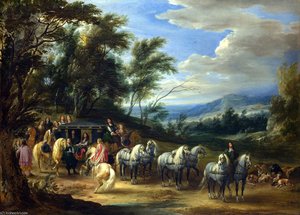
Adam Frans van der Meulen, a name perhaps less immediately familiar than some of his contemporaries within the vibrant world of 17th-century Baroque art, nevertheless holds a significant place in the history of European painting and, crucially, as a key architect of Louis XIV’s carefully constructed image – the ‘Sun King’. His life unfolded not merely as a chronicle of artistic skill but as a dedicated service to the French monarchy, translating military might and regal splendor into breathtaking canvases and, most notably, into the monumental tapestry cycles that adorned the palaces of Versailles and elsewhere. Van der Meulen wasn’t simply recording historical events; he was actively shaping them, crafting a visual narrative designed to glorify Louis XIV's reign and cement his legacy for posterity – a potent blend of artistry and propaganda.From Brussels Workshop to Parisian Court
Van der Meulen’s artistic journey began within the traditional framework of a master-apprentice relationship. He entered the workshop of Peter Snayers, an established Antwerp painter renowned for his depictions of battle scenes, hunting expeditions, and the refined life of the court – subjects that would profoundly influence Van der Meulen's early work. Mastering the intricacies of portraying cavalry charges with dynamic realism, capturing the energy of military engagements, and rendering the textures of armor and weaponry formed the bedrock of his artistic skillset. Becoming a master within the Brussels Guild of Saint Luke in 1651 marked a significant milestone, signifying his growing competence as an artist. However, it was an invitation from Paris in 1664 – a summons from Jean-Baptiste Colbert, Louis XIV’s formidable Superintendent of Buildings, Arts and Manufactures – that irrevocably altered the course of his career. Colbert recognized Van der Meulen's exceptional talent for capturing movement, detail, and the dramatic scale of events, qualities deemed essential for immortalizing the king’s military triumphs through visual representation. This invitation led to his entry into the orbit of Charles Le Brun, the court painter and director of the Gobelins Manufactory – a pivotal moment that placed him at the heart of France's burgeoning tapestry industry and its propagandistic ambitions.The Art of Propaganda: Tapestries and Military Campaigns
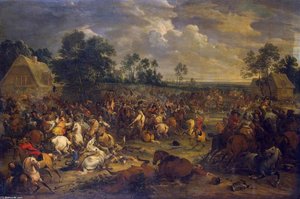
Van der Meulen’s role within the Gobelins was multifaceted and demanding. He wasn’t simply tasked with executing designs; he actively participated in conceptualizing complex narrative cycles, meticulously planning the composition and execution of vast tapestry projects intended to serve as potent symbols of royal authority and national pride. The “History of the King” series – a monumental undertaking depicting Louis XIV's military conquests – stands as a testament to his skill and strategic vision. He personally documented the king’s campaigns, accompanying Louis on expeditions to Flanders and Burgundy, sketching scenes of battles, sieges, and intricate strategic maneuvers with remarkable precision. These detailed drawings served as the foundational basis for the paintings that were then translated into the elaborate designs woven into the tapestries themselves – a process demanding not only artistic talent but also an understanding of textile production and color theory. Collaboration was paramount; Van der Meulen frequently worked alongside other Flemish artists, such as Adriaen Frans Boudewijns and Abraham Genoels, who contributed their expertise in landscape design and engraving, ensuring the tapestry cycles were visually rich and historically accurate. The “Maison Royales” series – showcasing the opulent palaces of Louis XIV – further demonstrated his versatility and ability to capture both the grandeur of architecture and the refined elegance of courtly life. Crucially, Van der Meulen’s work wasn't merely about depicting events; it was fundamentally about constructing a carefully curated image of power, control, and divine right – a deliberate act of propaganda designed to shape public perception and reinforce the legitimacy of Louis XIV’s rule.Style, Influence, and Lasting Legacy
Van der Meulen’s artistic style is characterized by an arresting dynamism and meticulous attention to detail. His battle scenes are not static representations; they convey the chaotic energy, dramatic scale, and sheer intensity of warfare with remarkable realism. He possessed an exceptional ability to portray horses – a subject he clearly adored – with breathtaking grace and anatomical accuracy, earning him considerable acclaim within the artistic community and solidifying his reputation as a master equestrian painter. However, it’s essential to recognize that Van der Meulen's work was inextricably linked to its propagandistic purpose; while undeniably beautiful and technically accomplished, it served a clear political agenda – glorifying Louis XIV’s reign and projecting an image of invincibility and absolute authority. This focus on realism, combined with a deliberate emphasis on spectacle and grandeur, significantly influenced the development of military painting in France, establishing a style that would be emulated by subsequent generations of artists. Beyond his paintings, his designs for tapestries played a crucial role in elevating France’s status as a leading center for tapestry production during Louis XIV's reign – a testament to his artistic influence and the enduring power of visual propaganda. Recognized for his contributions, Van der Meulen received numerous honors – including a royal privilege granting him the right to have engravings produced from his works, appointment as “Ordinary Painter to the King” in 1673, and admission to the prestigious Royal Academy of Painting and Sculpture without having to submit a traditional reception piece – a remarkable testament to his established reputation and the esteem in which he was held by the French court. Adam Frans van der Meulen died in Paris in 1690, leaving behind a legacy not just as a skilled artist but as an instrumental figure in shaping the visual narrative of one of Europe’s most powerful monarchs – a lasting reminder that art can be both beautiful and profoundly political.Current Meta Description:
Adam Frans van der Meulen (1632-1690) was a Flemish Baroque painter renowned for his dynamic battle scenes & landscapes glorifying Louis XIV's triumphs, shaping the 'Sun King’s' image and influencing French military art.Current Meta Keywords:
Adam Frans van der Meulen, Adam-François van der Meulen, Flemish painter, Baroque art, Battle painting, Louis XIV, Military art, Tapestry design, 17th century painting, Horse paintingOtázky a odpovědi
Kde mohu si prohlédnout všechná umělecká díla autora Adam Frans van der Meulen?
Veškerá díla umělce Adam Frans van der Meulen na tato webová stránka si můžete prohlédnout na jeho stránce Všechná umělecká díla.
Kolik děl umělce Adam Frans van der Meulen je možné si prohlédnout?
Na stránce Všechná umělecká díla si můžete prohlédnout 94 uměleckých děl děl autora Adam Frans van der Meulen.
Pod jakými dalšími jmény nebo pseudony je Adam Frans van der Meulen známý/á?
Adam Frans van der Meulen se vystupuje även pod alternativními jmény Adam-François van der Meulen.