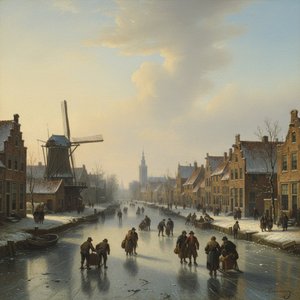
Abraham Johannes Couwenberg (1806-1844): A Pioneer of Romantic Landscape Painting
Abraham Johannes Couwenberg, born in Delft in 1806, was a Dutch painter who left an indelible mark on the artistic landscape of his era. His formative years were steeped in the traditions of Delft’s renowned art academy, where he honed his skills and absorbed the stylistic nuances of the Dutch Romantic movement. From early on, Couwenberg demonstrated exceptional talent for capturing the grandeur and emotion of nature—a passion that would define his entire oeuvre.- Early Influences: Couwenberg’s artistic sensibilities were profoundly shaped by the topographical paintings of Willem Jacob Hendrikz Kok, a prominent Delft artist who championed the meticulous observation of detail and the depiction of atmospheric effects. Kok's emphasis on capturing the sublime beauty of the Dutch countryside instilled in Couwenberg a deep appreciation for landscape painting as a vehicle for conveying profound emotional experiences.
- Formal Training & Artistic Development: He pursued formal training at the Drawing Academy of Arnhem, where he excelled under the tutelage of Johann Christian Dahl—a Norwegian Romantic painter who championed dramatic compositions and expressive brushwork. Dahl’s influence encouraged Couwenberg to embrace bolder techniques and explore innovative approaches to portraying the grandeur of the natural world.
The Romantic Vision: Atmospheric Landscapes & Dramatic Composition
Couwenberg's artistic style embodies the core tenets of Romantic landscape painting—characterized by monumental scale, dramatic lighting, and an unwavering commitment to conveying emotion. He skillfully employed atmospheric perspective—a technique pioneered by Claude Lorrain—to create illusionistic depth and heighten the sense of grandeur within his canvases. His compositions often featured towering mountains, turbulent seascapes, and expansive vistas bathed in ethereal light, reflecting the Romantic fascination with sublime beauty and the power of nature to inspire awe and contemplation.- Notable Techniques: Couwenberg’s brushwork was marked by loose, expressive strokes that captured the dynamism of his subjects—particularly prevalent in his depictions of stormy seas and windswept hillsides. He meticulously blended colors to achieve subtle tonal gradations and imbue his paintings with a palpable sense of atmosphere.
- Iconic Works: Among Couwenberg’s most celebrated achievements are “Beach Scene” (1840), a captivating portrayal of maritime leisure and romanticism, and panoramic depictions of Dutch landscapes—particularly those dominated by brooding cloudy skies—which exemplify the Romantic preoccupation with conveying emotional intensity.
Museum Connections & Legacy
Couwenberg’s artistic legacy extends beyond his individual paintings; he played a crucial role in establishing connections between Dutch art history and international artistic trends. His works are housed in prestigious museums across Europe, including the Rijksmuseum Amsterdam—a testament to his enduring influence on Romantic landscape painting and its continued appreciation by connoisseurs worldwide.- Recognition & Influence: Couwenberg’s commitment to capturing the sublime beauty of Dutch landscapes cemented his place as a pivotal figure in the Romantic movement—inspiring subsequent generations of artists to explore similar themes and techniques.
Concluding Remarks
Abraham Johannes Couwenberg remains an artist whose work continues to resonate with audiences today—a testament to his masterful command of technique, his profound understanding of artistic expression, and his unwavering devotion to portraying the majesty of the natural world. His paintings serve as enduring reminders of the Romantic spirit—characterized by passion, imagination, and a belief in the transformative power of art.Otázky a odpovědi
Jak mohu si prohlédnout všechna umělecká díla umělce Abraham Johannes Couwenberg?
Veškerá díla umělce Abraham Johannes Couwenberg na tato webová stránka si můžete prohlédnout na jeho stránce Všechná umělecká díla.
Mohu si u Abraham Johannes Couwenberg prozkoumat používání barev napříč všemi jeho díly?
Barevný profil děl umělce Abraham Johannes Couwenberg naleznete na jeho stránce Genom palety.
Mohu si prohlédnout díla umělce Abraham Johannes Couwenberg podle tématu?
Díla umělce Abraham Johannes Couwenberg si můžete prohlédnout podle tématu na stránce Atlas témat.