
Introduction
The grandeur of the seventeenth century in France found its most profound expression through a dramatic shift in visual storytelling, where light and shadow became the primary architects of emotion. As the nation emerged as a central pillar of European culture, a distinct group of artists began to move away from the rigid constraints of Mannerism, embracing instead the theatricality and movement that define the baroque era. These painters utilized deep chiaroscuro, sweeping diagonals, and a sense of monumental scale to capture both the divine and the earthly with unprecedented intensity.
This period was marked by a sophisticated tension between the intense, emotional realism favored in the shadows and the structured, classical clarity that would eventually define the French aesthetic. From the intimate, candlelit scenes of domestic life to the sprawling, sun-drenched landscapes and the opulent portraits of the royal court, these masters transformed the canvas into a stage for human drama and natural splendor. Their work was not merely decorative; it was a visual language of power, spirituality, and the sublime, reflecting a society navigating the complexities of absolute monarchy and religious fervor.
Today, the legacy of these masters remains vital, as their mastery of light and composition continues to influence how we perceive depth and emotion in visual media. Their ability to balance intense realism with idealized beauty offers a timeless study in the power of the brushstroke. The following selection explores ten essential figures of this movement, ranging from the masters of light and landscape to the architects of grand, formal portraiture, each representing a unique facet of the French baroque spirit.
Nicolas Poussin
 The Rape of the Sabine Women - Nicolas Poussin
Nicolas Poussin stands as a foundational figure among French baroque painters, bridging the gap between rigorous classical structure and the theatricality of the seventeenth century. Born in 1594 in Les Andelys, Normandy, his artistic journey was defined by a methodical discipline that began with technical training in Rouen and continued through his formative years in Paris. His deep literacy in Latin allowed him to translate complex classical texts into visual narratives, a skill that would become his hallmark. After moving to Rome in 1624, he transitioned away from the fluid, sensuous influences of Venice toward a more structured, intellectual approach that defined the French baroque aesthetic.
His masterpiece, The Rape of the Sabine Women (1637), exemplifies this dramatic evolution. The work captures a pivotal moment of Roman legend through a crowded, high-stakes composition that utilizes intense movement and chiaroscuro to heighten the sense of urgency. By organizing such chaotic, historical action within a balanced and logical framework, Poussin perfectly embodies the era's ability to marry profound emotional intensity with the grand, ordered principles of classical antiquity.
Georges de la Tour
 The Fortune-Teller - Georges de la Tour
A master of the nocturnal and the intimate, Georges de La Tour remains a quintessential figure among French baroque painters due to his profound ability to manipulate light and shadow. While many of his contemporaries focused on the grandiosity of the French court, La Tour’s work often retreated into the quiet, candlelit corners of the seventeenth century. His career, which saw him rise to the prestigious position of "Painter to the King" under Louis XIII, was deeply rooted in the Duchy of Lorraine, where he lived and worked until his death in 1652.
His technical mastery is most strikingly realized in The Fortune-Teller (1635), a work that exemplifies the dramatic chiaroscuro characteristic of the Baroque movement. In this composition, a single, unseen light source pierces through the darkness, casting intense highlights on the figures and creating a sense of profound mystery. The painting captures a candid moment of social interaction, where the interplay of light and shadow heightens the emotional tension and the sense of intrigue surrounding the scene. Through this meticulous use of oil on canvas, La Tour transformed mundane, everyday moments into theatrical, spiritual, and deeply human narratives.
Claude Lorrain
 Sunrise - Claude Lorrain
Born in the Duchy of Lorraine around 1600, Claude Lorrain represents a vital link in the evolution of French Baroque landscape painting. While his early years involved a mysterious transition from humble beginnings to the artistic circles of Rome, his mastery of light would eventually define the era's aesthetic. Unlike the dramatic, high-contrast shadows often associated with the movement, Lorrain’s contribution to the French Baroque tradition lies in his ability to harmonize classical antiquity with a revolutionary sense of atmosphere.
His 1646 masterpiece, Sunrise, serves as a profound testament to this skill. In this work, he moves beyond mere topographical recording to create an idealized, pastoral Arcadia. By utilizing delicate transitions of light, he captures the fleeting, ethereal quality of dawn, allowing the viewer to experience a sense of profound tranquility. His ability to integrate mythological and biblical themes into these luminous, sun-drenched settings allowed him to become a leading figure of the period, influencing how light and space were perceived throughout Europe. Through works like Sunrise, Lorrain transformed the landscape into a poetic, spiritual experience, blending the structural elegance of the Baroque with a uniquely serene, atmospheric vision.
Hyacinthe Rigaud
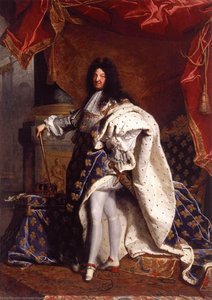 Portrait of Louis XIV - Hyacinthe Rigaud
Hyacinthe Rigaud stands as a preeminent figure of the French Baroque movement, a master whose brushwork defined the visual language of absolute monarchy and aristocratic splendor. His work is instantly recognizable through its theatricality and a profound ability to render the tactile opulence of silk, lace, and velvet. By utilizing a sophisticated interplay of light and shadow, Rigaud infused his portraits with a sense of movement and psychological presence that elevated the genre beyond mere likeness.
His technical mastery is most famously realized in his 1701 masterpiece, Portrait of Louis XIV. In this iconic work, Rigaud employs the dramatic diagonals and grand compositions characteristic of the Baroque style to project the Sun King's divine authority. The meticulous attention to the intricate embroidery of the coronation robes and the luminous textures of the fabrics demonstrates the high level of precision that earned him a prominent position within the Académie royale de peinture et de sculpture.
Born in 1659, Rigaud’s style was deeply informed by the dynamic energy of Rubens and the elegant portraiture of Van Dyck. His ability to capture the essence of the 18th-century French nobility ensures his lasting legacy in the history of European art.
Charles Le Brun
 Adoration of the Shepherds - Charles Le Brun
A central figure of the French Baroque, Charles Le Brun (1619–1690) defined the visual language of an era through his grandiosity and theatricality. His journey began in the studio of Simon Vouet and was profoundly shaped by a formative four-year residency in Rome, where he studied under Nicolas Poussin. This synthesis of classical rigor and Italian dynamism allowed him to evolve from a talented student into the First Painter to Louis XIV, a position that granted him unprecedented influence over the artistic direction of the French court and the decoration of the Palace of Versailles.
Le Brun’s work is instantly recognizable by its monumental scale, rich color palettes, and a sophisticated command of light that creates a sense of divine or royal presence. In his Adoration of the Shepherds, this mastery is on full display. The composition utilizes the dramatic sweep characteristic of the Baroque, employing a theatrical arrangement of figures and ethereal light to bridge the gap between the earthly and the celestial. His brushwork captures intense emotion and movement, guiding the viewer through complex, layered scenes that possess both a quiet spiritual weight and a magnificent, sweeping grandeur.
Simon Vouet
 Venus and Adonis - Simon Vouet
Simon Vouet stands as a transformative figure in the history of French Baroque painters, acting as the primary conduit through which the dynamic energy of Italy reached the French court. After an early training in Paris, his formative years were spent in Rome, where he spent thirteen years absorbing the revolutionary techniques of the Italian masters. By synthesizing the dramatic tenebrism of Caravaggio with the vibrant, lyrical color palettes of Paolo Veronese, Vouet moved French art away from the rigidities of Mannerism and toward a more emotionally charged, theatrical aesthetic.
His election to the prestigious Accademia di San Luca and his subsequent return to Paris as Premier Peintre du Roi solidified his role in shaping the national style. His masterpiece, Venus and Adonis (1642), exemplifies this stylistic synthesis. In this work, he employs sophisticated chiaroscuro to heighten the mythological tension, using light to sculpt the muscularity of Adonis and the graceful drapery of Venus. Through his fluid brushwork and mastery of composition, Vouet defined the elegant yet dramatic visual language that characterizes the French Baroque movement.
Nicolas de Largillière
 Portrait of Jean-Baptiste Rousseau - Nicolas de Largillière
Nicolas de Largillière stands as a definitive figure of the French baroque movement, specifically through his ability to translate the social hierarchies of Paris into luminous, theatrical portraiture. His work is characterized by a sophisticated mastery of texture and a profound ability to capture the dignity of his subjects. A visitor can recognize a Largillière at a glance by the meticulous rendering of luxurious fabrics—such as velvet and silk—and the way he uses light to pull a sitter out of deep, dramatic shadows, a hallmark of the baroque aesthetic.
Born in Paris in 1656, his style was shaped by a diverse European journey. After moving to Antwerp as a child, he absorbed Flemish traditions before refining his technique under Sir Peter Lely in London. This international training allowed him to return to France as a premier portraitist, capable of satisfying both the nobility and the rising merchant class. His Portrait of Jean-Baptiste Rousseau (1710) serves as a quintessential example of this era. In this work, he utilizes a dark, commanding background to isolate the subject, employing masterful glazes to create a sense of intellectual authority and refined grace that defines the high baroque style.
Alexandre François Desportes
 NATURE MORTE A L'AIGUIERE - Alexandre François Desportes
Alexandre François Desportes stands as a quintessential figure among French baroque painters due to his ability to infuse the natural world with the theatricality and opulence characteristic of the era. While many of his contemporaries focused on grand historical narratives, Desportes mastered the art of the decorative and the dramatic through his specialized depictions of animal life and the rituals of the hunt. His work, often commissioned by Louis XIV and Louis XV, bridged the gap between rigorous academic portraiture and the lush, sensory-driven aesthetics of the French court.
His mastery of light and texture is profoundly evident in his representative work, Nature Morte à l'Aiguière. This composition exemplifies the baroque penchant for abundance and dramatic contrast, utilizing a sophisticated interplay of shadow and light to elevate a still life into a scene of regal splendor. Through the meticulous rendering of a golden ewer, soft fabrics, and overflowing fruit, Desportes captures a sense of tactile vitality. His training under Nicasius Bernaerts and his exposure to Flemish traditions allowed him to bring a unique, rhythmic energy to his subjects, ensuring his place as a premier chronicler of aristocratic elegance.
Pierre Mignard I
 Louis 14th - Pierre Mignard I
Pierre Mignard I stands as a cornerstone of the French Baroque movement, bridging the gap between the rigid traditions of Mannerism and the grand, theatrical elegance of the French court. His artistic identity was forged through a sophisticated synthesis of influences, beginning with his early training under Jean Boucher and his profound studies at the Château de Fontainebleau. However, it was his twenty-two-year immersion in Rome that truly defined his Baroque sensibility. There, he mastered the Italianate use of dramatic light and shadow, developing a style so refined and delicate that his depictions of the Madonna and Child earned the affectionate nickname “mignardises.”
This mastery of grace and controlled drama is epitomized in his 1660 portrait, Louis XIV. In this work, Mignard moves beyond simple likeness to create a tableau of absolute authority. The painting utilizes the characteristic Baroque tension between deep, velvety shadows and luminous highlights to accentuate the textures of scarlet waistcoats and gold embroidery. By capturing the King in a direct, engaging three-quarter pose, Mignard infused the royal image with a sense of living presence, blending the grandeur of the Italian Baroque with a distinctly French sense of poise and prestige.
Eustache Le Sueur
 The Muses: Melpomene, Erato and Polyhymnia - Eustache Le Sueur
Eustache Le Sueur (1616–1655) stands as a cornerstone of the French Baroque movement, bridging the gap between the dramatic intensity of his era and a burgeoning neoclassical restraint. A founding member of the prestigious French Academy of Painting and Sculpture, Le Sueur developed his sophisticated style under the tutelage of Simon Vouet. His work is instantly recognizable by its remarkable precision and a sense of tranquil grandeur that distinguishes it from the more turbulent compositions of his contemporaries. Unlike the heavy chiaroscuro found in some Baroque works, Le Sueur’s mastery lies in a refined draftsmanship and a serene, intellectual approach to composition.
In his representative masterpiece, The Muses: Melpomene, Erato and Polyhymnia (1652), we witness the artist's ability to infuse mythological allegory with a profound sense of calm. The figures are rendered with an astonishing realism, particularly in the subtle nuances of their expressions and the textures of their attributes, such as the lyre and the book. By placing these divine figures within a richly detailed forest setting, Le Sueur captures the Baroque fascination with the intersection of classical tradition and the natural world, creating a scene that is both intellectually engaging and visually harmonious.
Conclusion
The grandeur of the French Baroque movement lies in its ability to balance intense emotional drama with a refined, classical structure. From the luminous, atmospheric landscapes of Claude Lorrain to the theatrical, light-drenched intimacy of Georges de la Tour, these masters transformed the visual language of Europe. Whether through the sweeping, royal elegance of Hyacinthe Rigaud or the meticulous, academic precision of Charles Le Brun, these artists captured the tension between movement and stillness, shadow and light, defining an era of unparalleled artistic sophistication.
For those looking to bring this historical splendor into a modern setting, OriginalUniqueArt.com offers a way to experience these masterpieces firsthand. Our full collection allows you to explore a vast array of French artistry, ranging from the most iconic Baroque works to later movements. We invite you to transform your living space into a private gallery by choosing one of our museum-quality, hand-painted oil reproductions, each meticulously crafted by expert artists to preserve the soul and texture of these timeless treasures.


