The Luminous Rebellion: Capturing the Fleeting Magic of Impressionism
To step into the world of the mid-nineteenth century is to witness a courageous rebellion against the somber, rigid constraints of academic realism. For generations, the art world was governed by the strictures of the French Salon, where history and mythology were rendered with meticulous, almost invisible brushwork. Yet, a group of visionaries—artists we now revere as the Impressionists—chose to turn their gaze toward the ephemeral beauty of the present moment. They sought not to replicate the world with photographic precision, but to capture its very pulse. Through the works of Claude Monet and Pierre-Auguste Renoir, we see a revolution born of light. These masters understood that sunlight is never static; it dances across the Seine, shimmers through a summer breeze, and transforms a landscape in the blink of an eye.
This movement was defined by a radical new way of seeing. By painting en plein air, or outdoors, these artists embraced the transient effects of atmosphere. They utilized short, broken brushstrokes of pure, unmixed color, allowing the viewer’s eye to optically blend the pigments. When we gaze upon Renoir’s La Poste at Cagnes, we are not merely looking at a rural scene; we are feeling the warmth of the Provençal sun on stone and the gentle movement of light filtering through lush foliage. It is an art of the optical moment, where the texture of the paint itself vibrates with the energy of life, capturing a sense of tranquility and contentment that remains as fresh today as it was in the 1870s.
Beyond the Surface: The Emotional Depth of the Post-Impressionist Revolution
As beautiful and luminous as the Impressionist era was, a creative tension began to emerge. While the masters of light had successfully recorded the momentary sensation of a sunbeam, there remained a profound human desire for something more enduring—a sense of structural permanence and emotional weight. This longing became the catalyst for Post-Impressionism, a movement that moved beyond the mere depiction of light to explore the depths of the human soul. Artists like Vincent van Gogh, Paul Cézanne, and Paul Gauguin felt that light alone was not enough; they sought to infuse their canvases with subjective truth and symbolic meaning.
This transition marked a shift from the external observation of nature to an internal exploration of emotion. The Post-Impressionists began to use color and form not just to represent reality, but to express intense, often raw, psychological states. In the swirling, energetic brushstrokes of Van Gogh, we find a mirror to his inner turmoil, while Cézanne’s meticulous studies of fruit and landscape sought to uncover the underlying geometric essence of the world. This era was a bold reimagining of the canvas, where color became a language of feeling and form became a vessel for meaning, laying the essential groundwork for the modern art that would follow.
A Sensory Voyage: Exploring Masterpieces from Monet to Van Gogh
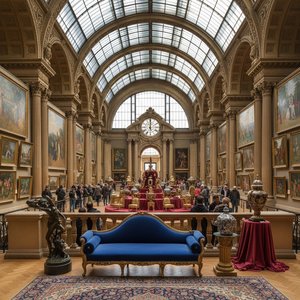
To wander through an exhibition of these works is to embark on a sensory pilgrimage. One might find themselves lost in the shimmering, sun-drenched landscapes of Theo van Rysselberghe, where Olive Trees near Nice serves as a meditation on the emotional resonance of nature. Here, the Mediterranean scene is more than a landscape; it is a carefully constructed experience of light and form that breathes with the vitality of the earth. The journey continues through the quiet, evocative halls of institutions like the Musée d'Orsay or the Courtaud Gallery, where the air itself seems to hum with the energy of a revolution.
In these galleries, the contrast between movements becomes palpable. You might move from the soft, atmospheric light of a Monet water lily to the intense, almost tactile presence of a Post-Impressionist still life. Consider the way Paul Cézanne arranges his peaches and grapes; there is a deliberate, structural weight to his composition that anchors the viewer, providing a sense of permanence amidst the fleeting beauty of the fruit. This dialogue between the transient and the enduring, between the optical impression and the emotional truth, creates a rich tapestry of human experience that continues to captivate the discerning collector.
Bringing the Gallery Home: The Art of Curating Timeless Impressions
For those of us who have cherished these masterpieces for decades, the desire to surround ourselves with their beauty is profound. Curating a collection of Impressionist and Post-Impressionist works is not merely about decoration; it is about creating a sanctuary of light and emotion within one's own home. Whether it is the soft glow of a Renoir floral arrangement or the dramatic, textured presence of a Van Gogh-inspired landscape, these pieces possess a unique ability to transform a space, offering solace and contemplation.
When selecting works for your personal collection, consider how the interplay of color and light can complement your environment. A vibrant, bold Post-Impressionist piece can serve as a dramatic focal point in a modern room, while a more delicate Impressionist landscape can bring a sense of tranquil, classical elegance to a traditional study. The key is to find pieces that resonate with your personal history and emotional landscape, allowing the art to act as a window into a world of timeless beauty.
Preserving the Legacy: The Craftsmanship of Hand-Painted Reproductions
At OriginalUniqueArt.com, we believe that the soul of these movements resides in the very texture of the paint. This is why we eschew the coldness of digital prints in favor of the authentic, hand-made oil reproduction. Our process is a tribute to the Great Masters, performed by professional artists who understand the specific "hand" and technique required to recreate the magic of Monet or the impasto of Van Gogh. Each piece is painted on 100% cotton artist canvas using high-quality oils, ensuring a depth of tonal range and a physical texture that a print simply cannot replicate.
When you touch one of our paintings, you can feel the actual brushstrokes—the ridges and valleys of paint that capture the light just as the originals did. We even offer a unique aged-and-cracked finish, creating an authentic craquelure effect that gives the work the venerable character of a museum original. Our commitment is to provide more than just a copy; we provide a continuation of the artistic legacy, allowing you to own a piece of history that breathes with the same passion and craftsmanship as the era it celebrates.