The Soul of the Space: Moving Beyond Ornamentation to Architectural Anchoring
Art and Architecture Integration Policy (French: Politique d'intégration des arts à l'architecture) is a policy of the Quebec Ministry of Culture and Communications of reserving part of the budget for construction or expansion of a government buildin...
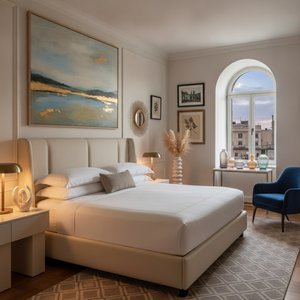
In the realm of high-end hospitality design, a common pitfall lies in treating art as a mere accessory—a colorful afterthought draped over a finished room like a fine silk scarf. However, for the discerning designer, true luxury is found when art ceases to be decorative and begins to function as an architectural anchor. When we speak of Impressionist masterpieces, we are not discussing simple imagery; we and talking about the introduction of a profound emotional weight that can ground even the most ethereal modern structures. An Impressionist canvas does not merely sit upon a wall; it commands the surrounding volume, providing a focal point around which the entire room’s energy orbits.
To anchor a space is to provide it with a sense of permanence and history. While contemporary architecture often leans toward sleek, minimalist lines and glass-heavy transparency, these environments can sometimes feel transient or unmoored. By integrating works that evoke the heavy, textured presence of a Monet or the structured light of Pissarro, a designer introduces a "soul" into the building. This is the difference between a room that is simply inhabited and one that is truly experienced. The art becomes the foundation upon which the architectural narrative is built, transforming a sterile corridor or a vast lobby into a curated sanctuary of meaning.
Atmospheric Depth: Utilizing Impressionist Light to Expand Interior Perceptions
 10 Iconic Impressionist Landscapes That Changed Art Forever
Introduction Imagine standing on the banks of the Seine at dawn, where the mist clings to the water and the light does not merely illuminate the world, but seems to dance upon it. To step into the era of Impressionist landscapes is to abandon the rig...
One of the most potent tools in an architect’s repertoire is the manipulation of perceived space. Impressionism, at its very core, is the study of light and its ability to dissolve boundaries. For a hotel designer working with challenging layouts—perhaps a low-ceilinged lounge or a narrow, dimly lit gallery—the works of masters like Claude Monet or Berthe Morisot offer a way to visually expand the horizon. These paintings do not present fixed, rigid edges; instead, they capture the fleeting dance of light and atmosphere, creating an illusion of depth that pulls the viewer’s gaze into a distant, sun-drenched meadow or a misty riverbank.
When a guest encounters a large-scale reproduction of a landscape, the wall itself seems to recede. The soft, broken brushstrokes and the luminous, pastel palettes characteristic of Morisot’s Cottage Interior can breathe life into enclosed spaces, replacing claustrophobia with a sense of serene openness. By strategically placing works that emphasize light emanating from an unseen source—much like the dramatic chiaroscuro found in the architectural studies of Pieter Neefs the Elder—designers can direct the flow of visual energy, guiding guests through a space using nothing more than the perceived movement of light captured on canvas.
The Curated Narrative: Using Masterpiece Series to Define Hotel Brand Identity
 Sunlit Interior: Madame Vuillard's Room at La Closerie des Genêts
A Glimpse into Intimate Domesticity: Vuillard’s Sunlit Interior Jean-Édouard Vuillard's *Sunlit Interior: Madame Vuillard's Room at La Closerie des Genêts* (1921) offers a captivating window into the private world of a woman within her personal space...
A luxury hotel is more than a collection of rooms; it is a story told through texture, scent, and sight. The selection of art serves as the primary narrator of this brand identity. For a boutique establishment seeking to evoke intimacy and domestic warmth, the Post-Impressionist works of Jean-Édouard Vuillard or Pierre Bonnard offer an unparalleled way to communicate "quiet luxury." Their ability to capture the intimate rhythms of daily life through complex patterns and warm, diffused light can transform a hotel suite into a personal, lived-in sanctuary.
Conversely, for grander, more monumental hotels, a series of expansive landscapes by Camille Pissarro or Alfred Sisley can establish an aura of prestige and timelessness. Using a cohesive series of paintings—perhaps linked by a shared color palette or a recurring theme of French countryside mornings—allows a designer to create a rhythmic brand experience that persists from the lobby to the private dining rooms. This curation ensures that every touchpoint within the property reinforces a singular, sophisticated vision, turning a stay into a continuous immersion in a beautifully curated world.
Compositional Harmony: Integrating Large-Format Impressionism with Modern Structural Lines
 Interior of Hagia Sophia, Constantinople
Subject and Composition This captivating architectural drawing offers a detailed glimpse into the majestic interior of the Hagia Sophia, one of the most iconic symbols of Byzantine architecture and religious history. The sketch captures the grandeur ...
The challenge of modern architectural integration lies in the tension between the rigid and the fluid. Modern structures are often defined by sharp angles, steel beams, and geometric precision. Introducing an Impressionist masterpiece requires a sophisticated understanding of compositional balance. The goal is not to clash with these lines, but to complement them. A large-format, multi-panel painting—where a single landscape is split across three or five canvases—can mirror the rhythmic intervals of a colonnade or the repetitive patterns of modern window glazing.
This "multi-panel" approach allows the art to become part of the wall itself, blurring the line between the structural surface and the artistic content. When the brushstrokes flow seamlessly across the edges of the panels, they create a sense of movement that softens the hard edges of contemporary design. This creates a sophisticated dialogue: the architecture provides the strength and structure, while the Impressionist works provide the breath and the pulse. It is a symbiotic relationship where neither element overwhelative the other, but rather both elevate the overall aesthetic experience.
Tactile Luxury: The Impact of Hand-Painted Textures on Sensory Guest Experiences
 Musee National d'Orsay
A Palace of Light Embracing Impressionism’s Soul The Musée d'Orsay is far more than a mere repository for canvas and pigment; it is a profound sensory experience, a journey back to the vibrant, pulsing heart of nineteenth-century artistic revolution....
In an age dominated by digital perfection and flat, printed surfaces, true luxury is increasingly defined by tactility. A high-quality print may capture the color of a masterpiece, but it lacks the "soul" found in the physical depth of oil paint. For the premium hotel environment, the presence of 100% hand-painted reproductions on cotton canvas introduces a sensory dimension that guests can feel even from a distance. The visible impasto—the thick, energetic application of paint—creates a play of shadow and light across the surface of the canvas that no digital medium can replicate.
This texture invites closer inspection and deeper engagement. When a guest walks past a painting where the brushstrokes are palpable, they are participating in a moment of authentic connection with craftsmanship. The subtle variations in the paint, the richness of the pigments, and the way light catches the ridges of the oil create a dynamic surface that changes as the viewer moves. This tactile depth reinforces the hotel's commitment to excellence and authenticity, signaling to the guest that every detail of their environment has been curated with an uncompromising dedication to quality.
Strategic Implementation: From Custom Murals to Multi-Panel Architectural Installations
 Mastering Light: The 25 Best Artworks by Impressionist Legend Camille Pissarro
Introduction Imagine standing before a canvas where the air itself feels alive, vibrating with the soft hum of a French countryside morning or the rhythmic pulse of a bustling street corner. To step into the world of Camille Pissarro is to abandon th...
The final stage of architectural art integration is the technical execution of large-scale installations. For grand lobbies or expansive ceiling voids, the possibilities extend far beyond the traditional frame. We specialize in creating large-format murals and frescoes, painted on massive canvas rolls that can recreate the awe-inspiring scale of historical ceilings within a modern context. These works allow designers to reimagine the very envelope of the room, turning a flat ceiling into a sky of Impressionist clouds or a sun-drenched garden.
Strategic implementation also involves bespoke customization, such as "remixing" art history to suit a specific color palette or using our professional digital mockup service to visualize how a multi-panel installation will interact with existing furniture and lighting. Whether it is a custom portrait commission that integrates a hotel's heritage or a large-scale landscape designed to anchor a grand staircase, the integration of Impressionist art must be a deliberate, engineered process. When executed with precision, these installations do more than decorate; they define the very essence of the architectural space, leaving an indelible mark on the memory of every guest.