The Architect of Dreams: An Introduction to Salvador Dalí and Surrealism
To step into the world of Salvador Dalí is to abandon the safety of the waking mind and surrender to a landscape where logic dissolves like wax under a summer sun. Born in 1904, Dalí emerged not merely as a painter, but as a provocateur of the subconscious, a figure whose very name became synonymous with the radical disruptions of the Surrealist movement. While his contemporaries often sought to capture the spontaneous flow of thought through automatism, Dalí pursued a more structured, almost clinical approach to the irrational. He did not simply want to depict dreams; he sought to systematize them, creating a visual language so precise and hyper-realistic that the impossible became undeniably tangible. The Surrealist movement itself was born from the ashes of post-war disillusionment, heavily influenced by the psychoanalytic breakthroughs of Sigmund Freud. It aimed to bridge the gap between the internal reality of the psyche and the external reality of the physical world. Within this avant-garde circle, Dalí stood as a titan, possessing an unparalleled ability to translate the chaotic impulses of the id into meticulously rendered oil paintings. His work serves as a portal, inviting the viewer to traverse terrains where time is fluid, anatomy is distorted, and the boundaries between the sentient and the inanimate are perpetually blurred.The Paranoiac-Critical Method: Decoding the Mechanics of Delusion
At the heart of Dalí’s technical and conceptual brilliance lies his self-invented Paranoiac-Critical Method. For the art student seeking to understand the mechanics of his genius, this is the essential key. Unlike the passive state of dreaming, which Dalí viewed as a mere byproduct of sleep, the Paranoiac-Critical Method was an active, conscious process. He described it as a spontaneous method of irrational knowledge based on the critical and systematic exploitation of confusion and the association of delirious phenomena. In simpler terms, it was the practice of cultivating a state of controlled paranoia to perceive multiple, overlapping realities within a single image. This method allowed Dalí to look at a common object—a piece of fruit, a landscape, or a human face—and through a deliberate psychological distortion, see something entirely different. It is the art of the double image. By training his mind to recognize these obsessive associations, he could construct compositions that functioned on two levels: the literal and the hallucinatory. This was not mere trickery; it was an attempt to capture the way the human brain imposes meaning upon chaos. Through this rigorous intellectual exercise, Dalí transformed the act of painting into a diagnostic tool for exploring the depths of human obsession and delusion.A Lexicon of the Subconscious: Analyzing Dalí’s Recurring Symbols
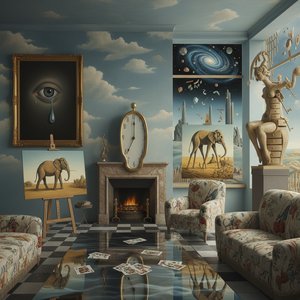
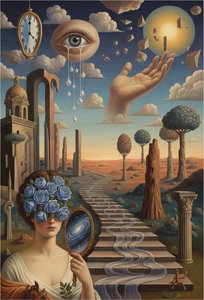
To navigate a Dalínian canvas is to encounter a recurring vocabulary of symbols, each carrying profound psychological weight. One cannot discuss his oeuvre without addressing the melting clocks, perhaps the most iconic motif in art history. Found in masterpieces such as The Persistence of Memory, these soft watches represent the collapse of cosmic order and the relativity of time, suggesting that in the realm of the subconscious, the rigid structures of Newtonian physics hold no dominion. Beyond the temporal, Dalí utilized a diverse array of biological and architectural metaphors. The ants, often seen swarming over objects or limbs, serve as a visceral symbol of decay, mortality, and the frantic, consuming nature of human anxiety. Conversely, the crutches that support many of his distorted figures represent the necessity of external supports for the fragile ego, providing stability to structures that would otherwise collapse under the weight of their own psychic tension. We also encounter the eggs, symbols of prenatal life and hope, often juxtaposed against much more grotesque or unsettling imagery. By mastering this lexicon, Dalí created a cohesive universe where every element, no matter how bizarre, contributes to a larger narrative of human vulnerability and desire.Optical Illusions and Double Images: The Fluidity of Reality
The true mastery of the Paranoiac-Critical Method is most evident in Dalí’s use of optical illusions and double images. This technique challenges the viewer's very perception of truth, forcing a constant re-evaluation of what is being seen. In works like The Hallucinogenic Toreador, the eye is led through a labyrinth of shapes that coalesce into recognizable figures only to dissolve back into abstract forms. This fluidity creates a sense of ontological instability; the viewer can never quite settle on a single interpretation, mirroring the shifting nature of thought itself. These illusions are achieved through an almost academic precision in light and shadow. Dalí utilized chiaroscuro and extreme perspective to give his hallucinations a three-dimensional weight, making the impossible feel physically present. When a landscape suddenly reveals itself to be a face, or a group of figures transforms into a bowl of fruit, the shock is not merely visual but intellectual. It forces an acknowledgment that reality is a construct of perception, a fragile veneer that can be stripped away to reveal the complex, often unsettling layers of meaning hidden beneath the surface.From Freud to Canvas: The Psychological Foundations of Dalí's Vision
The intellectual scaffolding of Dalí’s work is deeply rooted in Freudian psychoanalysis. He was profoundly moved by the concept of the unconscious—that reservoir of repressed desires, traumas, and primal instincts that governs much of human behavior. His paintings act as a visual manifestation of the "dream work," the process by which the mind disguises the true content of a dream through displacement and condensation. Dalí’s fascination with the Oedipal complex, sexual anxiety, and the concept of the "uncanny" is woven into the very fabric of his compositions. He sought to bring these hidden tensions into the light of day, using the canvas as a stage for the drama of the psyche. By applying the precision of a Renaissance master to the subject matter of a psychoanalyst, he achieved a unique synthesis: the hyper-realism of the irrational. This marriage of classical technique and modern psychological theory allowed him to create works that are simultaneously beautiful and disturbing, inviting us to confront the shadows within ourselves.Preserving the Surreal: The Legacy of Dalí in Modern Art History
The impact of Salvador Dalí extends far beyond the boundaries of the Surrealist movement. His influence can be traced through much of 20th-century pop culture, from advertising and film to contemporary digital art. He pioneered the idea of the artist as a celebrity, a persona whose life was as much a work of art as his paintings. Yet, for the serious student and collector, his true legacy lies in his profound expansion of the visual vocabulary available to humanity. Today, we see his echoes in any art that dares to challenge the boundaries of perception or explore the depths of identity. His ability to render the ephemeral with such permanence continues to inspire awe. For those seeking to bring this sense of wonder into their own environments, the study of his works offers endless discovery. Whether through the contemplation of a museum-grade original or the acquisition of a meticulous hand-painted oil reproduction, Dalí’s vision remains a vital, breathing force in the world of fine art.For those moved by the enduring power of these masterpieces, OriginalUniqueArt.com offers an unparalleled collection of museum-quality reproductions. Our master artists specialize in recreating the profound textures and complex layers of Dalí’s vision on 100% cotton canvas. From the delicate impasto of a custom portrait to the expansive grandeur of a large-scale surrealist landscape, we provide the means to bring the extraordinary into your personal collection. Explore our curated gallery of canonical masterpieces and experience the sublime.