The Rise of Civic Art: From Ancient Commemoration to Modern Identity
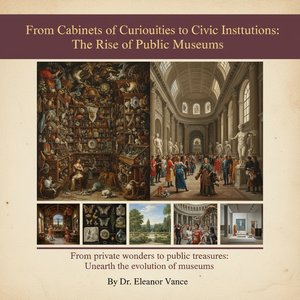 From Cabinets of Curiosities to Civic Institutions: The Rise of Public Museums
Explore the fascinating history of public museums! Discover how cabinets of curiosities evolved into vital cultural institutions. Learn about the key figures & movements shaping museum development – a deep dive for history enthusiasts.
For millennia, art has served as more than mere aesthetic pleasure; it’s been a potent vehicle for constructing and reinforcing collective identity. The earliest examples – cave paintings depicting successful hunts, Egyptian monuments glorifying pharaohs – weren't simply records but declarations of power, belief, and shared experience. This impulse to visually articulate “us” versus “them,” to solidify a community’s narrative through tangible form, is the bedrock upon which civic art evolved. The Roman Empire understood this intrinsically, employing portrait busts and triumphal arches not just as celebrations of individual emperors but as symbols of imperial strength accessible to all citizens. These weren't isolated acts of patronage; they were carefully orchestrated displays designed to foster loyalty and a sense of belonging within a vast, diverse realm. As empires rose and fell, so too did the focus of civic art shift – from divine rulers to religious tenets, then to burgeoning nation-states seeking to define themselves through shared histories and aspirations. The very act of commissioning public works became an assertion of sovereignty, a visual proclamation of existence and purpose.
Rembrandt's 'The Standard-Bearer': Representing Dutch Republican Values
 The Standard-Bearer
Rembrandt's 'The Standard-Bearer' (1636) is a captivating portrait showcasing skill & realism. Explore the Dutch Master's use of light, shadow & character.
The 17th-century Dutch Republic presented a fascinating case study in civic art. Having recently thrown off the yoke of Spanish rule, the newly independent nation sought to forge its own identity – one distinctly different from the opulent monarchies surrounding it. While grand allegorical paintings were common elsewhere, Rembrandt van Rijn’s 1636 masterpiece, “The Standard-Bearer,” offers a strikingly realistic and intimate portrayal of civic duty. Unlike idealized depictions of heroism, Rembrandt presents us with Frans Banninck Cocq, captain of the Amsterdam civic militia, in a moment of dynamic action, yet grounded in everyday life. The painting isn’t about glorifying war; it's about celebrating the collective responsibility of citizens to defend their hard-won freedom. Rembrandt’s masterful use of chiaroscuro – the dramatic interplay of light and shadow – doesn’t simply enhance the visual impact but also imbues the scene with a sense of gravitas and realism. The faces of the militiamen aren't uniformly heroic; they are individuals, each with their own character and imperfections, reflecting the diverse composition of Dutch society. This commitment to portraying reality, rather than idealizing it, became a hallmark of Dutch civic art, emphasizing the strength found in unity and shared purpose.
Monumental Visions: Gutzon Borglum and the Sculpting of National Narratives
 Gutzon Borglum
Gutzon Borglum (1867-1941): Renowned American sculptor of Mount Rushmore & Stone Mountain. Explore his monumental neoclassical style and patriotic masterpieces!
Fast forward to the 20th century, and we encounter Gutzon Borglum, an American sculptor whose work is inextricably linked with the very concept of national monumentality. His most famous creation, Mount Rushmore, isn’t merely a depiction of four presidents; it's a carefully constructed narrative about the founding principles of the United States – liberty, democracy, and expansion. Borglum understood the power of scale and symbolism, choosing figures who represented key moments in American history and embodying ideals that resonated with a burgeoning national consciousness. However, his work wasn’t without controversy. The creation of Mount Rushmore involved displacing indigenous populations and appropriating sacred land, raising complex questions about whose stories are told and whose are silenced. Stone Mountain, another colossal sculpture by Borglum, similarly reflects the fraught history of the American South and its complicated relationship with Confederate ideals. Borglum’s work demonstrates the immense power – and potential pitfalls – of using art to sculpt national narratives, highlighting the importance of critical engagement with historical representations.
Pierre Puvis de Chavannes and the Allegorical Expression of French Civic Ideals
 Pierre Cécile Puvis de Chavannes
Pierre Puvis de Chavannes: French painter known for monumental murals & allegorical scenes, profoundly influencing Symbolism and shaping public art in late 19th-century France.
In contrast to Borglum's overtly monumental style, Pierre Puvis de Chavannes, a 19th-century French painter, employed a more subtle yet equally powerful approach to civic art. His large-scale murals, often depicting allegorical scenes of peace, labor, and justice, were intended to inspire moral upliftment and reinforce republican values in post-revolutionary France. Works like “The Labors of Earth” and “Peace” weren’t about celebrating specific historical events but rather about embodying abstract ideals that underpinned the French Republic. Puvis de Chavannes's distinctive style – characterized by flattened figures, muted colors, and a deliberate lack of dramatic perspective – evokes a sense of timelessness and serenity. His murals were often commissioned for public buildings like schools and hospitals, intended to be accessible to all citizens and serve as visual reminders of the nation’s core principles. He profoundly influenced Symbolism and shaped public art in late 19th-century France by creating works that weren't simply decorative but actively engaged with the social and political landscape.
Impressionism’s Urban Landscapes: Monet and the Everyday Life of Paris
 untitled (9355)
Explore Claude Monet’s "untitled (9355)", an Impressionistic Parisian street scene bursting with color & movement. Discover a vibrant snapshot of urban life, capturing fleeting moments in a dynamic composition.
While not explicitly commissioned as civic art, Claude Monet’s Parisian street scenes – such as “untitled (9355)” – offer a compelling glimpse into the everyday life of a rapidly modernizing city. His paintings capture fleeting moments in time, depicting bustling boulevards, crowded cafes, and the vibrant energy of urban existence. These weren’t idealized depictions of Parisian grandeur; they were honest portrayals of a dynamic society undergoing profound transformation. Monet's focus on capturing light and atmosphere – his signature Impressionistic technique – imbues these scenes with a sense of immediacy and authenticity. By celebrating the beauty of everyday life, Monet inadvertently contributed to a growing sense of civic pride among Parisians, fostering a connection to their city and its evolving identity. The paintings served as visual documentation of a changing world, capturing the spirit of an era for generations to come.
Public Art as a Reflection of Community: Contemporary Expressions of Belonging
Today, public art continues to evolve, reflecting increasingly diverse perspectives and engaging with complex social issues. From large-scale murals celebrating local heroes to interactive installations fostering community dialogue, contemporary artists are pushing the boundaries of what civic art can be. The rise of street art, often created without official sanction, demonstrates a desire for artistic expression outside traditional institutions. Many cities now actively commission public art projects that prioritize community engagement, involving residents in the design and creation process. This collaborative approach ensures that artworks reflect the values and aspirations of those who live there, fostering a sense of ownership and belonging. The impact of public art extends beyond aesthetics; it can stimulate economic development, promote cultural awareness, and inspire social change. Ultimately, civic art remains a powerful tool for shaping our understanding of ourselves and the communities we inhabit – a testament to its enduring relevance in an ever-changing world.