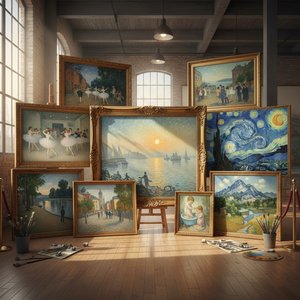
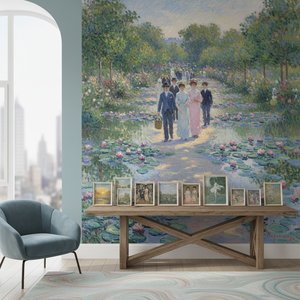
The Dawn of Impressionism: Challenging Academic Traditions
Impressionism was a 19th-century art movement characterized by visible brush strokes, open composition, emphasis on accurate depiction of light in its changing qualities (often accentuating the effects of the passage of time), ordinary subject matter...
For centuries, the art world adhered to a strict hierarchy dictated by the Académie des Beaux-Arts in France. Historical and mythological scenes, rendered with meticulous detail and polished precision, were prized above all else. Artists labored for years mastering techniques designed to create illusions of reality – perfect perspective, idealized forms, and dramatic narratives. But beneath this veneer of order, a quiet rebellion was brewing. A new generation of painters, disillusioned with the constraints of academic tradition, began to seek alternative ways of representing the world around them. They weren’t interested in grand stories or moral lessons; they wanted to capture the fleeting beauty of everyday life, the ephemeral effects of light and atmosphere, and their own subjective experience of a moment in time.
This burgeoning movement found early expression in the works of artists like Gustave Courbet, whose commitment to Realism – depicting subjects as they truly were, without idealization – paved the way for a more radical departure. However, it was a group of young painters meeting at Charles Gleyre’s studio—Claude Monet, Pierre-Auguste Renoir, Alfred Sisley, and Frédéric Bazille—who would ultimately ignite the Impressionist revolution. They shared a dissatisfaction with the established norms and a desire to paint *en plein air*, directly from nature, rather than relying on sketches made in the studio.
The initial reception was far from welcoming. Their canvases, characterized by visible brushstrokes and a lack of traditional finish, were often dismissed as unfinished or amateurish. Critics derided their work, finding it lacking in substance and skill. Yet, these artists persevered, driven by a conviction that they had discovered a new way of seeing – and representing – the world.
En Plein Air: Painting the Ephemeral Effects of Light and Atmosphere
En plein air (pronounced [ɑ̃ plɛ.n‿ɛʁ]; French for 'outdoors'), or plein-air painting, is the act of painting outdoors. This method contrasts with studio painting or academic rules that might create a predetermined look. The theory of 'En plein air' ...
The practice of painting *en plein air*—French for “in open air”—was central to the Impressionist project. Prior to this, artists typically completed their paintings in the studio, relying on preliminary sketches and memory. But Monet and his colleagues recognized that capturing the subtle nuances of light and color required direct observation. They set up their easels outdoors, confronting the challenges of changing weather conditions and the fleeting passage of time.
This wasn’t merely a technical shift; it represented a fundamental change in artistic philosophy. By immersing themselves in the landscape, they sought to record not just what they *saw*, but how they *felt*—the sensation of sunlight filtering through trees, the shimmering reflections on water, the vibrant hues of a summer meadow. The invention of portable paint tubes made this practice more feasible, allowing artists to easily transport their materials and work directly from nature. Pierre-Henri de Valenciennes had theorized about landscape portraiture in 1800, but it was the Impressionists who truly embraced and perfected the technique.
Consider Claude Monet’s series of paintings depicting haystacks or Rouen Cathedral. These weren't attempts to create definitive representations of these subjects; rather, they were explorations of how light transformed their appearance at different times of day and under varying atmospheric conditions. Each painting is a unique record of a specific moment, capturing the ephemeral beauty of light and shadow.
Brushstrokes & Color Theory: The Techniques Behind the 'Impression'
 The Enduring Legacy of Oil on Canvas: Technique, History & Aesthetic Impact
Explore the rich history & techniques of oil painting – from Renaissance masters to Impressionism. Discover pigments, layering methods, and why this timeless medium endures. Expert insights for artists & art enthusiasts.
The name “Impressionism” itself arose from a satirical critique of Claude Monet’s 1872 painting, *Impression, soleil levant* (Impression, Sunrise). Louis Leroy, a critic for Le Charivari, used the term dismissively, suggesting that the work was merely an “impression” of nature, lacking in detail and finish. However, the name stuck, and it came to define the movement’s distinctive aesthetic.
Central to Impressionist technique was the use of short, broken brushstrokes of pure, unmixed color. Rather than blending colors smoothly on the palette or canvas, they applied them side-by-side, allowing the viewer's eye to mix them optically. This created a sense of vibrancy and movement, capturing the flickering effects of light and atmosphere. They were influenced by scientific theories about color perception, recognizing that the human eye doesn’t perceive colors in isolation but rather as combinations and contrasts.
The rejection of traditional shading techniques was also crucial. Instead of using dark tones to create depth and volume, they employed complementary colors—colors opposite each other on the color wheel—to suggest shadow and form. This resulted in paintings that were brighter, more luminous, and more alive than anything seen before.
Monet, Renoir, and Degas: Key Figures and Their Distinct Visions
 Vetheuil, Barge on the Seine
Explore the Impressionist masterpieces of Claude Monet (1840-1926). Discover his iconic water lilies, haystacks & Rouen Cathedral series. A founder of French Impressionism and a pivotal figure in modern art.
While united by a shared commitment to Impressionist principles, Monet, Renoir, and Degas each developed their own distinct artistic voices. Claude Monet is perhaps the most iconic figure of the movement, renowned for his series paintings—haystacks, water lilies, Rouen Cathedral—that explored the changing effects of light on specific subjects. His dedication to capturing the ephemeral beauty of nature remains unparalleled.
Pierre-Auguste Renoir brought a warmth and sensuality to Impressionism, focusing on scenes of everyday life—picnics, dances, portraits—populated by elegant figures bathed in soft light. He was particularly skilled at depicting the female nude, capturing its delicate beauty with fluid brushstrokes and vibrant colors.
Edgar Degas, while often associated with Impressionism, pursued a more unconventional path. He was fascinated by movement, particularly that of ballet dancers, and his paintings capture their grace and energy with dynamic compositions and unusual visual angles. He also explored themes of urban life, depicting scenes of cafes, racecourses, and laundries.
Beyond Representation: Capturing Perception and Emotional Resonance
The Impressionists weren’t simply trying to reproduce what they saw; they were attempting to capture their subjective experience of a moment in time. They sought to convey the *sensation* of light, color, and atmosphere—the feeling of warmth on the skin, the shimmering reflections on water, the vibrant energy of a bustling city street.
This emphasis on perception paved the way for later artistic movements, such as Post-Impressionism. Artists like Paul Cézanne, while building upon Impressionist techniques, began to explore more formal concerns—the underlying structure of objects and the expressive potential of color. Cézanne’s *Les Grandes Baigneuses* exemplifies this shift, demonstrating an innovative approach to landscape and figure painting that influenced modern art movements like Cubism.
The Impressionists challenged conventional notions of beauty and representation, opening up new possibilities for artistic expression. Their legacy continues to inspire artists today, reminding us of the power of observation, the importance of subjective experience, and the enduring allure of light and color.
The Enduring Legacy of Impressionism: Influence on Modern Art
The initial hostility towards Impressionism gradually gave way to widespread acclaim. By the late 19th century, their paintings were being exhibited in major museums around the world, and they had gained a devoted following among collectors and art enthusiasts. But their impact extended far beyond the realm of painting.
Impressionism’s emphasis on subjective experience and its rejection of academic tradition paved the way for a host of modern art movements—Post-Impressionism, Fauvism, Cubism, Expressionism—that challenged conventional norms and explored new forms of artistic expression. The techniques developed by Monet, Renoir, Degas, and their colleagues continue to be studied and admired by artists today.
At OriginalUniqueArt.com, we celebrate the enduring legacy of Impressionism by offering high-quality reproductions of masterpieces by these iconic artists. Whether you’re a seasoned collector or simply beginning your art journey, we invite you to explore the captivating world of Impressionism and discover the beauty and emotional resonance of these timeless works. Browse our collection today and bring the magic of Monet, Renoir, and Degas into your home.