The Great Academy Breakup: Why 1848 Was the Ultimate Art Revolution
 The Pre-Raphaelite Brotherhood: Rediscovering Romanticism, Mythological Depth, and Vivid Detail in Victorian Art
The Rebellion Against Tradition: The Birth of the Pre-Raphaelite Brotherhood In the mid-19th century, the rigid corridors of the British Royal Academy felt increasingly stifling to a group of young, fervent visionaries. Driven by a profound dissatisf...
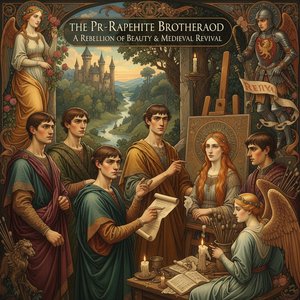
In the mid-19th century, the air in London was thick with more than just industrial smog; it was charged with the electric tension of revolution. As political uprisings swept across continental Europe in 1848, a different kind of insurrection was brewing within the stifling corridors of the British Royal Academy. A small, fervent circle of young visionaries—including William Holman Hunt, John Everett Millais, and Dante Gabriel Rossetti—found themselves suffocating under the weight of academic tradition. To them, the prevailing style was nothing more than slosh: a heavy-handed, formulaic, and muddy approach to composition that prioritized artificial shadows over authentic light.
This was not merely a disagreement over technique; it was a radical rejection of the status quo. These young rebels sought to stage an artistic coup, looking backward to move forward. They found their inspiration in the era before Raphael, a time they believed possessed a raw, unadulated sincerity and spiritual purity that had been lost to the polished artificiality of the Renaissance masters. By forming the Pre-Raphaelite Brotherhood (PRB), they declared war on the dark, somber palettes of their predecessors, aiming to replace academic artifice with a profound commitment to truth to nature. It was a movement born from dissatisfaction, fueled by a desire to reconnect the viewer with the tangible, breathing world.
Hyper-Realism & High Contrast: The Visual DNA of the Brotherhood
 Christ in the House of His Parents
Sir John Everett Millais's 'Christ in the House of His Parents': A Window into Victorian Faith Sir John Everett Millais’s “Christ in the House of His Parents,” often referred to as "The Carpenter’s Shop," stands as a monumental achievement within the...
To witness a Pre-Raphaelite canvas is to experience a sudden, breathtaking clarity that feels almost jarring compared to the muted tones of Victorian salons. The Brotherhood pioneered a revolutionary technique, painting on a wet white ground. This allowed light to pass through thin layers of pigment and reflect back from the base, creating a luminous intensity reminiscent of stained glass. This method ensured that colors remained vibrant, saturated, and startlingly real, far removed from the muddy browns and heavy glazes favored by the Academy.
Their obsession with detail was nothing short of scientific. Every leaf in a forest, every intricate fold of silk, and every glint of light on a water droplet was rendered with an almost photographic precision. In works like William Holman Hunt’s Self Portrait, we see this dedication to meticulous observation; the texture of fabric and the precise stitching of a suit are presented with an unwavering intensity that demands engagement. This pursuit of naturalism required an incredible level of patience and execution, as the artists sought to capture the divine complexity of the natural world through painstaking layers of oil paint. The result was a symphony of color and light that felt alive, pulsing with a brilliance that contemporary critics often found scandalous.
Beyond the Canvas: Myth, Poetry, and the Pursuit of Moral Truth
 Cupid's Hunting Fields
Cupid's Hunting Fields: A Pre-Raphaelite Reverie Edward Coley Burne-Jones’s “Cupid’s Hunting Fields” is more than simply a depiction of a mythological scene; it’s an immersion into the very heart of Pre-Raphaelite ideals – a yearning for beauty, a re...
The Pre-Raphaelite movement was never solely about the visual; it was a deeply literary and symbolic endeavor. For figures like Dante Gabriel Rossetti, the boundaries between painting, poetry, and illustration were perpetually blurred. His life was an immersion in beauty, where verses were as richly symbolic as his canvases. The Brotherhood drew heavily from medieval legends, Shakespearean drama, and the works of contemporary poets like Keats and Tennyson, weaving complex narratives into their compositions. They used art as a vessel for moral truth, imbuing even the most mythological scenes with a sense of spiritual weight.
Consider the works of Edward Coley Burne-Jones, such as Cupid's Hunting Fields, where the viewer is invited into a timeless realm of myth and innocence. Here, the arrangement of figures—gods and mortals intertwined amidst lush greenery—serves a narrative purpose, exploring themes of love and desire through carefully constructed symbolism. Even in more domestic or religious depictions, such as Millais’s Christ in the Haystack (often known as Christ in the House of His Parents), the realism is used to ground the divine in the everyday, making the sacred feel tangible and human. This engagement with deep, often melancholic themes allowed the movement to transcend mere decoration, turning every painting into a profound meditation on the human condition.
The Aesthetic Afterglow: How Pre-Raphaelite Detail Influenced Modern Design
While the Brotherhood itself was a specific historical moment, its aesthetic DNA drifted far beyond the 19th century, influencing the very fabric of modern visual culture. The movement’s emphasis on intricate pattern, vibrant color, and the beauty of the natural world laid the groundwork for the Arts and Crafts movement and, eventually, the decorative flourishes found in Art Nouveau. Their rejection of mass-produced, soulless imitation in favor of handcrafted sincerity resonates even today in our appreciation for artisanal quality and authentic textures.
The Pre-Raphaelite legacy can be seen in the way we approach modern graphic design and even contemporary digital aesthetics. The concept of hyper-detail—the idea that a high-resolution, immersive experience can transport a viewer to another world—is a direct descendant of their pursuit of naturalism. Whether it is through the lush, detailed environments of modern cinematic storytelling or the bold, saturated palettes used in contemporary illustration, the spirit of the PRB lives on in any medium that dares to prioritize visual impact and narrative depth over simple abstraction.
From Rebellion to Icon: Preserving the Vivid Legacy of the PRB
 Self Portrait
William Holman Hunt's 'Self Portrait': A Window into Victorian Vision The year is 1845. William Holman Hunt, a young artist wrestling with the burgeoning realities of Victorian England, presents us with a remarkably intimate and profoundly significan...
Today, the Pre-Raphaelite Brotherhood stands not as a forgotten relic of Victorian era dissent, but as a cornerstone of art history. What began as a secret society of rebels has become a celebrated canon of masterpieces that continue to captivate the modern imagination. Their ability to marry intense realism with profound romanticism ensures that their work remains relevant, offering a window into an era of immense social and artistic transformation.
Preserving this legacy requires more than just museum archives; it requires bringing these vivid textures and luminous colors into our contemporary spaces. At OriginalUniqueArt.com, we honor this tradition of excellence by specializing in the creation of high-quality, hand-painted reproductions that capture the very soul of these masterpieces. Our master artists, holding degrees from prestigious academies, use the same dedication to detail and layering techniques that the Brotherhood pioneered, ensuring that every brushstroke on a 100% cotton canvas reflects the true depth and brilliance of the original. Whether you are looking to transform a personal memory through our custom photo-to-oil services or seeking to adorn your home with the breathtaking intensity of a Pre-Raphaelite legend, we bring the majesty of art history directly to your walls.