what basic materials do artists use to make a fresco? colored chalks and plaster paint and plaster tesserae and grout
Artists creating a fresco primarily utilize lime plaster, water, and dry-powder pigments. While mosaics rely on stone or glass tesserae and grout, a true fresco requires a support of damp lime plaster. The process involves applying pigment to this wet surface to ensure the color becomes part of the wall.
The construction of a fresco wall is a layered process. It begins with a scratch layer to prepare the surface, followed by the arriccio, a rough underlayer containing more lime than aggregate. The final, smooth layer is the intonaco, which serves as the specific surface for the painting.
The materials used in these layers include:
- Lime: Often prepared as grassello di calce, which is slaked quicklime in excess water.
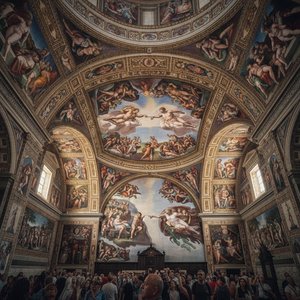
- Aggregate: Typically sand, though Michelangelo used volcanic ash in the Sistine Chapel for smoother spreading.
- Additives: Coccio Pesto, a mixture of crushed terracotta or brick and lime, can be used for stronger plaster.
What basic materials do artists use to make a fresco?
To execute a fresco, an artist requires four essential elements: pigment for color, a binder to hold particles together, a vehicle to carry the pigment, and a support surface. In the buon fresco technique, the moisture of the damp lime plaster acts as the primary vehicle.
The distinction between techniques lies in the use of binders. In buon fresco, or true fresh fresco, the artist applies dry-powder pigments ground in water directly onto wet plaster. This method relies on the chemical properties of the lime itself rather than an external glue or resin to secure the color.
In contrast, the fresco-secco technique involves a different approach:
- Pigment: Often mixed with a binder like egg yolks.
- Application: Applied to the top of dry plaster rather than wet.
- Durability: While allowing for more detail, it does not achieve the same permanent integration as true fresco.
How does pigment bond to plaster?
Pigment bonds to plaster through a chemical reaction called carbonation. When alkaline-resistant pigments are applied to damp lime plaster, the calcium hydroxide in the lime reacts with carbon dioxide in the air. This transforms the lime into calcium carbonate, locking the pigment particles into a crystalline matrix.
This metamorphosis ensures the artwork is not merely a layer sitting on a surface, but a part of the architecture itself. This process is what allows the vibrant colors of Renaissance masterpieces to endure for centuries. Because the pigment is absorbed into the intonaco, the final layer of smooth plaster, the bond is incredibly durable.
The technical rigor of this bond requires the artist to work within a giornata, or "day's work." Because the plaster must be damp for the reaction to occur, the artist can only complete as much as the drying time allows. If a mistake is made before the plaster sets, the intonaco often must be scraped away entirely.
How is fresco different from standard painting?
 Villa Farnesina
Discover Villa Farnesina in Rome: a Renaissance masterpiece brimming with frescoes by Raphael & Peruzzi! Explore classical mythology, humanist ideals, and breathtaking architecture at Agostino Chigi's opulent retreat. Plan your visit today!
Fresco differs from standard painting because the pigment becomes chemically integrated into the wall's structure through carbonation. While standard painting sits as a layer atop a substrate, a true fresco undergoes a metamorphosis where the art and the architecture become one single, permanent entity.
The visual and physical qualities of fresco are distinct from other media:
- Finish: It creates a matte, luminous, and ethereal quality that modern prints cannot replicate.
- Depth: The colors possess a depth of color and a soft quality due to the crystalline matrix.
- Permanence: Unlike oil or acrylic on canvas, the pigment is locked within the calcium carbonate of the wall.
We see this mastery in the works of the High Renaissance. In the Villa Farnesina in Rome, Raphael’s Triumph of Galatea showcases a vibrant celebration of movement and light. Similarly, in the Sistine Chapel, Michelangelo’s figures in the ceiling frescoes—such as those in The Creation of Adam—demonstrate how the medium can render muscularity and anatomical precision that appears almost tangible under the chapel's light.
Frequently asked questions
What is the purpose of volcanic ash in the Sistine Chapel?
Michelangelo used volcanic ash in the Sistine Chapel to allow for smoother spreading.
What is intonaco in fresco painting?
The intonaco is the smooth, final layer of plaster on which the painting occurs.
What is another name for true fresco?
True fresco is also known as buon fresco.
What is the arriccio layer?
The arriccio is a rough underlayer containing more lime than the aggregate.
Learn more
- Vatican City, ItalyThe Sistine ChapelExplore the breathtaking scale and storytelling of the world's most famous ceiling frescoes.
- 1475 – 1564MichelangeloDiscover the life and mastery of the Renaissance master behind these iconic works.
- Rome, ItalyVilla FarnesinaImmerse yourself in the mythological narratives and beauty of these exquisite frescoes.