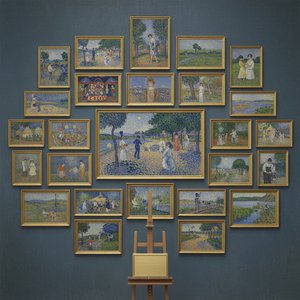
pointillism vs impressionism
 untitled (1944)
, Georges Seurat
Impressionism is a 19th-century movement focused on capturing fleeting light and movement through spontaneous, visible brushstrokes. Pointillism, a disciplined offshoot of Neo-Impressionism that emerged in the 1880s, uses a systematic application of tiny, distinct dots of pure color to create images through optical mixing.
Impressionism originated in France during the 1870s and 1880s. These artists sought to recreate the sensation of a scene in the eye of the viewer, often using unusual visual angles and ordinary subject matter. The movement served as a precursor to later styles, including Post-Impressionism, Fauvism, and Cubism.
Pointillism developed around 1886 as a more structured response to the Impressionist style. While both movements studied how light interacts with the human eye, Pointillism replaced spontaneous, emotional brushstrokes with a rigid, analytical technique. Key distinctions include:
- Impressionism: Characterized by open composition and short, broken brushstrokes to capture atmospheric effects.
- Pointillism: Defined by a mechanical technique using small, discrete dots of color applied in patterns.
How do the brushwork and color application differ in each style?
 The Poppy Field, 1884
, Georges Seurat
Impressionism uses broad, fluid, and expressive brushstrokes to capture atmosphere and spontaneous light. In contrast, Pointillism employs a mechanical, systematic application of small, distinct dots of pure color. While Impressionists often blend colors physically on a palette, Pointillists rely on the viewer's eye to mix colors optically.
The texture of the canvas changes significantly between these two methods. Impressionist works allow for great variation in paint handling, where an artist might adjust the thickness of the paint or blend colors directly on the canvas to catch a specific moment of light. This creates a sense of immediacy.
Pointillism is much more rigid and requires a high level of precision and extensive time. This method is often linked to Divisionism, which aims for maximum luminosity by avoiding the muddy results of subtractive mixing. Instead, it uses the principles of additive mixing, similar to how pixels function on a computer monitor. For example, in Georges Seurat's The Poppy Field (1884), the systematic use of color creates a serene landscape through these precise applications.
Which movement focuses more on scientific color theory versus light and atmosphere?
 Georges Seurat
. A pioneer of Pointillism known for A Sunday Afternoon on the Island of La Grande Jatte. Explore his luminous hand-painted reproductions today.
Pointillism focuses on scientific color theory and the principles of optics to achieve maximum luminosity. Impressionism focuses on the accurate depiction of light, atmosphere, and the changing qualities of light to capture a fleeting moment in time through spontaneous observation.
Neo-Impressionists, such as Georges Seurat and Paul Signac, sought to create a more scientific approach to painting. They applied colors based on the principles of optics, placing small dots of contrasting colors next to each other to achieve an intense visual effect. This method is often referred to as Divisionism or chromoluminarism.
Impressionism remains deeply concerned with the naturalistic depiction of light and the effects of the passage of time. Artists in this movement often focused on the reflection of colors between objects and the play of light. While Post-Impressionists like Paul Cézanne later sought to restore order and structure to painting by reducing objects to basic shapes, the original Impressionist goal remained the capture of atmospheric sensation.
Frequently asked questions
Who pioneered Pointillism?
Georges Seurat was the pioneer of Pointillism.
What is another name for Pointillism?
Pointillism is also known as Neo-Impressionism.
When did Post-Impressionism develop?
Post-Impressionism developed roughly between 1886 and 1905.
When did Impressionism originate?
Impressionism originated in France during the 1870s and 1880s.
Learn more
- 1859 – 1891Georges Seurat Artist CollectionExplore hand-painted reproductions of masterpieces by the father of Pointillism.
- Georges SeuratThe Poppy Field, 1884Discover how Seurat used Pointillism to transform the Impressionist landscape.