Expressionism
Aragon (Rafael Barradas)
Rafael Barradas (1890–1929) vytvořil dílo Aragon. Patří k hnutí Expressionism. Je vyrobeno z Oil On Canvas.
- Oil On Canvas

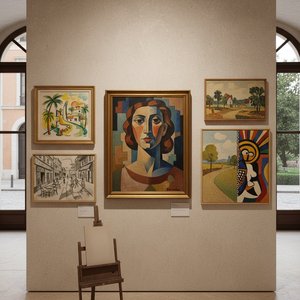
 Náhled v interiéru

 Ručně malovaná olejná reprodukce
 Sdílet
 Sdílet
 Informační list pro studenty


 Stáhnout
 Podobné položky
 Rentgenové snímky
 Slideshow
 Otázky a odpovědi

 Statistiky
Aragon v kostce
- Název díla
- Aragon
- Autor
- Rafael Barradas (1890–1929)
- Rok narození umělce
- Montevideo, Uruguay
- Technika
- Oil On Canvas
- Pohyb
- Expressionism
- Období
- Modern
- Motiv
- portrait, religious figures, expressionism, geometric forms, shadows, texture
Co przedstawuje dílo Aragon?
The Subject and Artist of Aragon
Aragon is a work by Rafael Barradas, an Uruguayan modernist painter and graphic artist. The piece presents a group portrait of three figures, rendered in a distinctly Expressionistic style. These subjects, appearing as clergymen or religious officials, are defined by bold, angular lines and simplified forms. Their attire, including collars and hats, suggests a position of religious authority.
Barradas, born in Montevideo, Uruguay, in 1890, developed a unique visual language through his immersion in European avant-garde movements. His approach often synthesized the dynamism of Futurism and the structural deconstruction of Cubism. In this work, the artist prioritizes emotional impact over accurate representation, utilizing sharp edges to construct the faces and torsos of the subjects.
The composition focuses entirely on the heads and upper bodies of the three men against a dark, textured background. This tight cropping, combined with the severe and detached expressions of the figures, creates a sense of solemnity. The artist’s method emphasizes the physical presence of the subjects through heavy, layered application of paint.
Composition and Visual Elements
The composition is tightly cropped, focusing exclusively on the heads and upper torsos of the three figures. This close framing eliminates environmental context, pushing the subjects toward the viewer. Bold, angular lines define the faces, utilizing sharp edges to construct the features. The arrangement relies on a geometric vocabulary; squares, rectangles, and triangles are used to build the forms of the figures rather than following naturalistic contours.
A single, unseen light source casts heavy shadows across the subjects. These shadows accentuate the structural planes of the faces, heightening the dramatic tension. The perspective is intentionally flattened, rejecting any sense of receding space or depth. Against this lack of spatial dimension, the background remains dark and heavily textured, providing a stark contrast to the geometric subjects.
Technique and Artistic Materials
The work is executed in oil paints on canvas. The application of pigment is heavy, utilizing a thick impasto that creates a palpable, rough surface. This layered approach builds a physical texture across the pictorial plane, emphasizing the material presence of the paint itself.
Visible brushwork defines the forms, rejecting smooth transitions in favor of direct, gestural marks. These strokes contribute to the structural clarity of the figures, using sharp edges and angularity to construct the subjects. The interplay of light and shadow is achieved through this deliberate, uneven application, which accentuates the planes of the faces and adds a sense of weight to the composition.
Vysokorozlišené fotografie díla Aragon
Rafael Barradas, Aragon. Veřejná doména
Odpovědi na otázky k dílu Aragon
V jaké technice je vytvořeno dílo „Aragon“ od Rafael Barradas?
Technikou díla „Aragon“ od Rafael Barradas je Oil On Canvas. Reprodukce mají za cíl věrně zachytit vzhled této techniky.
Jaká témata se objevují v díle „Aragon“ od Rafael Barradas?
Motivy díla „Aragon“ jsou portrait, religious figures, expressionism, geometric forms, shadows, texture, clergy, angular.
Lze obraz díla „Aragon“ od Rafael Barradas volně reprodukovat?
Co se týče autorských práv, dílo "Aragon" spadá do v rámci volného užití – autorská práva vypršela.
Kdo je autorem díla "Aragon"?
Dílo "Aragon" vytvořil/a Rafael Barradas. Informace na této stránce popisují originální dílo umělce Rafael Barradas.
K jakému stylu patří „Aragon“?
„Aragon“ je dílo z období Expressionism. Tento směr představuje uměleckou tradici, jejíž je dílo součástí.
Do které éry tvorby Rafael Barradas spadá dílo "Aragon"?
Dílo „Aragon“ pochází z období Mature Period v tvorbě umělce Rafael Barradas. Tato klasifikace dílo zasazuje do kontextu vývoje jeho tvůrčí dráhy.
Patří dílo „Aragon“ od Rafael Barradas do volného užití, a proč?
Dílo „Aragon“ od Rafael Barradas spadá do v rámci volného užití – autorská práva vypršela. Autorská práva se počítají od roku úmrtí autora; Rafael Barradas zemřel(a) v roce 1929.
Jakým způsobem se dílo „Aragon“ vpisuje do celkové tvorby umělce Rafael Barradas?
V rámci tvorby umělce Rafael Barradas se dílo „Aragon“ řadí do stylu Expressionism a doplňuje tak motivy futurist & cubist echoes, uruguayan religious themes, spanish exile reflections, aragon – a stark portrait, barradas' intense vision, early expressionistic style, short career, bold impact.
Je dílo "Aragon" typické pro to, co Rafael Barradas obvykle vytvářel/a?
Mezi opakující se témata umělce Rafael Barradas patří futurist & cubist echoes, uruguayan religious themes, spanish exile reflections, aragon – a stark portrait, barradas' intense vision, early expressionistic style, short career, bold impact; dílo „Aragon“ se zaměřuje na portrait, religious figures, expressionism, geometric forms, shadows, texture, clergy, angular.
O umělci, Rafael Barradas

1890–1929, Uruguay
Rafael Barradas
Rafael Barradas: Život v pulzujícím rytmu modernity Rafael Pérez Giménez Barradas, narozený roku 1890 v Montevideu v Uruguayi, se stal klíčovou postavou rozvíjejícího se modernistického hnutí na počátku 20. století. Jeho životní příběh je příběhem neustálého uměleckého hledání, živé fúze uruguayských kořenů a evropské avantgardy. Již od mládí, obklopený rodinou s hlubokými uměleckými sklony – pianistkou sestrou, básníkem bratrem a malířem otcem – Barradas v sobě absorboval estetické cítění, které definovalo jeho celoživotní dílo.
O umělci Rafael Barradas Významná díla umělce Rafael Barradas
Také od autora Rafael Barradas
 Barcelona Street at 1 pm1918
 The Tango1913
 Playa Ramirez (on the terrace)
 Hospitalet de Llobregat
Eseje k tématu Aragon
 Rafael Barradas: Bridging Brazilian Modernism with European InfluencesExplore the life & art of Rafael Barradas, a pioneering Uruguayan modernist who blended European influences with vibrant local heritage. Di…
 20th century Argentine painters20th-century Argentine painters like Lucio Fontana, Antonio Berni, and Marta Minujín defined a movement. Find museum-quality reproductions …
 Spontaneity and Matter: Distinguishing CoBrA from Art InformelMaster the differences between CoBrA and Art Informel with our expert guide. Learn to identify these post-war movements today.