Expressionism
Prophet (Emil Nolde)
Emil Nolde (1867–1956) vytvořil dílo Prophet. Patří k hnutí Expressionism. Je vyrobeno z Woodcut.
- Woodcut

 Náhled v interiéru

 Ručně malovaná olejná reprodukce
 Sdílet
 Sdílet
 Průvodce


 Stáhnout
 Podobné položky
 Rentgenové snímky
 Slideshow
 Otázky a odpovědi

 Statistiky
Prophet: základní údaje
- Název díla
- Prophet
- Autor
- Emil Nolde (1867–1956)
- Rok narození umělce
- Nolde, Dánsko
- Technika
- Woodcut
- Pohyb
- Expressionism
- Období
- Modern
- Motiv
- man, face, beard, black and white, portrait, eyes
Co przedstawuje dílo Prophet?
The Portrait of Prophet by Emil Nolde
In Prophet, the German Expressionist painter Emil Nolde captures a man who exists between the physical and the divine. The subject is a portrait of a man likely intended to represent a prophet, a figure carved from shadow and light. His beard and hairstyle suggest a man from a distant past or a religious leader, a person shaped by the weight of revelation. The face is a landscape of heavy lines and stark contrasts.
The man’s intense gaze pierces through the grain of the medium. A furrowed brow carries the imprint of deep emotion, perhaps a mixture of sadness, concern, or a singular, driving determination. This is not a likeness of a person in repose, but a study of a soul under pressure. The features are simplified, stripped of unnecessary detail to reveal the raw essence of the subject's internal state.
Emil Nolde uses the starkness of the form to emphasize this spiritual tension. Every line serves the gravity of the man's expression. The eyes do not merely look; they witness. The stillness of the portrait holds a quiet, heavy ache.
Composition and Visual Elements
The man's face occupies the center, a heavy presence that fills most of the frame. His head tilts slightly, caught in a moment of quiet anguish or deep contemplation. Around him, the background remains largely empty, a void that forces the eye back to the subject's features. There is no horizon, only the weight of the gaze.
Bold, thick lines carve the anatomy of the man. They define the coarse texture of his beard, the sharp ridge of his nose, and the deep-set hollows of his eyes. These lines are not smooth; they are angular and sharp, cutting through the space to shape his hair and facial structure. The geometry is simplified, reducing the man to essential, striking forms.
The color palette is stripped of all distraction. It exists in a narrow world of black and white, bridged only by subtle shades of grey. This lack of color heightens the dramatic tension, turning the portrait into a study of light and shadow. The starkness leaves no room for anything but the raw emotion of the expression.
Technique and Artistic Medium
The work emerges from the physical resistance of wood. This woodcut print relies on the deliberate act of carving lines into a solid block to define its form. Each stroke is a subtraction, a removal of material that leaves behind a sharp, angular topography. The artist works with wood, ink, and paper to translate a vision into a permanent, tactile presence.
Ink meets the paper through the pressure of the press. This contact creates a grainy texture across the surface, a subtle roughness that speaks of the material's origin. The depth of the shadows and the brightness of the highlights depend entirely on the variation of the lines. Thicker cuts hold more ink to create heavy shadows, while thinner, delicate lines allow the paper to breathe through the composition. The result is a stark, high-contrast landscape of light and dark.
The medium demands a directness of hand. There is no blending here, only the immediate impact of the carved edge. The grain of the wood and the weight of the ink settle into the fibers of the paper, creating a surface that feels both raw and finished. It is a quiet collision of tool and grain.
Prophet ve vysokém rozlišení
Emil Nolde, Prophet. Veřejná doména
Digitální expert porovnává barvy s původním obrazem a retušuje soubor tak, aby věrně odpovídal tahům štětcem umělce.
Koupit obraz ve vysokém rozlišeníDotazy k Prophet
Jaký emocionální náboj nese dílo „Prophet“ od Emil Nolde?
„Prophet“ je spojováno s Dramatic pocity. Emocionální náboj díla popisuje dojem, který z něj vyzařuje.
Kdo je autorem díla "Prophet"?
Dílo "Prophet" vytvořil/a Emil Nolde. Informace na této stránce popisují originální dílo umělce Emil Nolde.
Do kterého uměleckého směru a do jaké éry spadá dílo „Prophet“ od Emil Nolde?
V díle „Prophet“ od Emil Nolde se setkává směr Expressionism s érou – 19. století.
Obsahuje "Prophet" výrazné světlonápadové kontrasty?
„Prophet“ od Emil Nolde vykazuje Statement kontrast mezi světlými a tmavými částmi.
Jsou barvy díla „Prophet“ od Emil Nolde syté, nebo tlumené?
Dílo „Prophet“ od Emil Nolde je zachyceno s Muted saturací.
Jakou náladu vyjadřuje „Prophet“ od Emil Nolde v rámci směru Expressionism?
„Prophet“ vyzařuje Dramatic emocionální nádech v rámci směru Expressionism.
Jaká atmosféra je u díla „Prophet“ od Emil Nolde vyznávána?
Dílo „Prophet“ od Emil Nolde je v náladě popsáno jako Dramatic. Tato klasifikace může pomoci při zařazení díla do konkrétního prostředí.
Jaké je místo díla „Prophet“ mezi opakovanými tématy umělce Emil Nolde?
Mezi opakující se témata umělce Emil Nolde patří post-impressionism, die brücke, religious themes, expressionist style; dílo „Prophet“ se zaměřuje na man, face, beard, black and white, portrait, eyes.
K jakému stylu patří „Prophet“?
„Prophet“ je dílo z období Expressionism. Tento směr představuje uměleckou tradici, jejíž je dílo součástí.
O umělci, Emil Nolde
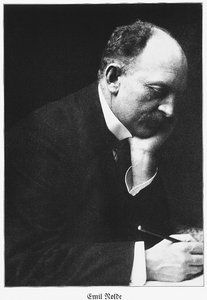
1867–1956, Dánsko
Emil Nolde
Život a identita Emila Noldeho Narodil se jako Hans Emil Hansen 7. srpna 1867, muž, který se později proslavil pod jménem Emil Nolde, vyrůstal v blízkosti vesnice Nolde v kurmarku Šlezvig. Jeho raná léta byla formována venkovským, zemědělským životem jeho rodiny. Postupem času se však od této cesty odvrátil a místo toho se vydal cestou dřevořezbaře a dekoratéra nábytku.
Také od autora Emil Nolde
 Sunset
 Sea with Red Sky
 Couple on the beach1903
 Masks1911
Eseje k tématu Prophet
 Egon Schiele: Top 25 Děl Mistra Expresionismu | Reprodukce a Dekorace s OriginalUniqueArtProzkoumejte top 25 děl Egona Schieleho – mistra expresionismu. Obdivujte portréty, akvarely a kresby plné emocí a psychologické hloubky. R…
 Emile Nolde: A Journey into Expressionist Nature & the Primal SelfExplore the powerful Expressionism of Emile Nolde – a pioneer of emotive landscapes & spiritual themes. Discover his journey, influences, a…
 Master of Emotion: The 25 Greatest Artworks by Rogier van der WeydenImmerse yourself in the profound emotion of Rogier van der Weyden. Explore 25 iconic Early Netherlandish masterpieces, from intricate textu…