Expressionism
Summer Clouds (Emil Nolde)
Emil Nolde (1867–1956) vytvořil dílo Summer Clouds. Patří k hnutí Expressionism. Je vyrobeno z Oil.
- Oil

 Náhled v interiéru

 Ručně malovaná olejná reprodukce
 Sdílet
 Sdílet
 Informační list


 Stáhnout
 Podobné položky
 Rentgenové snímky
 Slideshow
 Otázky a odpovědi

 Statistiky
Summer Clouds v kostce
- Název díla
- Summer Clouds
- Autor
- Emil Nolde (1867–1956)
- Rok narození umělce
- Nolde, Dánsko
- Technika
- Oil
- Pohyb
- Expressionism
- Období
- Modern
- Motiv
- ocean, clouds, sky, blue, white
Co przedstawuje dílo Summer Clouds?
Identification of the Artwork and Artist
Summer Clouds is an expressionist work by Emil Nolde. Born in 1867 in Nolde, Denmark, the artist developed a visual language centered on intense, personal feeling and the psychological weight of his subjects. His approach moved beyond mere representation to capture the internal pulse of the natural world.
Nolde’s career spanned much of the early twentieth century until his death in 1956. His practice was defined by a search for a visual language capable of holding the intensity of his observations, often utilizing color as the primary substance of form. This work reflects his preoccupation with the immediate sensation of light and atmosphere.
The Composition and Visual Elements
The composition is defined by a horizontal division between a blue ocean and the sky above. Within the celestial expanse, at least thirteen white clouds are scattered across the scene. These forms vary in both size and shape, with some positioned closer to the water's surface while others recede into the distance. The arrangement creates a sense of depth through the varying scale of these atmospheric elements.
The interaction of the blue water and the white clouds establishes a serene and peaceful atmosphere. The work captures the quiet beauty of nature through this simple, direct arrangement of color and form. The visual weight is distributed across the canvas, focusing on the relationship between the sea and the sky.
Vysokorozlišené fotografie díla Summer Clouds

Emil Nolde, Summer Clouds. Veřejná doména
Odpovědi na otázky k dílu Summer Clouds
Jakou techniku bylo použito pro dílo „Summer Clouds“ od Emil Nolde?
Technikou díla „Summer Clouds“ od Emil Nolde je Oil. Reprodukce mají za cíl věrně zachytit vzhled této techniky.
Co zachycuje dílo "Summer Clouds"?
Témata obsažená v díle „Summer Clouds“ od Emil Nolde zahrnují ocean, clouds, sky, blue, white. Tato témata společně shrnují obsah celého uměleckého díla.
Patří „Summer Clouds“ od Emil Nolde do volného tisku?
Co se týče autorských práv, dílo "Summer Clouds" spadá do v rámci volného užití – autorská práva vypršela.
K kterému umělci je dílo "Summer Clouds" připisováno?
Dílo "Summer Clouds" se připisuje autorovi Emil Nolde.
K jakému stylu patří „Summer Clouds“?
Dílo „Summer Clouds“ od Emil Nolde patří k období směru Expressionism, který dílu dodává jeho stylistický kontext.
Patří dílo „Summer Clouds“ od Emil Nolde do volného užití, a proč?
Dílo „Summer Clouds“ od Emil Nolde spadá do volného užívání (v rámci volného užití – autorská práva vypršela). Autorské právo vyprší po určité době od úmrtí umělce, ke kterému došlo v roce 1956.
Jaké místo v tvorbě umělce Emil Nolde zaujímá dílo "Summer Clouds"?
Dílo „Summer Clouds“ sdílí s ostatními pracemi umělce Emil Nolde styl období Expressionism a opakující se témata: post-impressionist influences, die brücke group member, expressionist style, focus on color and form, subjective and primal themes.
Je dílo "Summer Clouds" typické pro to, co Emil Nolde obvykle vytvářel/a?
Mezi opakující se témata umělce Emil Nolde patří post-impressionist influences, die brücke group member, expressionist style, focus on color and form, subjective and primal themes; dílo „Summer Clouds“ se zaměřuje na ocean, clouds, sky, blue, white.
O umělci, Emil Nolde
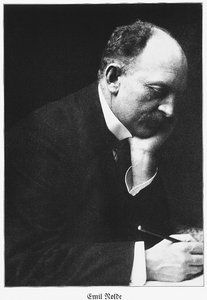
1867–1956, Dánsko
Emil Nolde
Život a identita Emila Noldeho Narodil se jako Hans Emil Hansen 7. srpna 1867, muž, který se později proslavil pod jménem Emil Nolde, vyrůstal v blízkosti vesnice Nolde v kurmarku Šlezvig. Jeho raná léta byla formována venkovským, zemědělským životem jeho rodiny. Postupem času se však od této cesty odvrátil a místo toho se vydal cestou dřevořezbaře a dekoratéra nábytku.
Také od autora Emil Nolde
 Sunset
 Sea with Red Sky
 Couple on the beach1903
 Masks1911

Eseje k tématu Summer Clouds
 Ethereal Skies: The Curated Collector's Guide to Cloudscape Masterpieces and Atmospheric GrandeurDiscover the sublime beauty of cloudscape masterpieces. From Impressionist light to atmospheric depth, explore a curated journey through fi…
 Expressionism vs. New Objectivity: Emotion vs. Precision in German ArtMaster the tension between Expressionist emotion and New Objectivity precision. Explore the soul of German modern art now.
 Emile Nolde: A Journey into Expressionist Nature & the Primal SelfExplore the powerful Expressionism of Emile Nolde – a pioneer of emotive landscapes & spiritual themes. Discover his journey, influences, a…