Portrét Gaspare Diziani

27 nejslavnějších obrazů autora Gaspare Diziani, výběr z galerie

Aktualizováno říjen 2026 · seřazeno podle našeho skóre popularity (vyhledávání, návštěvy a objednávky u každého díla) · 27 děl umělce Gaspare Diziani v našem katalogu

Stručně řečeno

Z všech originálů, které Gaspare Diziani zanechal, je nejslavnější Dawn (1738), který se nachází ve sbírce Metropolitan Museum of Art, New York. Hned za ním následují Laying Venus (1714) a The Family of Darius before Alexander the Great (1728). Náš katalog obsahuje 27 děl umělce Gaspare Diziani; galerie si zachovala 27 děl, která obdivuje celý svět, přičemž každé je znázorněno s datem vzniku, názevem muzea a jeho příběhem.

1689 – 1767, Belluno Nejvíce děl: Bavarské státní sbírky malby

10 nejlepších obrazů umělce Gaspare Diziani: výběr galerie

1
Dawn (1738) od Gaspare Diziani

Dawn

1738 · Oil On Canvas · Metropolitan Museum of Art, New York

Gaspare Diziani’s Dawn is an oil on canvas ceiling decoration created in 1738. The work functions as an allegorical representation of the morning, designed to crown the interior of a room. In this composition, the central figure of Dawn is surrounded by several cherubic putti. To the left, three putti engage in playful activities, including the carrying of a basket overflowing with flowers and foliage. On the right, a single…

Výběr umělce Gaspare Diziani pokračuje, od 11 do 27

Motivy, které zaujaly Gaspare Diziani

Čtyři témata, která se v těchto originálech nejčastěji objevují, z nichž každé má svůj nejlepší příklad.

Muzea, v nichž jsou vystavena originálna umělce Gaspare Diziani

8 muzea, v nichž je umístěno nejvíce obrazů z této stránky.

Muzea Město Díla autora Gaspare Diziani Obrazy z tohoto seznamu
Bavarské státní sbírky malby, MnichovBavarské státní sbírky malby Mnichov 3 The Family of Darius before Alexander the Great, Joseph Is Sold by His Brothers, Joseph Interprets the Dreams of Pharaoh
Statens Museum for Kunst, KodaňStatens Museum for Kunst Kodaň 2 Monk, Praying Monk
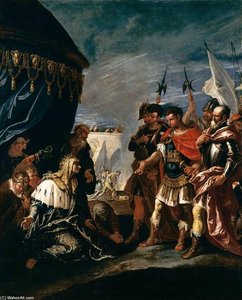
Nationalmuseum, StockholmNationalmuseum Stockholm 2 The Family of Darius Pleading to Alexander, The Adoration of the Lamb. Study
Szépművészeti Múzeum, BudapešťSzépművészeti Múzeum Budapešť 2 Adoration of the Magi, Adoration of the Magi
Metropolitan Museum of Art, New YorkMetropolitan Museum of Art New York 1 Dawn
Národní muzeum ve Varšavě, VaršavaNárodní muzeum ve Varšavě Varšava 1 Moses trampling on the Pharaoh’s crown
Gemäldegalerie, BerlínGemäldegalerie Berlín 1 Christ before Pilate
Los Angeles County Museum of Art, Los AngelesLos Angeles County Museum of Art Los Angeles 1 The Assumption of the Virgin

Gaspare Diziani dekáda po dekádě: originální díla, která definují každou z nich

Díla podle dekád

Vyberte si dekádu a prohlédněte si originál, který ji definuje.

Otázky sběratelů o obrazech umělce Gaspare Diziani

Kterým dílem je Gaspare Diziani nejznámější?Odhalit odpověď

Dawn (1738), Metropolitan Museum of Art, New York. Následují Laying Venus (1714) a The Family of Darius before Alexander the Great (1728).

Kolik let bylo Gaspare Diziani, když bylo vytvořeno dílo Dawn?Odhalit odpověď

49 let: dílo Dawn pochází z roku 1738 a Gaspare Diziani se narodil/a v roce 1689.

Kterých deset nejslavnějších obrazů má Gaspare Diziani?Odhalit odpověď

Dawn, Laying Venus, The Family of Darius before Alexander the Great, Monk, Praying Monk, Moses trampling on the Pharaoh’s crown, Joseph Is Sold by His Brothers, Joseph Interprets the Dreams of Pharaoh, The Family of Darius Pleading to Alexander a sketch for a plafond - painting. Hodnocení výše uvádí rok a muzeum pro každé z nich.

Kolik obrazů zanechal(a) Gaspare Diziani?Odhalit odpověď

Náš katalog obsahuje 27 děl umělce Gaspare Diziani z let 1714 až 1757.

Ve kterých muzeích jsou vystavena díla mistrovská umělce Gaspare Diziani?Odhalit odpověď

Většinou v Bavarské státní sbírky malby (Mnichov), Statens Museum for Kunst (Kodaň) a Nationalmuseum (Stockholm). V tabulce muzeí výše jsou vypsány všechny.

V jakých letech namaloval Gaspare Diziani svá nejznámější díla?Odhalit odpověď

V období 1750s: 7 z celkem 27 děl na této stránce vzniklo právě tehdy, z toho Joseph Is Sold by His Brothers z nich.

Jaká jsou první a poslední slavná originální díla umělce Gaspare Diziani?Odhalit odpověď

Na této stránce je nejstarší dílo z Laying Venus (1714) a nejnovější z Christ before Pilate (1757).

Jaká témata si Gaspare Diziani vybíral nejčastěji?Odhalit odpověď

Religious (4), Woman (2) a Clouds (2) napříč 27 díly na této stránce.

Kterou techniku používal(a) Gaspare Diziani nejčastěji?Odhalit odpověď

Oil, u 2 z 27 děl na této stránce.

Která díla umělce Gaspare Diziani jsou vystavena v Bavarské státní sbírky malby?Odhalit odpověď

The Family of Darius before Alexander the Great, Joseph Is Sold by His Brothers a Joseph Interprets the Dreams of Pharaoh: muzeum Bavarské státní sbírky malby, Mnichov má v obsluze 3 děl z této stránky.

Gaspare Diziani: život a dílo

The Radiant Legacy of Gaspare Diziani

In the luminous era of the late Baroque and the burgeoning Rococo, Gaspare Diziani emerged as a painter of profound technical assurance and dramatic flair. Born in the serene town of Belluno, Italy, his artistic journey began under the guidance of Antonio Lazzarini, a foundation that would eventually lead him to the heart of the Venetian art world. As he moved toward Venice, Diziani immersed himself in the prestigious studios of Gregorio Lazzarini and the influential Sebastiano Ricci. These early mentors provided him with the tools to master the sweeping movements and emotional depth characteristic of his era, allowing him to develop a style that resonated with both religious fervor and aristocratic elegance.

Diziani’s career was marked by a remarkable ability to navigate the shifting tides of 18th-century aesthetics. While his work shared the stage with contemporaries like Giambattista Tiepolo, Diziani carved out a unique space through his versatility and command over both canvas and fresco. His early period, spanning roughly between 1710 and 1720, saw him contributing significant works to sacred spaces, such as the Mary Magdalene for the church of Santo Stefano in Belluno and the Entry into Jerusalem for San Teodoro in Venice. These religious commissions allowed him to explore the interplay of light and shadow, a hallmark of the late Baroque that would later soften into the more delicate, ornamental textures of the Rococo.

A Master of Light and Grandeur

The breadth of Diziani’s influence extended far beyond the borders of the Republic of Venice. His reputation for excellence carried him to the courts of Dresden and Munich, demonstrating a reach that transcended local boundaries and touched the great cultural centers of Europe. This international presence is perhaps best exemplified by the sheer scale of his ambition; one of his most monumental achievements remains the largest painting housed within the Hermitage Museum in St. Petersburg, a testament to his ability to command vast, immersive spaces.

Beyond his grand canvases, Diziani’s artistry was deeply rooted in the decorative traditions of his time. His skill in fresco painting is evident in his work on the Life of Saint Helena at the Scuola del Vin, where he transformed architectural surfaces into narrative windows of spiritual intensity. Whether working on a small-scale preparatory sketch or a massive ceiling piece, his hand was characterized by a certain celerity and technical confidence that captured the very essence of the Rococo spirit—a blend of grace, movement, and light.

The enduring significance of Gaspare Diziani lies in his role as a bridge between eras. He successfully synthesized the dramatic tension of the Baroque with the airy, ornamental beauty of the Rococo, leaving behind a body of work that continues to fascinate scholars and art lovers alike. Through his mastery of color and composition, he helped define the visual language of an age of splendor.