


1


Aktualizováno listopad 2026 · seřazeno podle našeho skóre popularity (vyhledávání, návštěvy a objednávky u každého díla) · 27 děl umělce Adriaan Jozef Heymans v našem katalogu
Stručně řečeno
Z pohledu galerie je nejslavnějším dílem Adriaan Jozef Heymans obrazem Sunset on the Heath (1877), jehož originál je vystaven v Museum of Fine Arts Ghent (MSK) v obci Ghent. Woodland near Bertogne (1875) a St Abbs Harbour (1891) doplňují trio, které každé oko okamžitě pozná. Z 27 děl umělce Adriaan Jozef Heymans v našem katalogu představuje galerie níže 27 nejznámějších děl, z nichž každé je originálem s uvedením roku vzniku, muzea a toho, co jej činí jedinečným.


 Stable InteriorKrálovské muzeum výtvarného umění Antverpy
12
 On the Scheldt at Antwerp, Belgium
13
 Le repos, neigeLeeds Art Gallery
14
 A Corner of the HeathLeeds Art Gallery
15
 Night An ImpressionLeeds Art Gallery
16
 Silver Birches
17
 Road over the HeathLeeds Art Gallery
18
 Summer in Campine, BelgiumLeeds Art Gallery
19
 Soleil couchant dans les marécages
20
 LandscapeLeeds Art Gallery
21
 LandscapeLeeds Art Gallery
22
 The Path across the HeathLeeds Art Gallery
23
 Paysage d'HollandeLeeds Art Gallery
24
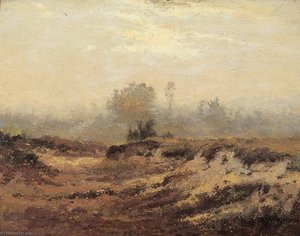 Dunes dans la bruyèreLeeds Art Gallery
25
 Towards Evening, Campine, BelgiumLeeds Art Gallery
26
 Shepherd Putting in His SheepLeeds Art Gallery
27
 Soleil couchant, Houffalize, Belgium
Čtyři témata, která se v těchto originálech nejčastěji objevují, z nichž každé má svůj nejlepší příklad.
4 muzea, v nichž je umístěno nejvíce obrazů z této stránky.
| Muzeum | Město | Díla autora Adriaan Jozef Heymans | Obrazy z tohoto seznamu |
|---|---|---|---|
 Leeds Art Gallery |
Leeds | 12 | Le repos, neige, A Corner of the Heath, Night An Impression |
 Museum of Fine Arts Ghent (MSK) |
Ghent | 5 | Sunset on the Heath, Early Morning, Snow-covered Hamlet |
 Královské muzeum výtvarného umění Antverpy |
Antverpy | 4 | Woodland near Bertogne, Duck Nests in the Reed, Wood by Moonlight |
 Indianapolis Museum of Art |
Indianapolis | 1 | The Dunes |
Vyberte si dekádu a prohlédněte si originál, který ji definuje.
Sunset on the Heath (1877), Museum of Fine Arts Ghent (MSK), Ghent. Následují Woodland near Bertogne (1875) a St Abbs Harbour (1891).
38 let: dílo Sunset on the Heath pochází z roku 1877 a Adriaan Jozef Heymans se narodil/a v roce 1839.
Sunset on the Heath, Woodland near Bertogne, St Abbs Harbour, Early Morning, Snow-covered Hamlet, The Dunes, Houffalize by Night, Haystacks by Night, Duck Nests in the Reed a Wood by Moonlight. Hodnocení výše uvádí rok a muzeum pro každé z nich.
Náš katalog obsahuje 27 děl umělce Adriaan Jozef Heymans z let 1875 až 1909.
Většinou v Leeds Art Gallery (Leeds), Museum of Fine Arts Ghent (MSK) (Ghent) a Královské muzeum výtvarného umění Antverpy (Antverpy). V tabulce muzeí výše jsou vypsány všechny.
V období 1870s: 2 z celkem 27 děl na této stránce vzniklo právě tehdy, z toho Sunset on the Heath z nich.
Na této stránce je nejstarší dílo z Woodland near Bertogne (1875) a nejnovější z Snow-covered Hamlet (1909).
Le repos, neige, A Corner of the Heath a Night An Impression: muzeum Leeds Art Gallery, Leeds má v obsluze 12 děl z této stránky.
Adriaan Jozef Heymans, a name synonymous with the quiet majesty of the Belgian countryside, stands as a transformative figure in the annals of nineteenth-century art. Born in 1839 in Antwerp, his early life was marked by both simplicity and a profound connection to the natural world. Following the untimely loss of his father when he was just seven years old, Heymans found solace and inspiration in the care of his uncle, the mayor of Wechelderzande. This small village near Antwerp served as his first classroom, where the subtle shifts in light across the meadows and the rhythmic textures of the local flora planted the seeds of a lifelong devotion to plein air painting.
His formal artistic journey began in 1853 at the Royal Academy of Fine Arts in Antwerp. Under the tutelage of masters like Jacob Jacobs, Heymans absorbed the foundational principles of classical composition and Romanticism. However, his spirit was too restless for the rigid confines of academic tradition. A pivotal sojourn to Paris between 1855 and 1858 exposed him to the revolutionary currents of the Barbizon School. Immersed in the works of artists who sought truth in the direct observation of nature, Heymans began to shed the dramatic, often staged lighting of Romanticism in favor of a more honest, atmospheric realism. This period was crucial, as it instilled in him a reverence for tonal harmony and the belief that a landscape could convey deep emotional resonance through nothing more than the interplay of shadow and mist.
As his career matured, Heymans became a central architect of a movement that would redefine Belgian Impressionism. In 1890, alongside contemporaries such as Gustave Courbet and Jean Petit Albert Dumont, he helped establish the Kalmthout School, often affectionately referred to as the "Grey School." This was not a rejection of color, but rather a sophisticated refinement of it. The movement sought to move away from the garish, high-contrast palettes of earlier eras, choosing instead to explore the nuanced beauty found within muted tones—soft greys, deep blues, and earthy browns. For Heymans, these colors were the true language of the Belgian atmosphere, capable of capturing the damp, heavy air of the Campine region and the fleeting, melancholic light of a fading dusk.
His technical evolution is most strikingly visible in his transition from expressive, energetic brushwork to a more restrained and precise application of paint. In masterpieces such as "Soleil couchant, Houffalize," one can witness his ability to render the dying light of the Ardennes hills with breathtaking subtlety. He did not merely paint scenery; he painted the very breath of the landscape. His works like "Towards Evening, Campine" demonstrate a profound mastery of tonal gradation, where the boundaries between earth and sky seem to dissolve into a singular, emotive experience. This dedication to capturing the ephemeral qualities of light—the way it clings to a leaf or softens the horizon—became his artistic signature.
The historical significance of Adriaan Jozef Heymans lies in his role as a bridge between the traditional landscape traditions of the past and the modern, sensory-focused approach of the future. By championing the Kalmthout School, he provided a distinct identity for Belgian art, one that was rooted in local topography yet connected to the broader European movement toward Impressionism. His ability to find grandeur in the humble, and drama in the quietest moments of nature, has ensured his place as a pioneer of the Belgian landscape.
Today, his contributions are remembered through several key artistic milestones:
Though he passed away in Brussels in 1921, the legacy of Heymans continues to resonate. His paintings remain windows into a vanished era of the Belgian countryside, inviting modern viewers to pause and find beauty in the soft, grey, and infinitely moving light of the natural world.