Francis Campbell Cadell: A Scottish Colourist's Vision of Elegance
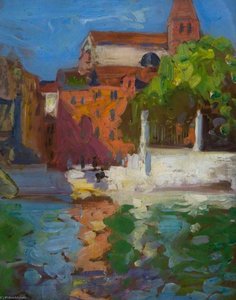
Francis Campbell Boileau Cadell (pronounced "caddle") was a Scottish Colourist painter born in Edinburgh in 1883, the son of Dr. Francis Cadell FRSE (1844-1909), a prominent surgeon and his wife, Mary Hamilton Boileau (1853-1907). His childhood home resided at 22 Ainslie Place on Edinburgh’s prestigious Moray Estate, fostering an environment steeped in artistic appreciation. Jean Cadell, his sister, achieved renown as a celebrated actress, shaping his formative years with exposure to theatrical artistry. From the age of sixteen, he pursued formal studies at the Académie Julian in Paris, immersing himself within the vibrant currents of French avant-garde thought—a connection that would prove profoundly influential on his artistic trajectory. Cadell’s artistic sensibilities were decisively molded by the burgeoning Fauvist movement, spearheaded by artists like Matisse. The bold use of colour and expressive brushstrokes became hallmarks of his distinctive style, reflecting a rejection of academic conventions in favor of capturing emotional resonance rather than photographic realism. This stylistic choice wasn't merely aesthetic; it represented a fundamental challenge to the prevailing artistic dogma of the time—a deliberate assertion of subjective experience over objective representation. Returning to Scotland after Paris, Cadell established himself as a consistent exhibitor in Edinburgh and Glasgow, alongside London, demonstrating unwavering dedication to his craft and engaging actively with the evolving artistic landscape of his era. He meticulously documented the beauty of Edinburgh’s New Town interiors, capturing light and shadow with remarkable precision—a technique that would become synonymous with Scottish Colourism. A left-handed painter—a fact that garnered considerable attention—Cadell famously countered skepticism regarding unconventional techniques by referencing Michelangelo’s own practice. This anecdote encapsulates his rebellious spirit and intellectual curiosity, highlighting a refusal to conform to societal expectations. His fellow students questioned him about how he knew Michelangelo was left-handed; Cadell responded with wry humor, revealing that the president of the Royal Scottish Academy had departed abruptly after dismissing the inquiry. Such anecdotes underscore Cadell’s astute observation of artistic discourse and his willingness to challenge established norms. He skillfully employed a glazing technique—applying translucent layers upon translucent layers—to achieve luminous effects and subtle textural nuances. This painstaking process allowed him to convey not just visual information but also emotional depth, mirroring the spirit of Impressionism while simultaneously pushing boundaries toward Expressionism. Cadell’s artistic output encompassed landscapes, portraits, still lifes, and decorative panels, demonstrating versatility within his chosen medium. However, he is particularly revered for his depictions of Iona Abbey—a place that held a profound spiritual significance for him—where he captured the ethereal beauty of the island's coastline and heather-covered hills with breathtaking watercolour compositions. His portraits were characterized by their elegance and sensitivity, portraying subjects with nuanced expressions and capturing fleeting moments of emotion through masterful shading. Cadell’s work was recognized and celebrated during his lifetime, securing a prominent place in Scottish art history. The retrospective held at the National Gallery of Scotland in 1942 solidified his reputation as one of Scotland's foremost Colourists—a testament to his enduring artistic vision.- Notable Works: Lady in White, A Lady in Black and Gold, Still Life
- Influences: Matisse (Fauvism)
- Technique: Glazing (Layering translucent washes of colour)
- Places Exhibited: Edinburgh, Glasgow, London
Въпроси и отговори
Кога и къде е роден/а Френк Кадел?
Френк Кадел е роден в Единбург през 1883 г.
Мога ли да сортирам творбите на Френк Кадел по цвят?
Страницата Спектрален индекс организира творбите на Френк Кадел по цвят.
От коя държава е Френк Кадел?
Френк Кадел е роден в Шотландия.