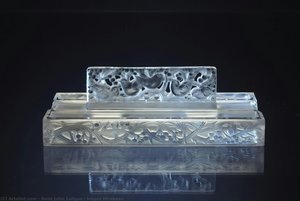
René Jules Lalique: A Master of Light, Form, and the Soul of Art Nouveau
René Jules Lalique’s name resonates through the annals of art history as a singular visionary—a jeweler who redefined luxury, a glassmaker who transformed materials, and an artist whose creations captured the very essence of beauty. Born in 1860 in Aÿ-en-Champagne, France, amidst the rolling hills of the Champagne region, Lalique’s life was a testament to his unwavering dedication to artistic expression and his profound connection with nature. His early years, steeped in rural tranquility and imbued with a deep appreciation for the natural world—particularly the flora and fauna surrounding his family estate—would profoundly shape his distinctive aesthetic vision. The untimely death of his father propelled young René into an apprenticeship with the esteemed goldsmith Louis Aucoc in Paris, setting him on a path that would ultimately lead to international acclaim.The Early Years: Apprenticeship and Artistic Foundations
Lalique’s formative years were marked by rigorous training and exposure to diverse artistic influences. Following his father's death, he began an apprenticeship with the renowned goldsmith Louis Aucoc in Paris, where he honed his skills in jewelry-making techniques and gained invaluable experience working alongside some of France’s leading artisans. Simultaneously, he pursued formal education at the École des Arts Décoratifs, immersing himself in the broader world of design and art. Crucially, he also spent time studying sculpture under Justin Lequien, a master sculptor known for his dynamic and expressive figures—an influence that would later manifest in Lalique’s own intricate designs. These early experiences laid the foundation for his unique artistic style, blending technical mastery with an innate sense of beauty and a deep understanding of materials. His time spent traveling to London further broadened his horizons, exposing him to diverse artistic movements and techniques.From Jewelry to Glass: A Revolutionary Shift
Lalique’s early career was primarily focused on creating exquisite jewelry for prominent French houses such as Cartier and Boucheron during the late 1880s. However, it was in 1890 that he embarked on a transformative journey—the opening of his own boutique in Paris's prestigious Opéra district. This marked a pivotal moment, signaling a decisive shift away from traditional jewelry design towards a more organic and imaginative approach. Lalique rejected the prevailing opulent aesthetic of the time, favoring instead materials often considered secondary – horn, ivory, enamel, and most significantly, glass—elevating them to equal status with precious gemstones like diamonds and rubies. This bold move was revolutionary, challenging established conventions and establishing him as a true innovator. His jewelry became miniature sculptures, teeming with life: dragonflies with iridescent wings crafted from *plique-à-jour* enamel, orchids rendered in delicate gold filigree, peacocks displaying their plumage in vibrant gemstones. These weren’t merely adornments; they were wearable works of art, imbued with a sense of movement and naturalism rarely seen before.The Art Nouveau Era: Nature as Muse
Lalique's designs epitomized the spirit of Art Nouveau—a style characterized by flowing lines, organic forms, and an emphasis on depicting nature in its most beautiful and evocative form. He drew inspiration from a wide range of sources, including flora and fauna – what he termed his “3Fs” – as well as female figures and mythological themes. His creations reflected a deep reverence for the natural world, capturing the delicate beauty of flowers, insects, and birds with astonishing precision and artistry. The influence of his childhood spent in Aÿ was particularly evident in his later glasswork, which often evoked the rolling hills and lush landscapes of his birthplace. His work resonated deeply with the public, attracting a devoted clientele including Sarah Bernhardt, one of France’s most celebrated actresses, who commissioned numerous pieces that reflected her own dramatic persona.The Dawn of Glass: Innovation and Industrialization
While Lalique's jewelry established his reputation as a master craftsman, it was his exploration of glass that cemented his legacy as a true visionary. His collaboration with perfumer François Coty in 1907 proved to be a watershed moment, leading him to dedicate himself increasingly to the art of glassmaking. He acquired the Verrerie d'Alsace in 1921, allowing him to experiment with mass production techniques while maintaining artistic control. This wasn’t about creating cheap imitations; it was about making beauty accessible to a wider audience. Lalique pioneered innovative techniques such as *cire perdue* (lost-wax casting) and frosted glass finishes, pushing the boundaries of what was possible with this versatile material. His creations—vases, bowls, chandeliers, automobile hood ornaments—became synonymous with luxury and elegance, adorning the homes of discerning collectors worldwide. His work during the Art Deco era reflected a shift towards more geometric forms and streamlined designs, mirroring the modern spirit of the age.A Lasting Legacy: Influence and Remembrance
René Lalique’s influence extends far beyond his own creations. He not only transformed the fields of jewelry and glass but also inspired generations of artists and designers. His daughter, Suzanne Lalique, continued the family artistic tradition as a painter and set designer for the Comédie-Française. His granddaughter, Marie Claude-Lalique, carried on the legacy of glassmaking until her death in 2003. The Maison Lalique continues to thrive today, upholding the standards of quality and artistry established by its founder. René Lalique passed away on May 1st or 5th, 1945, and was laid to rest in Père Lachaise Cemetery, a fitting final resting place for an artist whose work embodies both beauty and enduring spirit. His creations can be found in prestigious museums around the world, serving as a testament to his profound impact on art history. René Lalique wasn’t simply creating objects; he was crafting dreams, capturing the ephemeral beauty of nature, and leaving an indelible mark on the aesthetic landscape of the 20th century. His work remains a powerful reminder that true artistry lies in the ability to transform ordinary materials into extraordinary expressions of human creativity.Въпроси и отговори
Къде могат да бъдат намерени произведенията на Рене Лалик, групирани по художествено направление?
Арт теченията, в които е работил Рене Лалик, могат да бъдат разгледани на страницата за Всички направления на художника, която групира произведенията по художествено направление.
Мога ли да разгледам творбите на Рене Лалик чрез ключови думи?
За да намерите творби на Рене Лалик по конкретна тема, използвайте страницата на художника По ключови думи, която групира произведенията по ключови думи.
С какви псевдоними или алтернативни имена е известен Рене Лалик?
Рене Лалик се появява и под алтернативните имена Рене Жул Лалик.