Also known as: Катерина Мария-Агнес Фал дьо Сен Пол
Още…
Movements: pop art
Creative periods: mature period
Art period: Модерно
Died: 2002
Born: 1930, Ню Йорк, Съединени американски щати
Nationality: Съединени американски щати
Topics explored:
mothers
vibrant colors
vase
Niki de Saint Phalle - A Life Forged in Fire
Niki de Saint Phalle was born Catherine Marie-Agnès Fal de Saint Phalle on October 29, 1930, in Neuilly-sur-Seine, France. Her father, André Marie de Saint Phalle, whose banking company went bankrupt during the Wall Street Crash of 1929, came from an old noble family from France. Her mother, Jeanne-Jacqueline Harper, a woman from the American upper middle class, suffered from depression due to her husband’s infidelities. As her mother left to join her husband in the United States, she spent her early years with her paternal grandparents in France and reunited her parents, brother and two sisters in August 1933. This is where a few elements key to her artistic career came to be, as she was raised by a nanny she called Nana, foreshadowing the figure that would later inhabit her art, and her mother started to call her Niki.
Early Life & Trauma: Saint Phalle’s childhood was marked by instability and hardship. Her father's financial ruin instilled in her a sense of vulnerability, while she endured physical abuse from her mother and sexual assault from her father—experiences that profoundly shaped her worldview and fueled her artistic drive.
Education & Artistic Beginnings: Despite facing challenges at Roman Catholic schools and Brearley School, Saint Phalle demonstrated early on a rebellious spirit and a passion for art. Her fascination with Greek tragedies, Shakespeare, and Camus nurtured her intellectual curiosity and prepared her for the exploration of complex themes in her future work.
Modeling Career & Parisian Influences: At 18, Saint Phalle embarked on her modeling career, appearing in prestigious magazines like Vogue and Elle—a formative period that exposed her to influential artists and movements such as Surrealism and Nouveau Réalisme.
The Shooting Paintings & Nouveau Réalisme
Saint Phalle’s breakthrough came with her “shooting paintings,” or *Tirs*, which revolutionized artistic practice by injecting chance and raw energy into the creative process. She constructed assemblages incorporating plaster, fabric, and paint-filled bags, then dramatically shot at them with firearms, allowing the impact to dictate the final composition. These explosive acts challenged conventional artistic processes, inviting viewers to contemplate the relationship between art and everyday life.
Experimental Technique: The *Tirs* represented a radical departure from traditional painting—a deliberate embrace of destruction as a catalyst for creation.
Group Affiliations: Saint Phalle joined Nouveau Réalisme, alongside luminaries like Jean Tinguely, Arman, Yves Klein, and Jacques de la Villeglé—a collective that championed the fusion of art and reality.
The Birth of the Nanas & Feminist Vision
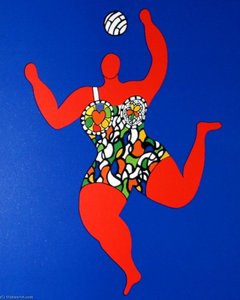
Saint Phalle’s artistic identity solidified with the creation of the *Nanas* in 1966—gigantic sculptures embodying feminine energy, sensuality, power, and playful abandon. Rejecting conventional representations of women, the *Nanas* celebrated female strength and challenged patriarchal norms at a time when such expressions were often marginalized.
Monumental Sculpture: The *Nanas*, constructed from polyester and painted plaster, became Saint Phalle’s signature style—a bold statement of artistic ambition and innovation.
Social Commentary: Her sculptures addressed pressing social issues—particularly the role of women in society—reflecting her unwavering commitment to feminist ideals.
The Tarot Garden & Legacy
In 1979 Saint Phalle embarked on what would become her most ambitious project: The Tarot Garden, a sprawling sculpture garden in Tuscany, Italy—a fantastical realm inspired by the imagery of the tarot deck. Each sculpture is a unique architectural marvel, constructed from concrete, mosaic tiles, mirrors, and found objects, creating an immersive environment that invites exploration and contemplation.
Collaborative Spirit: Saint Phalle worked closely with artists like Jasper Johns, Robert Rauschenberg, Larry Rivers, composer John Cage, and architect Mario Botta—enriching her practice through diverse perspectives.
Enduring Influence: Her distinctive style—a vibrant fusion of Surrealism, Pop Art, and outsider art—created a unique visual language that resonated with audiences worldwide. Saint Phalle’s work continues to inspire artists today, particularly those exploring themes of feminism, body positivity, and environmentalism.
Death & Remembrance
Niki de Saint Phalle passed away on May 21, 2002, in La Jolla, California—leaving behind a rich artistic legacy that continues to captivate viewers with its originality, passion, and unwavering commitment to self-expression. Her sculptures remain exhibited in museums around the world, ensuring her influence endures for future generations.
От редакционния екип на OriginalUniqueArt.com
Квиз за изкуство
За всеки въпрос има само един верен отговор.
Въпрос 1:
Каква е родена националност на Ники де Сент Пол?
Въпрос 2:
Кога е родена Ники де Сент Пол?
Въпрос 3:
Какво е първото изкуство, което Ники де Сент Пол изучава?
Въпрос 4:
Кои са известни художници, които НИки де Сент Пол е събирала в компанията си?
Въпрос 5:
Какво е най-известният проект на Ники де Сент Пол?
Разгледайте топ 10 легендарни бронзови скулптури, променили изкуството! От Роден до Микеланджело – истории на гении и вечни шедьоври. Вдъхновете се за вашия дом с OriginalUniqueArt.bg. Разгледайте пълната колекция онлайн!
Explore the rich history of sculpture from ancient masterpieces to contemporary innovations. Discover key techniques, influential artists & investment potential for discerning art collectors.
Explore the rich history of sculpture with OriginalUniqueArt. Discover key techniques, influential artists & investment potential for discerning collectors. Expert insights into valuing and collecting timeless masterpieces.
OАсистент на студиотоНа линия · отговаря в рамките на минута
Здравейте! Мога да ви помогна с избора на произведение на изкуството, проследяването на поръчка или отговори на въпроси относно гаранцията. С какво мога да ви бъда полезен?