César Klein: A Pioneer of Expressionist Synthesis
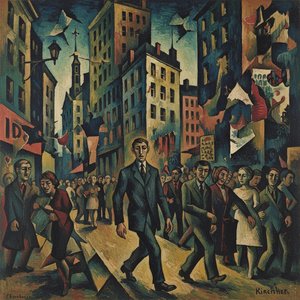
César Klein (14 September 1876 – 13 March 1954) stands as a pivotal figure in German Expressionism, embodying its ambition to grapple with the anxieties and traumas of the early 20th century through visceral imagery and emotionally charged abstraction. Born in Hamburg, Germany, Klein’s formative years instilled within him a meticulous craftmanship honed by an apprenticeship under a master craftsman—a grounding that would profoundly shape his artistic approach throughout his prolific career. This dedication to technique wasn't merely stylistic; it represented a conscious rejection of Impressionism’s fleeting beauty and embraced instead the forceful assertion of inner emotion onto canvas.
Early Influences & Artistic Training: The Düsseldorf School of Painting & November Group
Klein’s artistic journey commenced at the Hamburg School of Applied Arts, followed by intensive studies at the Düsseldorf Art Academy and the Royal Museum of Applied Arts in Berlin—institutions renowned for fostering a rigorous academic tradition. However, Klein swiftly transcended these boundaries, recognizing the limitations of purely representational art in conveying the psychological complexities he sought to explore. He was deeply influenced by the Düsseldorf School of Painting’s emphasis on tonal harmony and compositional rigor, principles that informed his own meticulous approach to painting. Simultaneously, Klein actively participated in the November Group—a collective of artists committed to exploring social and political themes through artistic expression—where collaborative experimentation fostered a spirit of innovation and challenged conventional aesthetic norms. This engagement with avant-garde discourse solidified Klein’s conviction that art could serve as a catalyst for societal transformation.
Collaborative Spirit & Bauhaus Influence
His collaboration with Walter Gropius and other visionary thinkers at the Bauhaus cemented Klein’s position as a champion of functional aesthetics intertwined with emotional resonance. The Bauhaus ethos—characterized by its pursuit of unity between craft and art, architecture and design—provided Klein with an ideal framework for translating his artistic ideas into tangible realities. He championed innovative approaches to architectural decoration and furniture design, demonstrating his belief that artistic expression should enrich everyday life and contribute to the betterment of society. This commitment to social responsibility distinguished Klein from many of his contemporaries and ensured his enduring legacy as a pioneer of modern art.
Expressionist Style & Technique: Lithographs & Woodcuts – Precision & Texture
Klein’s artistic output spanned a remarkable range of mediums, demonstrating his mastery of diverse techniques. His lithographs and woodcuts are characterized by exceptional precision—a testament to his meticulous craftsmanship—and textural richness achieved through careful manipulation of printing processes. Unlike Impressionists who prioritized capturing fleeting moments of light and color, Klein deliberately employed bold lines and contrasting tonal values to convey emotional intensity and psychological depth. He meticulously researched materials and experimented with etching techniques to achieve unparalleled visual impact—a stylistic hallmark that distinguishes his oeuvre from other artistic movements of the period.
Stained Glass Windows & Mosaics – Color & Light
Klein’s exploration of color and light extended beyond painting into monumental stained glass windows and mosaics—projects that demanded a profound understanding of optical principles and compositional considerations. He skillfully combined hues and shades to create immersive visual experiences that evoked powerful emotional responses, mirroring the spiritual aspirations of Expressionist artists. The radiant colors emanating from his stained glass panels illuminated spaces with an ethereal glow—a deliberate contrast to the muted palettes favored by Impressionists—underscoring Klein’s conviction that art could transcend mere visual perception and communicate intangible ideas.
Notable Projects & Collaborations: Marmorhaus Cinema Decoration & Ernst Toller’s *Hinkemann*
Klein's artistic legacy extends beyond his studio practice, encompassing significant contributions to theatrical design and architectural decoration. His monumental mural for the Marmorhaus cinema in Berlin—a daring undertaking that pushed the boundaries of spatial perception—stands as a symbol of Expressionist ambition. He meticulously considered every element of the cinematic environment—lighting, color palettes, textural surfaces—to create an atmosphere conducive to conveying the drama’s emotional core. Furthermore, he collaborated closely with Ernst Toller on *Hinkemann*, crafting a stage set that powerfully conveyed the psychological tension inherent in the play. These projects underscored Klein’s belief that art could engage audiences on multiple levels—visually, emotionally, and intellectually.
Klein's work gained notoriety during the infamous Degenerate Art exhibition of 1937—a politically motivated showcase orchestrated by the Nazi regime that condemned Expressionism as “degenerate” and undermined its artistic merit. Despite this censure, Klein’s oeuvre continues to inspire admiration for its uncompromising honesty and expressive power. His exploration of psychological themes—fear, anxiety, alienation—resonates powerfully with contemporary audiences, securing his place as a seminal figure in the history of modern art. César Klein's enduring influence testifies to the transformative potential of art to confront societal anxieties and champion artistic innovation.