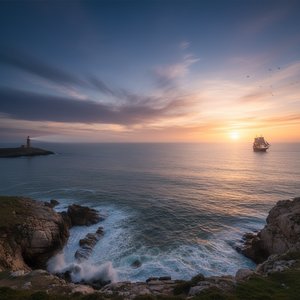
Alfred Harvey Moore: A Painter of Coastal Tranquility
Alfred Harvey Moore (born circa 1879 – living) emerged as a prominent British seascape artist during the late Victorian and Edwardian eras, capturing the serene beauty of the English coastline with meticulous detail and imbued with a palpable sense of nostalgia. While biographical information remains somewhat sparse, his artistic legacy speaks volumes about his dedication to portraying the natural world and reflecting the spirit of his time—a testament to an artist who eschewed formal training for profound observation and personal expression.
Moore’s formative years were spent in Liverpool, where he honed his artistic skills through self-study and meticulous observation—a practice that would fundamentally shape his distinctive style. Unlike many artists of his generation who prioritized academic instruction, Moore championed a deeply rooted connection to the subject matter, prioritizing direct engagement with nature over prescribed artistic conventions. This unwavering commitment to realism is vividly apparent in his canvases, which depict harbors, beaches, and estuaries with astonishing accuracy—down to subtle nuances in light and texture that convey an unparalleled sense of atmosphere.
His artistic sensibilities were profoundly influenced by Impressionism and Luminism, movements championed by luminaries like Frederic Church and George Inness. These artists served as guiding beacons for Moore’s technique, inspiring him to adopt a painterly style characterized by soft brushstrokes and muted color palettes—a deliberate choice designed to capture the fleeting luminescence of twilight and evoke the contemplative mood of rural landscapes. The resulting paintings possess an understated elegance that resonates with viewers seeking solace in scenes of tranquil beauty.
Moore gained considerable recognition during his lifetime, establishing himself as a respected member of the Watermill Art Gallery and exhibiting extensively throughout London. His works captivated audiences who appreciated their ability to distill the grandeur of the British countryside into exquisitely rendered depictions—a genre particularly favored by collectors eager to acquire pieces that embodied the spirit of Victorian summers. Among his most celebrated compositions are “The Old Water Mill,” “Leigh,” and “The Thames off Yantlett Creek, Kent,” each exemplifying Moore’s mastery of tonal painting and capturing the essence of a bygone era with remarkable sensitivity.
Alfred Harvey Moore's enduring contribution to British art history resides in his unwavering devotion to portraying the natural world with honesty and profound empathy—a stance that aligns seamlessly with the broader artistic currents of his time. His paintings continue to inspire admiration for their timeless beauty and serve as poignant reminders of a period marked by both scientific breakthroughs and an abiding appreciation for the pastoral landscapes of Britain, securing his place as a significant figure in Victorian seascape art.