Портрет на Уилиъм Мейсън Браун

44-те най-известни картини на Уилиъм Мейсън Браун, всяка от които е уникална

Обновено Ноември 2026 · класирано според нашия индекс на популярност (търсения, посещения и поръчки за всяко произведение) · 44 творби на Уилиъм Мейсън Браун в нашия каталог

Накратко

Summer Pastures (1856) е картината на Уилиъм Мейсън Браун, която привлича най-много погледи. След това погледът се насочва към Still Life (also known as Fruit and Art Objects) (1888) и Landscape with Two Indians (1855). Сред 44 произведения на Уилиъм Мейсън Браун в нашия каталог, тези 44 са най-известните – всяко от тях е уникален оригинал, представен с годината на създаване, музея и причината за неговата вечност.

1823 – 1899, Ню Йорк Hudson river school Най-много творби: Toledo Museum of Art

Топ 10 картини на Уилиъм Мейсън Браун, през погледа на галерията

1
Summer Pastures (1856) на Уилиъм Мейсън Браун

Summer Pastures

1856 · Oil On Canvas

The scene unfolds within the quiet expanse of Summer Pastures, a work that captures a specific moment of pastoral peace. Painted in 1856, this piece brings the viewer into a lush, green world where the air feels heavy with the warmth of a midsummer afternoon. The artist, William Brown, also known by his full name William Mason Brown, directs our gaze across a landscape that feels both vast and intimately…

Знаменитите картини на Уилиъм Мейсън Браун, номера от 11 до 44

Знаменитите картини на Уилиъм Мейсън Браун, период по период

Темите, които привличат погледа на Уилиъм Мейсън Браун

Четирите найчесто срещани теми в тези оригинални творби, всяка с най-добрия си пример.

Музеите, в които се съхраняват оригиналите на Уилиъм Мейсън Браун

7 музея, които притежават най-голям брой от картините на тази страница.

Музеи Град Творения на Уилиъм Мейсън Браун Картини от този списък
Toledo Museum of Art, ТоледоToledo Museum of Art Толедо 1 Landscape with Two Indians
Yale Center for British Art, Ню ХейвънYale Center for British Art Ню Хейвън 1 Tiptree Hall and Farm, Essex
Crystal Bridges Museum of American Art, БентовилCrystal Bridges Museum of American Art Бентовил 1 Raspberries in a Wooded Landscape
Cleveland Museum of Art, КливландCleveland Museum of Art Кливланд 1 Still Life with Cantaloupe
Birmingham Museum of Art, БирмингъмBirmingham Museum of Art Бирмингъм 1 Still Life with Cantaloupe
Национална галерия на изкуствата, УокшънтънНационална галерия на изкуствата Уокшънтън 1 Mound of Cherries
Fries Museum, ЛьоуарденFries Museum Льоуарден 1 Still Life with Melon, Peach, Fruit-Filled Compote and Glass of Wine on a Marble Table Top

Уилиъм Мейсън Браун през десетилетията: един уникален оригинал за всяко

Произведения по десетилетия

Изберете десетилетие, за да видите оригиналната творба, която го определя.

Картини на Уилиъм Мейсън Браун: въпроси към галерията

Кое е най-известното произведение на Уилиъм Мейсън Браун?Разкрийте отговора

Summer Pastures (1856). Следващите са Still Life (also known as Fruit and Art Objects) (1888) и Landscape with Two Indians (1855).

На каква възраст Уилиъм Мейсън Браун създава Summer Pastures?Разкрийте отговора

33 години: Summer Pastures е от 1856 г., а Уилиъм Мейсън Браун е роден/а в 1823.

Кои са десетте най-известни картини на Уилиъм Мейсън Браун?Разкрийте отговора

Summer Pastures, Still Life (also known as Fruit and Art Objects), Landscape with Two Indians, Tiptree Hall and Farm, Essex, Untitled (also known as Landscape with Indians), Three Men in a Landscape, Landscape with Two Indians, Raspberries in a Wooded Landscape, Still Life with Watermelon, Grapes, Peaches, Plums and Cantaloupe и Still Life with Melon, Grapes, Peaches, Pears and Black Raspberries. Класацията по-горе показва годината и музея за всяко от тях.

Колко са известните творби на Уилиъм Мейсън Браун?Разкрийте отговора

В нашия каталог са представени 44 произведения на Уилиъм Мейсън Браун, датирани от 1850 до 1888.

Къде могат да се видят най-известните оригинали на Уилиъм Мейсън Браун?Разкрийте отговора

Предимно в Toledo Museum of Art (Толедо), Yale Center for British Art (Ню Хейвън) и Crystal Bridges Museum of American Art (Бентовил). В горната таблица с музеи са изброени всички тях.

През кой период Уилиъм Мейсън Браун създава най-известните си картини?Разкрийте отговора

В 1850s: 7 от 44 произведенията на тази страница са създадени тогава, като Summer Pastures са сред тях.

Коя е най-ранната и коя е най-късната известна картина на Уилиъм Мейсън Браун?Разкрийте отговора

На тази страница най-старата е Tiptree Hall and Farm, Essex (1850), а най-новата е Still Life (also known as Fruit and Art Objects) (1888).

Какви теми предпочиташе Уилиъм Мейсън Браун?Разкрийте отговора

Landscape (8), Life (8) и Fruits (6), разпределени в 44 произведения на тази страница.

Към кое художествено направление принадлежи творчеството на Уилиъм Мейсън Браун?Разкрийте отговора

Hudson river school, судейки по оригиналите на тази страница.

Уилиъм Мейсън Браун: портрет на художника

The Meticulous Vision of William Mason Brown

Born in Troy, New York, William Mason Brown emerged as a distinctive voice within the American art landscape, carving out a legacy defined by an extraordinary devotion to detail. His artistic journey began under the tutelage of Abel Buell Moore, the preeminent portraitist of Troy, which laid the foundation for a career that would traverse several captivating genres. While his early training was rooted in the intimate realm of portraiture, Brown’s creative spirit eventually expanded into the sweeping vistas of the landscape and the hyper-realistic precision of still life painting.

As a prominent member of the second generation of the Hudson River School, Brown’s early work reflected the romantic traditions established by masters such as Thomas Cole. During his time in Newark, New Jersey, starting around 1850, he specialized in landscapes that captured the grandeur and serenity of the natural world. These works often featured a striking balance between vast, atmospheric backgrounds—such as distant mountains and flowing rivers—and an exacting, almost photographic precision in the foreground elements. This duality allowed him to evoke both the sublime scale of nature and a profound sense of tranquility.

A Transition to Hyper-Realistic Still Life

A pivotal shift occurred in 1858 when Brown moved to Brooklyn, New York, a transition that saw him move away from the expansive horizons of landscape painting toward the concentrated intensity of still life. This period marked his emergence as a master of trompe-l'œil, a technique designed to deceive the eye into perceiving three-dimensional reality on a flat canvas. Influenced by the Pre-Raphaelite movement and the teachings of John Ruskin, Brown developed a style characterized by an almost obsessive attention to texture and light.

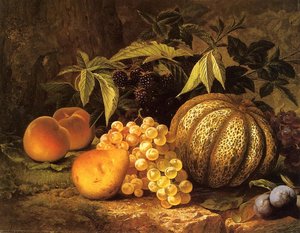
His still lifes became celebrated for their ability to replicate the tactile essence of the subjects they depicted. He possessed a rare talent for textural duplication, capturing the delicate fuzz on a peach or the intricate rind of a cantaloupe with such clarity that his work was often compared to the precision of French academician Jean-Léon Gérôme. In these compositions, Brown avoided visible brushwork, preferring a smooth, seamless finish that allowed the viewer to lose themselves in the luminous highlights and organic weights of fruit, berries, and flowers.

Legacy and Artistic Significance

Throughout his long career, Brown was a consistent and respected presence in the American art community, exhibiting annually at the National Academy of Design for over three decades. His ability to reach a wide audience through chromolithographic reproductions ensured that his meticulous renderings of nature were admired far beyond the gallery walls. His work remains preserved in prestigious institutions, including:

The historical significance of William Mason Brown lies in his unique ability to bridge the gap between the romanticism of the Hudson River School and the rigorous, scientific observation of the Pre-Raphaelite influence. By mastering both the sweeping emotion of the landscape and the quiet, intense reality of the still life, he left behind a body of work that celebrates the profound beauty found in both the vastness of the earth and the smallest details of its bounty.